Governance
Describe management structure, voting thresholds, delegations of authority, and procedures for meetings. Specify roles of managing partners, committees, and any limitations on partner actions to prevent unilateral decisions.
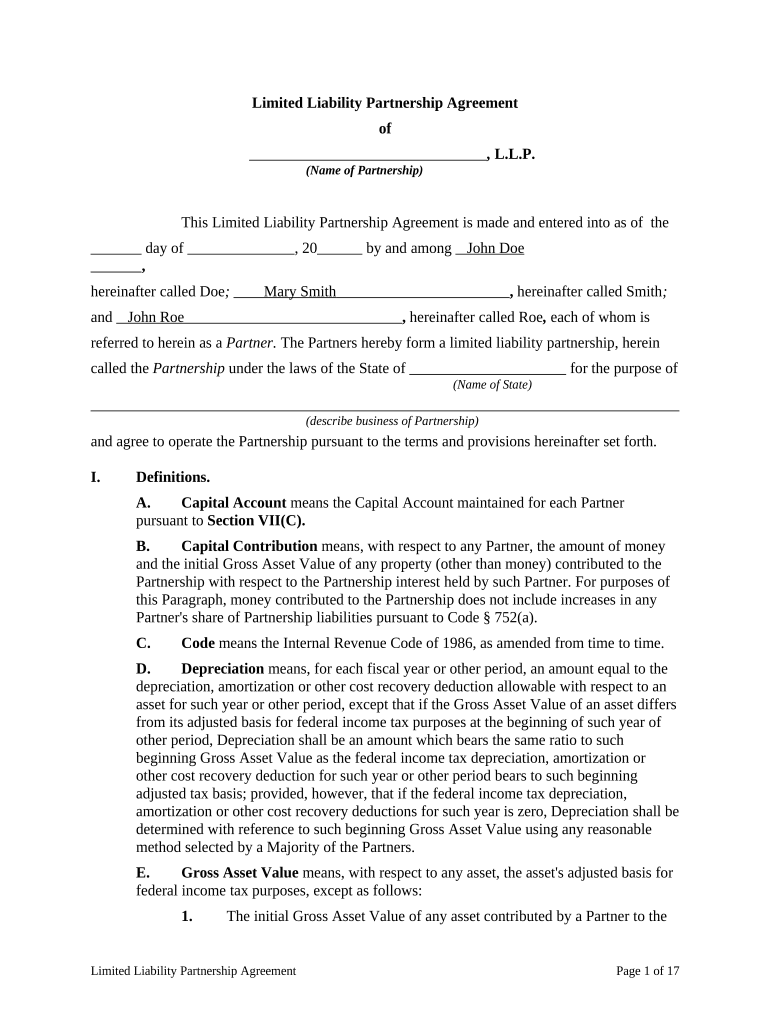
Use a written LLP Agreement to clarify governance, protect partner liability allocations, and reduce disputes. A detailed agreement helps establish predictable decision-making, supports tax reporting, and creates enforceable duties among partners under state contract law and partnership statutes.

Typical users and roles that prepare or review an LLP Agreement include business partners, attorneys, and company administrators.
As the primary decision-maker, the managing partner oversees daily operations, enforces the LLP Agreement, and implements partner votes. They must ensure capital accounts are maintained accurately, conflicts are disclosed promptly, and that amendments follow agreed procedures to minimize litigation risk.
Outside counsel drafts or reviews the LLP Agreement to align it with state statutes, tax objectives, and partner expectations. They advise on formation filings, recommend dispute-resolution clauses, and prepare amendment language to limit future ambiguity and manage enforceability risks.
Describe management structure, voting thresholds, delegations of authority, and procedures for meetings. Specify roles of managing partners, committees, and any limitations on partner actions to prevent unilateral decisions.
Set out initial capital, future contribution obligations, valuation methods for noncash assets, timing, remedies for missed contributions, and procedures for capital calls to preserve partnership operations.
Define profit and loss sharing formulas, priority distributions, preferred returns, tax allocations, and accounting methods to ensure consistent reporting and avoid disputes during tax filings.
Establish voting rights, quorum, supermajority thresholds for major actions, procedures for deadlocks including mediation or buyout mechanisms, and temporary management powers during disputes to maintain operations.
Include admission and withdrawal rules, buyout valuation formulas, transfer restrictions, right of first refusal, required approvals, and timeline for closing any ownership transfers, and tax allocation adjustments.
Define amendment procedures, notice periods, required voting majorities, dissenting partner protections, ratification processes, and record-keeping for versions to ensure enforceability and clarity on all changes.
| Field | Configuration |
|---|---|
| Signer Order | Set serial or parallel signing as needed. |
| Required Fields | Mark signature, date, and initial fields required. |
| Authentication | Choose email, SMS code, or KBA verification. |
| Retention Settings | Specify storage duration and export formats. |
Choose eSignature platforms that support your integrations, required authentication, and audit-trail standards for legal enforceability.
Use MM/DD/YYYY as stated in the document.
File partner registration within state timelines; varies by state.
Report partnership income on Schedule K-1 with Form 1065 filings.
Provide written notice per agreement timelines and state law.
Keep executed originals per retention policy and legal requirements.
| signNow | DocuSign | Adobe Sign | PandaDoc | HelloSign | |
|---|---|---|---|---|---|
| Starting Price | $8/user/mo | $15/user/mo | $14/user/mo | $19/user/mo | $15/user/mo |
| Free Trial | 7-day trial | Varies | Varies | Varies | Varies |
| Bulk Send | Yes | Yes | Yes | Yes | No |
| Audit Trail | Yes | Yes | Yes | Yes | Yes |
| HIPAA Compliant | Yes | Yes | Yes | No | No |
| Envelope Cap | No envelope cap | 100 envelopes/user/year | Varies | Varies | Varies |