Establishing secure connection…Loading editor…Preparing document…

Louisiana Petition for Possession

This template is fully customizable. Edit the text, fill out the fields, and send it for signature. Give it a try!
Louisiana Petition for Possession

What the Louisiana Petition for Possession Is and when it applies

A Louisiana Petition for Possession is a civil pleading filed to request the court order a landlord or property owner be returned physical possession of real property. Typical uses include nonpayment of rent, lease termination, holdover tenants, or other breaches of a residential or commercial lease. The petition sets out the parties, property description, factual basis for possession, amount due if claimed, and the relief requested; it initiates court scheduling and service requirements under local parish rules and courtroom procedure.

Why filing a formal petition matters

Filing creates a court record, triggers required service and hearing procedures, and gives the claimant a legal path to recover possession and related damages. It documents your claim and allows enforcement via writ or sheriff once judgment is entered; e-signature use depends on ESIGN (15 U.S.C. ch. 96) and applicable state e-signature rules.

Why filing a formal petition matters

Core sections to include in a professional petition

A complete Petition for Possession is organized so clerks, judges, and opposing parties can quickly confirm jurisdiction, parties, facts, and relief. Clear structure reduces the risk of administrative rejection and improves enforceability after judgment.

Caption

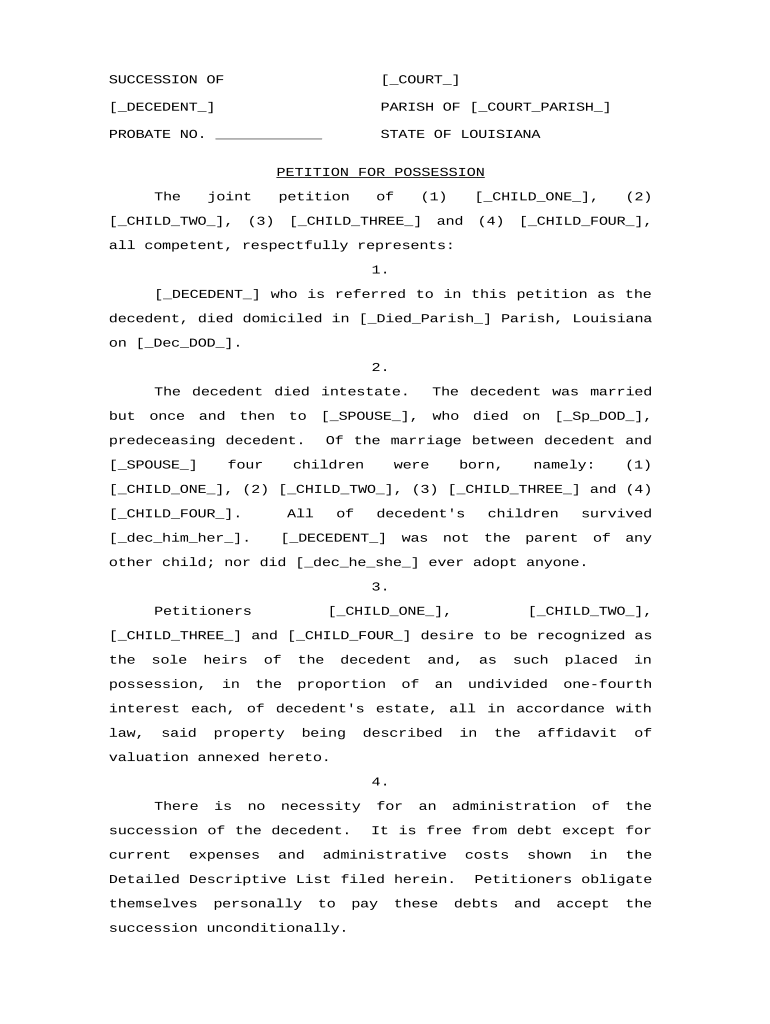
Court name, docket caption, parish and case type to establish venue and jurisdiction for the petition.
Parties

Full plaintiff and defendant names and proper legal entities; list authorized agents or managers for LLCs or corporations.

Property Description

Street address and unit number, with legal description or parcel number where available for precise identification.

Statement of Facts

Chronological facts: lease dates, breach details, notices delivered, and attempts to cure or demand possession.

Relief Sought

Specific remedy requested: judgment for possession, monetary damages, court costs, and issuance of writ for enforcement.

Verification

Signed verification or affidavit attesting to truth of allegations and listing attachments such as leases and notices.

Essential information the petition must contain

Plaintiff: Full legal name
Defendant: Full legal name
Property: Complete address
Lease period: Start and end dates
Amount due: Itemized dollar amounts
Service info: Method and date served

Step-by-step: filing a Petition for Possession

A straightforward sequence ensures proper filing, timely service, and readiness for the initial hearing.

  • 01
    Prepare petition: Draft facts, attach lease and notices, compute damages.
  • 02
    File with court: Submit to the appropriate parish clerk or e-filing system.
  • 03
    Serve defendant: Use sheriff, certified mail, or process server per local rule.
  • 04
    Attend hearing: Present proof; if successful, obtain writ for possession.

Setting up an online petition and signature workflow

Configure fields and authentication before sending to ensure complete submissions and auditable records.

Field Configuration
Signers Assign plaintiff and attorney roles with email addresses
Authentication Choose email link, SMS code, or KBA for higher assurance
Attachments Attach lease, notices, receipts as PDF files
Notifications Set reminders and delivery receipts for service tracking

Where and how petitions are typically submitted

Filing and service paths differ by parish; confirm local clerk procedures before submission.

  • Parish court clerk: File original complaint and pay filing fee
  • E-filing portal: Use if parish accepts electronic filings
  • In-person delivery: Deliver copies to clerk or courthouse intake
  • Service execution: Sheriff or process server completes service

Consequences and legal risks from improper petitions

Dismissal Risk: Court may dismiss for lack of jurisdiction or improper venue
Service Defects: Improper service can delay eviction and require re-service
Monetary Sanctions: Court may award costs or sanctions for frivolous filings
Enforcement Delay: Errors often extend the time to obtain writs and sheriff action
Perjury Exposure: False affidavits risk criminal or civil penalties
Waiver of Remedies: Incomplete claims can forfeit damages or possession rights

Common preparation errors to avoid

  • Using an incorrect defendant name or failing to identify an LLC manager causes service failures and potential dismissal.
  • Failing to attach the lease, written notices, or proof of payment history reduces ability to prove the claim at hearing.
  • Omitting or misdating notices of termination or demand for possession creates procedural defenses for the tenant.
  • Relying on unsigned or incomplete verification/affidavits can prevent entry of a judgment or writ of possession.

Practical tips for accurate and efficient petitions

These recommended practices reduce processing friction and help ensure the court accepts your petition on first submission.

Verify party identity
Confirm tenant name against the lease and government ID. If the tenant is an entity, ensure you have the registered legal name to avoid service and jurisdiction issues.
Attach supporting documents
Include lease, written notices, payment ledger, and any communications. Organize exhibits with numbered tabs so the court and opposing party can locate proofs quickly.
Confirm local rules
Check parish clerk instructions for filing format, required cover sheets, and accepted payment methods to avoid administrative rejection or extra delays.
Track service carefully
Use a verifiable service method and keep certificates or sheriff returns. Accurate service records are critical to preserve hearing dates and enforcement rights.

Digital signing and file format considerations

Use e-signature and e-filing tools that support PDF, DOCX, and secure attachments to maintain a verifiable record.

  • File formats: PDF and DOCX supported
  • Authentication: Email, SMS, or KBA options
  • Integrations: Works with court e-filing portals

Comparing eSignature platform pricing and features

Basic pricing and feature availability vary by vendor; signNow is listed first for side-by-side comparison of common purchase criteria.

signNow DocuSign Adobe Sign PandaDoc HelloSign
Starting Price $8/user/mo $15/user/mo $14/user/mo $19/user/mo $15/user/mo
Free Trial 7-day free trial No No Yes, limited Yes, limited
Bulk Send Yes Yes Yes Yes No
Audit Trail Yes Yes Yes Yes Yes
HIPAA Compliant Yes Yes Yes No No

Real-world examples of online petition workflows

Organizations use documented online signing and filing to move petitions from draft to enforcement more predictably.

Martin Properties

Managing a regional rental portfolio required faster turnovers and clearer records.

  • Used online signatures for landlord affidavits and attachments.
  • As a result, Martin Properties reduced time-to-enforcement and kept full audit trails for clerk submissions and sheriff writs.

Fertility Centers of Illinois

A healthcare provider needed consistent signed authorizations and service records.

  • Adopted an e-sign and document workflow for legal pleadings and notices.
  • This approach ensured signed verifications, retained secure copies, and simplified retrieval for compliance and potential litigation.

Who typically signs and certifies the petition

Property Owner

Owner or authorized manager. The owner or named corporate officer signs to verify facts and request relief; if an entity, include the signer’s title and authority to bind the company.

Authorized Agent / Attorney

Attorney or designated agent. Attorneys sign verifications and can file on behalf of clients subject to local filing rules and court appearance requirements.

Typical timing and scheduling considerations

Timeframes for service, answers, and hearings depend on parish rules and courtroom schedules; confirm local clerk timelines before filing.

Answer deadline:

Local rules set response period; often measured in days from service

Hearing schedule:

Court assigns hearing date following filing and service

Writ issuance:

If judgment entered, a writ of possession may be issued for enforcement

Execution window:

Sheriff schedules physical eviction subject to local timing

Appeal period:

Parties may have limited days to seek appellate review

Frequently asked questions about the Louisiana Petition for Possession

Answers to common procedural and technical questions to help avoid delays and preserve enforcement options.


Need help? Contact support

be ready to get more
Join over 28 million airSlate SignNow users