Establishing secure connection…Loading editor…Preparing document…

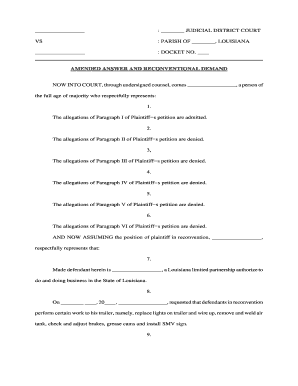
Louisiana Reconventional Demand

This template is fully customizable. Edit the text, fill out the fields, and send it for signature. Give it a try!
Louisiana Reconventional Demand

What a Louisiana Reconventional Demand Is and when it applies

A Louisiana Reconventional Demand is a defendant's pleading that asserts a related claim against the plaintiff within the same civil action. It functions as a counterclaim under Louisiana civil procedure, allowing the court to resolve both disputes together. The reconventional demand must arise from the same transaction or occurrence or be sufficiently connected to the principal suit so that joinder is proper. Filing it with the defendant's answer preserves rights, minimizes duplicative litigation, and places all contested issues before the same judge and jury when appropriate.

Why filing a reconventional demand matters in Louisiana cases

Filing a reconventional demand consolidates related claims, reduces duplicate litigation, and can preserve offset or affirmative relief without starting a separate suit.

Why filing a reconventional demand matters in Louisiana cases

Typical users and parties involved

Confirm local court practice and timing with the clerk or local rules before filing to avoid procedural defects.

  • Defense counsel handling contract, tort, or property disputes where a plaintiff seeks relief.
  • Individual defendants or small businesses asserting related damages or indemnity claims.
  • In-house legal teams or claims departments consolidating litigation exposure into one case.

Filing steps: Prepare and file your reconventional demand

Follow these steps to prepare, attach, and serve a reconventional demand alongside your responsive pleadings.

  • 01
    Draft: State factual basis, legal theory, and relief requested.
  • 02
    Include exhibits: Attach contracts, invoices, or records supporting the claim.
  • 03
    File with answer: Submit the demand when filing your responsive pleading per local rules.
  • 04
    Serve opposing party: Serve a copy and include a certificate of service.

Process overview: from drafting to resolution

These core actions summarize the typical lifecycle of a reconventional demand inside a Louisiana civil action.

  • Prepare Pleading: Draft reconventional demand with factual and legal support.
  • File & Serve: File with clerk and serve opposing counsel per rules.
  • Response & Discovery: Plaintiff answers; parties proceed to discovery.
  • Adjudication: Court resolves claims at motion or trial.

Digital workflow settings for preparing the document

Configure these fields when assembling the reconventional demand in an e-filing or e-signature platform.

Field Configuration
Upload Document PDF/A preferred; include exhibits as separate attachments.
Signature Fields Place signature and date fields for attorney and defendant.
Authentication Use email or SMS code; consider stronger auth for sensitive filings.
Filing Method Select court e-file or print-and-physically file per local rule.

Technical considerations for e-filing and e-signing

Ensure the chosen provider supports required export formats, maintains an audit trail, and complies with ESIGN and UETA for enforceability.

  • Document Formats: PDF and DOCX are accepted by most e-filing systems.
  • Integrations: Salesforce, Microsoft 365, Google Workspace, NetSuite are commonly supported.
  • Authentication: Email links, SMS codes, and KBA improve signer attribution.

Timing and filing windows to watch for

Key timing points affect when a reconventional demand should be filed and when it can be amended.

At Answer Filing:

File the reconventional demand with the defendant's answer if possible.

Local Rule Limits:

Some courts require it by the answer deadline or by an early scheduling order.

Amendment Window:

Amendments may be allowed before trial or by leave of court.

Service Deadlines:

Serve the plaintiff promptly per court or rule requirements.

Trial Preparation:

Assert damages early to permit discovery and appraisal.

Common drafting and procedural challenges

  • Failing to connect the reconventional demand to the original transaction, which can lead to severance or dismissal.
  • Omitting necessary supporting exhibits or dates, making proof at discovery or trial difficult.
  • Using inconsistent party names across pleadings, causing confusion in service and docketing.
  • Neglecting to check local e-filing rules, which can result in rejected filings or missed deadlines.

Key compliance and filing checkpoints

ESIGN / UETA: Ensure electronic signature intent and retention.
Confidentiality: Redact sensitive data when required.
HIPAA Consideration: Add privacy addendum for protected health information.
Notarization: Most reconventional demands do not require notarization.
Court Rules: Follow local filing and format requirements.
Audit Trail: Retain timestamps, signer IP, and actions.

Consequences of procedural errors

Waiver Risk: Late or improper filing may waive the claim.
Dismissal: Insufficient pleading can lead to dismissal.
Service Defect: Improper service may invalidate the filing.
Sanctions: Frivolous or bad-faith claims risk sanctions.
Increased Costs: Errors increase litigation time and expense.
Lost Evidence: Delays can impair evidence preservation.

Real-world examples and vendor experiences

Two examples illustrate how organizations streamline pleadings and signature workflows when asserting related claims.

Optica Ventures

Their team simplified document handling with a digital workflow to support legal pleadings.

  • The interface is easy-to-use for both staff and clients.
  • By standardizing templates and signatures they reduced turnaround time and improved consistency across related court filings, making reconventional demand assembly faster and less error-prone.

Martin Properties

A small real estate firm used online workflows to assemble counterclaims and exhibits.

  • The platform allowed mobile access for field staff.
  • Processing and executing documents online enabled them to meet tight filing windows, maintain audit trails for evidence, and coordinate signatures without in-person meetings.

Practical tips for accurate and efficient reconventional demands

Apply these best practices to reduce procedural risk and streamline litigation readiness.

Connect facts to relief
Clearly tie factual allegations to each element of the legal claim so the court can assess sufficiency without further amendment.
Attach key exhibits
Include contracts, invoices, or correspondence in chronological order and reference them by exhibit letter in the pleading.
Follow local format
Observe court formatting, pagination, and e-filing specifications to avoid administrative rejection.
Preserve audit trail
Retain signed copies, timestamps, and service receipts to establish chain of custody and service compliance.

eSignature vendor pricing and capability snapshot for handling reconventional demands

Compare common plan criteria relevant to filing and signing court-related pleadings; signNow is listed first per vendor comparison conventions.

signNow DocuSign Adobe Sign PandaDoc HelloSign
Starting Price $8/user/mo $15/user/mo $14/user/mo $19/user/mo $15/user/mo
Free Trial 7-day free trial Varies Varies Varies Varies
Bulk Send Yes Yes Yes Yes Varies
Audit Trail Yes Yes Yes Yes Yes
HIPAA Compliant Yes Yes Yes No No

Frequently asked questions about reconventional demands

Answers to common procedural and practical questions about drafting, filing, and serving reconventional demands in Louisiana.


Need help? Contact support

be ready to get more
Join over 28 million airSlate SignNow users