§15.906PROXY STATEMENTS: STRATEGY & FORMS
© 1994 Jefren Publishing Company, Inc. 15-168
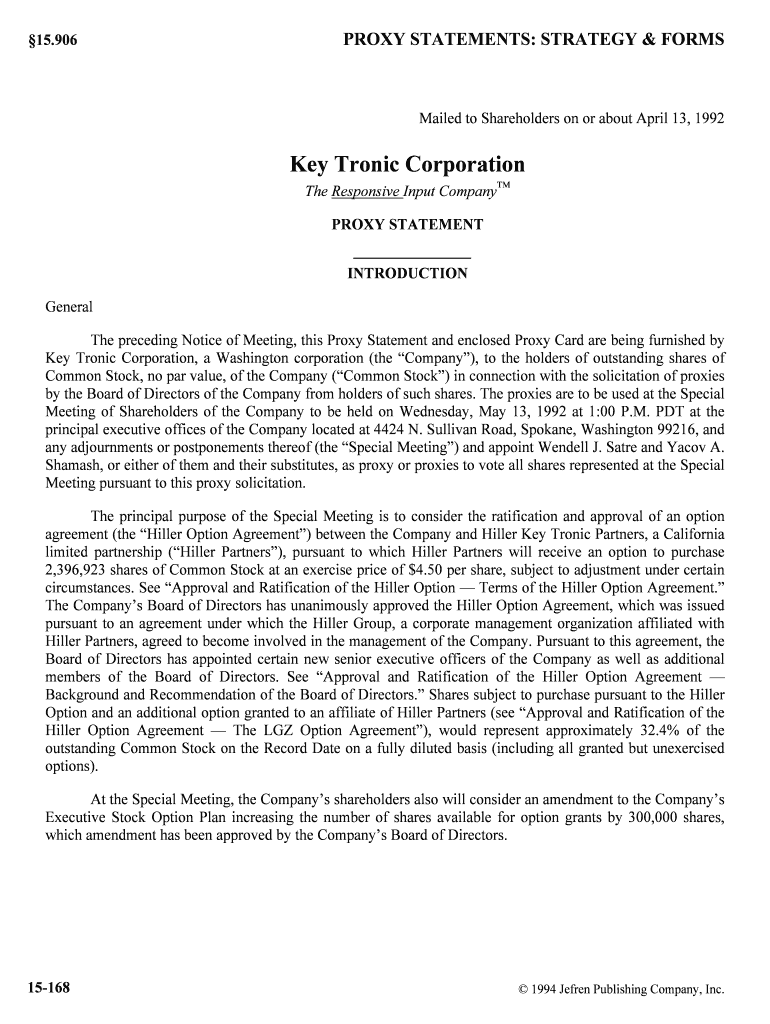
Mailed to Shareholders on or about April 13, 1992
Key Tronic Corporation The Responsive Input Company
PROXY STATEMENT
INTRODUCTION
General
The preceding Notice of Meeting, this Proxy Statement and enclosed Proxy Card are being furnishe d by
Key Tronic Corporation, a Washington corporation (the “Company”), to the holders of outstanding share s of
Common Stock, no par value, of the Company (“Common Stock”) in connection with the solic itation of proxies
by the Board of Directors of the Company from holders of such shares. The proxies are to be used at the Special
Meeting of Shareholders of the Company to be held on Wednesday, May 13, 1992 at 1:00 P.M. PDT at the
principal executive offices of the Company located at 4424 N. Sullivan Road, Spokane, Wa shington 99216, and
any adjournments or postponements thereof (the “Special Meeting”) and appoint Wendell J. Satre and Yacov A.
Shamash, or either of them and their substitutes, as proxy or proxies to vote all shares represente d at the Special
Meeting pursuant to this proxy solicitation.
The principal purpose of the Special Meeting is to consider the ratification and a pproval of an option
agreement (the “Hiller Option Agreement”) between the Company and Hiller Key Tronic Partners, a California
limited partnership (“Hiller Partners”), pursuant to which Hiller Partners will recei ve an option to purchase
2,396,923 shares of Common Stock at an exercise price of $4.50 per share, subject to adjustment unde r certain
circumstances. See “Approval and Ratification of the Hiller Option — Terms of the Hiller Option Agreement.”
The Company’s Board of Directors has unanimously approved the Hiller Option Agreement, which wa s issued
pursuant to an agreement under which the Hiller Group, a corporate management organizati on affiliated with
Hiller Partners, agreed to become involved in the management of the Company. Pursuant to this agreement, the
Board of Directors has appointed certain new senior executive officers of the Company as we ll as additional
members of the Board of Directors. See “Approval and Ratification of the Hiller Opt ion Agreement —
Background and Recommendation of the Board of Directors.” Shares subject to purchase pursuant to t he Hiller
Option and an additional option granted to an affiliate of Hiller Partners (see “Approval a nd Ratification of the
Hiller Option Agreement — The LGZ Option Agreement”), would represent approximately 32.4% of t he
outstanding Common Stock on the Record Date on a fully diluted basis (including all grante d but unexercised
options).
At the Special Meeting, the Company’s shareholders also will consider an amendment t o the Company’s
Executive Stock Option Plan increasing the number of shares available for option grants by 300,000 shares,
which amendment has been approved by the Company’s Board of Directors.
OFFICERS AND EMPLOYEES§15.906
October/November 1994 15-169
Record Date; Vote Required
Record holders of the Company’s Common Stock at the close of business on April 3, 1992 (the “Record
Date”), are entitled to notice of and to vote at the Special Meeting. The Company had 7,742,390 shares of
Common Stock issued and outstanding as of the Record Date. The affirmative vote of the holde rs of at least a
majority of the outstanding shares of Common Stock voting at the Special Meeting is requi red to approve and
ratify the Hiller Option Agreement and to approve and ratify the amendment to the E xecutive Stock Option
Plan. The total votes cast on each proposal also must represent more than fifty percent of the shares of Common
Stock issued and outstanding on the Record Date. Each share of Common Stock is entitled t o one vote on all
matters presented at the Special Meeting. The Company has no other class of stock issued or outstanding.
The Board of Directors has determined that, given the significance of the Hiller Opt ion to the
Company and certain requirements of the NASDAQ National Market System, on which the Compa ny’s
Common Stock is quoted, the Board would not authorize issuance of the Hiller Option wit hout consideration
and approval by the Company’s shareholders.
The Board of Directors is not seeking, and the vote of the shareholders will not be construed to
be, a waiver by the Company’s shareholders of any right of action or other challenge relating to any violation by
the Company’s directors of any fiduciary duty to the Company or its shareholders, relating to the validity of any
action involving a conflict of interest of any director of the Company, or relating to a ny violation of any federal
or state securities or similar disclosure laws, and the Company currently is unaware of any basis for such a
claim. However, ratification and approval by the Company’s shareholders will have the effe ct of limiting any
potential claim that the Hiller Option has not been duly authorized, although the Company currently is unaware
of any basis for such a claim.
The Company has been informed that the members of the Board of Directors intend to vot e all
shares beneficially owned by them in favor of ratification and approval of the Hiller Option Agreement and in
favor of the amendment to the Executive Stock Option Plan. As of the Record Date, t he members of the Board
of Directors as a group owned beneficially approximately 1,657,198 shares of Common Stock (excluding
outstanding but unexercised options to purchase Common Stock), or approximately 21.4% of the shares of
Common Stock outstanding on such date.
Proxies; Revocation
A proxy card for use at the Special Meeting is enclosed with this Proxy Statement. All completed,
signed and dated proxies returned to the Company will be voted at the Special Meeti ng in accordance with the
instructions thereon. IF NO INSTRUCTIONS ARE GIVEN ON AN OTHERWISE SIGNED AND DATED
PROXY CARD, THE PROXY WILL BE VOTED IN FAVOR OF THE RATIFICATION AND APPROVAL
OF THE HILLER OPTION AGREEMENT AND IN FAVOR OF THE RATIFICATION AND APPROVAL
OF THE AMENDMENT TO THE EXECUTIVE STOCK OPTION PLAN. Any proxy may be revoked at any
time before it has been voted by giving written notice of revocation to the Secretary of the Company at the
address set forth above; by delivering a completed, signed proxy bearing a date later t han any earlier proxy; or
by voting shares in person at the Special Meeting. The mere presence at the Speci al Meeting of the shareholder
who has given a proxy will not revoke such proxy.
§15.906PROXY STATEMENTS: STRATEGY & FORMS
© 1994 Jefren Publishing Company, Inc. 15-170
APPROVAL AND RATIFICATION OF THE HILLER OPTION AGREEMENT
Background and Recommendation of the Board of Directors Since the resignation of Alfred T. Zirkle as the Company’s President and Chief Executi ve Officer on
August 1, 1991, the Board of Directors has been actively searching for a President who will posit ion the
Company for long-term success. The Board of Directors has determined that the interests of the Company and
its shareholders would best be served by involving the Hiller Group in the management of the Company. This
determination was based in part on the extensive experience of the Hiller Group and its principal, Mr. Stanley
Hiller, in rebuilding underperforming companies.
Mr. Hiller, who is 67, is the Senior Partner of Hiller Investment Company and Managing Part ner of the
Hiller Group, and has served as Chairman of the Board, Chief Executive Officer or Seni or Officer of numerous
corporations over a 50 year period. Through the Hiller Group, which he founded in the late 1960s, he has
brought together groups of executives who become actively involved in the direct managem ent of companies,
usually at the request of its managers, directors or shareholders. During the past 20 years, Mr. Hi ller has
concentrated his efforts in the area of restructuring troubled companies, including G.W. Murphy Industries
(diversified manufacturing and services), Reed Tool Company (tool manufacturing), Baker Inte rnational
(Baker-Hughes) (oil field service), The Bekins Company (moving and storage) and York International (a ir
conditioning manufacturing), among others.
On February 1, 1992, the Company approved an agreement with the Hiller Group (the “Hiller
Agreement”), pursuant to which Mr. Hiller would be appointed a Director, Chief Executive Offic er and
Chairman of the Company’s Executive Committee and Mr. Hiller would designate two or three additional
persons to be appointed to the Company’s Board of Directors. The Hiller Agreement also provide d that, subject
to the approval of the Company’s shareholders, the Hiller Group would be granted an option on the terms
described herein under the caption “Terms of the Hiller Option Agreement.” The Hil ler Agreement also
provided that a portion of the shares, which in the aggregate would equal 25% of the outstanding sha res of the
Company on a fully diluted basis (including all granted but unexercised options), would be allocated to increase
the shares reserved for issuance under one of the Company’s existing stock option plans, in a num ber to be
determined, for future grants to current and future senior management of the Company. Under these
arrangements, Mr. Hiller will not receive any salary for his services as an officer and director of the Company,
and no such salary currently is anticipated to be paid in the foreseable future. Mr. Hiller will receive
reimbursement of certain out-of-pocket expenses. A copy of the Hiller Agreement is attac hed to this Proxy
Statement as Exhibit A.
In accordance with the Hiller Agreement, on February 29, 1992, the Company’s Board of Directors
approved an increase in the size of the Company’s Board of Directors from five to nine persons and appointed
Mr. Hiller as a director and Chief Executive Officer and Chairman of the Executi ve Committee of the
Company’s Board of Directors and Mr. Royce G. Pearson, a partner of Hiller Partners, was appointed Pre sident
and Chief Operating Officer of the Company. Effective March 3, 1992, Mr. Pearson and Messrs. Dale Pilz and
Kenneth Holtby were appointed as directors of the Company. The Board of Directors on March 9, 1992, gave
its final approval to the form of the Hiller Option Agreement and a related Regist ration Rights Agreement,
subject to shareholder approval. At the same Board meeting, Mr. K. Michael Cooper, a partner of Hiller
Partners, was appointed Executive Vice President of the Company. The Board also voted to increase by 300,000
shares the number of shares reserved under the Company’s existing Executive Stock Option Pla n for future
OFFICERS AND EMPLOYEES§15.906
October/November 1994 15-171
grants to existing and future senior management and key employees of the Company. None of the newly
appointed directors participated in the consideration of the Hiller Option Agreement, t he increase in option
shares or related matters.
§15.906PROXY STATEMENTS: STRATEGY & FORMS
© 1994 Jefren Publishing Company, Inc. 15-172
The Board of Directors believes that the Hiller Option Agreement and the relate d Registration Rights
Agreement are necessary in order to provide an appropriate incentive to the Hiller Group to improve the
financial performance of the Company and to enhance shareholder value. The Board of Direct ors also believes
that the terms of the Hiller Option Agreement are fair to the Company and its shareholders, because the exercise
price of the Hiller Option Agreement represented a significant premium over the marke t price of the Company’s
Common Stock at the time of grant, and because the vesting of the options over tim e serves to ensure the Hiller
Group’s continued participation in the Company. See “Terms of the Hiller option Agreement.” Finally, the
Board of Directors believes that the grant of registration rights for the shares held by Hill er Partners is necessary
in order to provide Hiller Partners with the alternative of realizing the benefits of the Hiller Option through a
public sale of such shares. See “Registration Rights Agreement.”
Hiller Partners is a limited partnership created by the Hiller Group in connection with the Hiller Option
Agreement and related matters. Mr. Hiller, as a General Partner of Hiller Partne rs and as a General Partner of
Hiller Investment Partners, which is a limited partner of Hiller Partners, has a 74.8% interest in Hiller Partners;
Mr. Pearson, President and a director of the Company, has a 10.5% interest in Hiller Partne rs as a limited
partner; and Mr. Cooper, Executive Vice President of the Company, has an 8.0% interest in Hil ler Partners as a
limited partner. Each partner of Hiller Partners will share in the economic benefit of the Hiller Option
(including any appreciation in the value of shares subject to such option above the exerc ise price of such option)
to the extent of their respective partnership interest. The Company currently is not a ware of any intention to
distribute interests in the Hiller Option to the partners of Hiller Partners.
The Board of Directors has approved the Hiller Option Agreement and recommends approval and
ratification of the Hiller Option Agreement by the Company’s shareholders.
The Hiller Group
The following information has been provided to the Company with respect to the Hiller Group and
members of the Hiller Group participating in the management of the Company pursuant to t he Hiller
Agreement. Mr. Hiller’s background is described above under the caption “Background and Recommendat ion
of the Board of Directors.”
Royce G. Pearson, 56, a member of the Hiller Group, served as Vice President and Chief Manufacturing
Officer for Levelor Corporation, a window blind manufacturer, from October 1988 to March 1992, prior to
which he served as Vice President of Manufacturing for Reed Tool Company.
K. Michael Cooper, 44, has been associated with the Hiller Group since 1975, and has been involved in
the management of a number of companies, including as divisional Vice President of Inte rnational Operations
and Managing Director of Nigerian operations for Baker International between 1975 to 1985. Subsequently, Mr.
Cooper served as a special advisor to Crocker Bank and as an officer of Levolor Corporation.
OFFICERS AND EMPLOYEES§15.906
October/November 1994 15-173
Other Newly Appointed Directors
The following information also has been furnished to the Company with respect to the two i ndividuals
appointed to the Company’s Board of Directors upon designation by Mr. Hiller in accordance wit h the Hiller
Agreement.
Dale Pilz, 66, served as Chief Executive Officer and President of GTE Satellite Communications
Corporation from 1983 to 1988; Chief Executive Officer and President of GTE Sprint Communicati ons
Corporation from 1983 to 1984; Chief Executive Officer and President of GTE Spacenet Corporation from
1981 to 1983; and Vice President of Southern Pacific Company, a transportation company, from 1980 to 1981.
Kenneth Holtby, 69, served in various positions in engineering, technology and product development for
the Boeing Company, an aircraft manufacturer, since 1947, and served most recently as Se nior Vice President
of Corporate Engineering for Boeing until his retirement in 1987.
Terms of the Hiller Option Agreement
The following descriptions of the terms of the Hiller Option Agreement and the related Registration
Rights Agreement are qualified in their entirety by the text of the Hiller Opt ion Agreement and the Registration
Rights Agreement, which are attached to this Proxy Statement as Exhibit B and Exhibit C, respectively.
The Hiller Option Agreement provides that Hiller Partners may purchase from the Company up to
2,396,923 shares of Common Stock (which shares would represent approximately 22.9% of the outstanding
Common Stock on the Record Date on a fully diluted basis, including all granted but unexe rcised options) at an
exercise price of $4.50 per share, subject to proportional adjustment in the number of shares and the exercise
price in the event of any recapitalization, stock split, stock dividend or simila r transaction. The last reported sale
price of the Common Stock on the last trading day prior to the approval of the Hiller Option was $3.125 per
share. The last reported sale price of the Common Stock on NASDAQ/NMS on April 3, 1992, the last trading
day before the printing of this Proxy Statement, was $5.875 per share.
The Hiller Option becomes exercisable as to half of the shares subject to the Hi ller Option after March
1, 1993 and as to the remainder of such shares after March 1, 1994, provided that Mr. Hiller has been involved
in the management of the Company as an officer or director from the date of the Hill er Option Agreement until
such date. In the event that Mr. Hiller dies or is physically or mentally incapable of performing services as a
director or officer of the Company prior to such dates, the Hiller Option becomes exercisabl e on such dates
notwithstanding the failure of Mr. Hiller to perform such services. The Hiller Option expires on March 1, 1997.
In addition, the Hiller Option becomes exercisable in full immediately upon a change in control of the
Company, which is defined to include (i) the direct or indirect sale or exchange by the shareholders of the
Company of all or substantially all of the stock of the Company where the shareholders of t he Company before
such sale or exchange do not retain, directly or indirectly, at least a majority of the beneficial interest in the
voting stock of the Company; (ii) a merger in which the shareholders of the Company before suc h merger do
not retain, directly or indirectly, at least a majority of the beneficial interest in the voting stock of the surviving
company; or (iii) the sale, exchange, or transfer of all or substantially all of the Company’s assets (other than a
sale, exchange, or transfer to one or more corporations where the shareholders of the Company before such sale,
exchange, or transfer retain,
§15.906PROXY STATEMENTS: STRATEGY & FORMS
© 1994 Jefren Publishing Company, Inc. 15-174
directly or indirectly at least a majority of the beneficial interest i n the voting stock of the corporation(s) to
which the assets were transferred).
The Board of Directors has not approved the Hiller Option Agreement for the purpose of making a
change of control of the Company more difficult, although the acceleration features of the Hiller Option may
have such an effect. The Hiller Option Agreement has not been entered into in response to any specific effort by
any person to accumulate the Company’s securities, and the Company currently is unaware of any such effort.
Certain Financial Effects of the Hiller Option
The Hiller Option may have the effect of increasing the weighted average number of sha res outstanding
under the modified treasury stock method of accounting for stock options, and the extent of t his increase will
depend upon certain factors, including the average market price of the Common Stock during the relevant
accounting period. Such an increase in weighted average shares outstanding would decrease the Company’s
earnings per share relative to earnings per share in the absence of the Hiller Option. In addition, if the book
value per share of the Common Stock at the time of exercise of the Hiller Option exceeds the exercise price
paid, the Company’s book value per share of Common Stock would be diluted accordingly.
Registration Rights Agreement
Pursuant to a Registration Rights Agreement entered into concurrently with the Hiller Option
Agreement (the “Registration Rights Agreement”), the Company has agreed, subject to certain conditions, to
register shares of Common Stock held by Hiller Partners, including (but not limited to) sha res subject to the
Hiller Option and the LGZ Option (as described below) (the “Registrable Shares”), under t he Securities Act of
1933, as amended (the “Securities Act”). Subject to certain exceptions, at any t ime after March 31, 1993, the
holders of at least 25% of the shares subject to the Hiller Option may on up to two oc casions require the
Company at its own expense to use its diligent best efforts to register all or part of the Registrable Shares under
the Securities Act, so long as the aggregate offering price to the public would be at least $5,000,000. In
addition, in the event that the Company registers shares under the Securities Act on i ts own behalf, the
Company is required at its own expense to include in such registration all or part of t he Registrable Shares upon
request of the holders thereof, subject to certain limitations. Finally, subject to certain exceptions and
limitations, the holders of Registrable Shares may upon request require the Company, at t he expense of such
holders, to register all or part of such shares on Form S-3 under the Securities Actif such Form is available, and
so long as the aggregate price to the public of such shares would be equal to at le ast $500,000. The registration
rights granted under the Registration Rights Agreement expire on March 1, 2002.
The LGZ Option Agreement
The Hiller Agreement provided that the Hiller Group’s involvement in the Company’s mana gement was
conditioned upon the grant to Mr. Hiller of an option to purchase 1,000,000 shares of the Company’s Common
Stock owned by LGZ, Inc., a Washington corporation (“LGZ”). LGZ is owned and controlled by Lewis G.
Zirkle, Chairman of LGZ’s Board of Directors and a member of the Company’s Board of Direct ors, Lewis G.
Zirkle, Jr., one of the Company’s Directors, Alfred T. Zirkle, formerly an officer and director of the Company,
and other members of the Zirkle family. In accordance with the Hiller Agreement, on March 2, 1992, LGZ and
Mr. Hiller, with the approval of the Company’s Board of Directors, entered into an option a greement (the “LGZ
Option Agreement”) providing Mr. Hiller the right to purchase 1,000,000 shares of the Company’s Comm on
Stock, at an exercise price
OFFICERS AND EMPLOYEES§15.906
October/November 1994 15-175
of $6.00 per share, subject to adjustment under certain circumstances (the “LGZ Option”). The LGZ Option
Agreement provides that upon exercise of any portion of the Hiller Option, Mr. Hiller must exerci se at least the
same proportion of the LGZ Option at such time.
The LGZ Option is exercisable at any time before March 2, 1995, but only after the Compa ny’s
shareholders have approved the Hiller Option Agreement. The LGZ Option terminates automa tically at such
time as Mr. Hiller ceases to be involved in the management of the Company and no member of the Hiller Group
is an employee, officer or director of the Company. The LGZ Option also terminates on September 2, 1993, in
the event that the price of the Common Stock has not reached $6.00 per share or the C ompany’s annual after-tax
earnings have not reached $0.50 per share, unless on or before such date Mr. Hiller pays to LGZ t he sum of
$100,000.
Pursuant to the LGZ Option Agreement, LGZ also has agreed to vote all of its share s of Common Stock
in favor of the approval and ratification of the Hiller Option Agreement. In addition, LGZ and Mr. Hiller have
agreed that such shares of Common Stock will be voted on all other matters in accordanc e with the mutual
agreement of Mr. Hiller and LGZ, and that upon request of Mr. Hiller, LGZ will grant to Mr. Hi ller or his
designee an irrevocable proxy to vote all Common Stock owned by LGZ. The Company has been informed that
as of the Record Date, LGZ owned 1,259,725 shares of Common Stock.
Price Range of Common Stock
The Company’s Common Stock is quoted on the NASDAQ National Market System. The following
table sets forth, for the periods indicated, the high and low closing sale prices per sha re of the Common Stock as
reported by NASDAQ. These quotations represent prices between dealers without adjustment for markups,
markdowns or commissions, and may not represent actual transactions.
Fiscal Period High Low
1990: First Quarter $6-5/8 $5-5/8
Second Quarter 6-1/2 5
Third Quarter 5-1/2 4-3/8
Fourth Quarter 4-3/8 4-1/16
1991: First Quarter $5-1/8 $4-1/8
Second Quarter 4-5/8 3-5/8
Third Quarter 5-1/2 3-5/8
Fourth Quarter 5-1/8 3-1/2
1992: First Quarter $3-5/8 $2-1/8
Second Quarter 2-3/4 1-7/8
Third Quarter 6-3/4 1-7/8
§15.906PROXY STATEMENTS: STRATEGY & FORMS
© 1994 Jefren Publishing Company, Inc. 15-176
APPROVAL AND RATIFICATION OF AMENDMENT TO
THE COMPANY’S EXECUTIVE STOCK OPTION PLAN
General The Company’s shareholders are being asked to act upon a proposal to approve the action of the Board
of Directors amending the Company’s Executive Stock Option Plan (the “ESO Plan”). The purpose of the ESO
Plan is to induce key employees to remain in the employ of the Company and to enc ourage such employees to
secure or increase on reasonable terms their stock ownership in the Company.
Under the ESO Plan, 370,000 shares of Common Stock initially were reserved for issuance pursuant to
nonqualified stock options to be granted to employees of the Company or its subsidiaries. The numbe r of shares
available for grant under the ESO Plan subsequently was increased to 796,870 through transfer of share s
previously authorized under the Company’s Incentive Stock Option Plan and Executive SAR Stoc k Option Plan
to the ESO Plan. In the event that any options under the ESO Plan expire or terminat e for any reason without
having been exercised in full, unpurchased shares subject to such options are available for furt her grants under
the ESO Plan.
In connection with the Hiller Agreement, the Board of Directors has approved an amendment to the
Executive Stock Option Plan to increase the number of shares available for grants by 300,000 share s to an
aggregate of 1,096,870 shares. See “Approval and Ratification of the Hiller Option Agreement—B ackground
and Recommendation of the Board of Directors.” As of March 11, 1992, options to purchase 172,985 shares
had been granted under the Executive Stock Option Plan, and, without giving effect to the a mendment, 623,885
shares remained available for future grants. Information with respect to options granted to the Company’s
officers and directors is set forth under the caption “Executive Compensation — Stock Option Plan.” The Board
of Directors believes that the attraction and retention of high quality personnel are e ssential to the Company’s
growth and success and that the increase in available shares is necessary for the Company to remain competitive
in its compensation practices.
The ESO Plan is administered by the Stock Option Sub-Committee of the Compensation Com mittee of
the Board of Directors which determines, in its discretion, the terms of options granted, inc luding the employees
to whom and the price at which options are granted, the exercise period, and the number of sha res subject to
options granted. The exercise price for options granted under the ESO Plan is determined by the Sub-
Committee and cannot be less than the fair market value of the Common Stoc k as of the date of grant. Options
may be paid for in cash or other consideration, including shares of the Company’s Common Stock. Outstanding
options under the ESO Plan generally are for ten (10) year terms and vest twenty percent (20%) of the total
grant for five (5) consecutive years commencing one (1) year after the date of grant. The ESO Plan provides
that each employee granted an option thereunder must agree to remain in the e mployment of the Company, at
the pleasure of the Company, for at least twelve months following the date of grant. Upon involuntary
termination of an optionee’s employment with the Company, options held by such optionee ma y be exercised
within two weeks following the date of termination, to the extent such options otherwise a re exercisable by their
terms.
The Board of Directors recommends a vote FOR approval and ratification of the proposed amendments
to the Option Plan.
OFFICERS AND EMPLOYEES§15.906
October/November 1994 15-177
Certain Federal Tax Consequences
The following summarizes only the current federal income tax consequences of stock options granted
under the Company’s stock option plans, including the ESO Plan. State and local tax consequences may differ.
The grant of either an incentive stock option (“ISO”) or a nonqualified stock option under the Plan will
not result in any federal income tax consequences to the optionee or to the Company. Upon exercise of a
nonqualified stock option, the optionee is subject to income taxes at the rate a pplicable to ordinary
compensation income on the difference between the option price and the fair market value of the shares on the
date of exercise. This income is subject to withholding for federal income and employm ent tax purposes. The
Company is entitled to an income tax deduction in the amount of the income re cognized by the optionee. Any
gain or loss on the optionee’s subsequent disposition of the shares will receive long- or short-term c apital gain
or loss treatment depending on whether the shares are held for more or not more than twel ve months,
respectively, following exercise. The Company does not receive a tax deduction for any suc h gain. Capital gains
currently are taxed at the same rates as ordinary income, except that the maxi mum marginal rate at which
ordinary income is taxed is currently 31% and the maximum rate at which long-term c apital gains are taxed is
28%. Special considerations apply to optionees who are reporting persons for purposes of Section 16(a) of the
Exchange Act and such optionees should consult their tax advisors with respect to the tax treatment of such
options.
An optionee recognizes no federal taxable income upon exercising an ISO (subject to the a lternative
minimum tax rules discussed below), and the Company receives no deduction at the ti me of exercise. In the
event of a disposition of stock acquired upon exercise of an ISO, the tax consequences depend upon how long
the optionee has held the shares. If the optionee does not dispose of the shares within two ye ars after the ISO
was granted, nor within one year after the ISO was exercised and shares were purchased, the opt ionee will
recognize a long-term capital gain (or loss) equal to the difference between the sal e price of the shares and the
exercise price. The Company is not entitled to any deduction under these circumstances.
If the optionee fails to satisfy either of the foregoing holding periods, he or she must recogniz e ordinary
income in the year of the disposition (referred to as a “disqualifying disposition”). The amount of such ordinary
income generally is the lesser of (i) the difference between the amount realiz ed on disposition and the exercise
price, or (ii) the difference between the fair market value of the stock on the e xercise date and the exercise price.
Any gain in excess of the amount taxed as ordinary income will be treated as a long- or short-term capital gain,
depending on whether the stock was held for more or not more than twelve months, respectivel y. The Company,
in the year of the disqualifying disposition, is entitled to a deduction equal to t he amount of ordinary income
recognized by the optionee.
The “spread” under an ISO — i.e., the difference between the fair market value of t he shares at exercise
and the exercise price — is classified as an item of tax preference in the year of exercise for purposes of the
alternative minimum tax.
§15.906PROXY STATEMENTS: STRATEGY & FORMS
© 1994 Jefren Publishing Company, Inc. 15-178
PRINCIPAL SHAREHOLDERS AND SECURITY
OWNERSHIP OF MANAGEMENT
The following table provides certain information which has been furnished to the Company regarding
ownership of the Common Stock as of the Record Date, with respect to (i) each director of the Company who
beneficially own shares; (ii) all directors and executive officers of the Company as a group; and (iii) each
beneficial owner of more than five percent of the Common Stock.
Name* Number of Shares Percent
Hiller Key Tronic Partners 1,259,825(1) 16.3%
3000 Sand Hill Road
Menlo Park, CA 94025
Stanley Hiller 1,259,825(2) 16.3%
LGZ, Inc. 1,259,725 16.3%
David L. Babson & Company, Inc. 584,100(3) 7.5%
One Memorial Drive
Cambridge, MA 02124
Key Tronic Corporation 448,769(4) 5.8%
Variable Investment Plan
Discretionary Trust
Dimensional Fund Advisors, Inc. 442,100(5) 5.7%
1299 Ocean Avenue, Suite 650
Santa Monica, CA 90401
Lewis G. Zirkle, Jr. 363,713(6) 4.7%
Lewis G. Zirkle 22,660(7) **
Alfred T. Zirkle (8) —
Mark Eppley 6,666(9) **
Wendell J. Satre 17,666(9) **
Yacov A. Shamash 6,666(9) **
All officers and directors as a group (15) persons) 1,750,915(10) 22.4%
* The address is in care of the Company, unless otherwise noted.
** Less than one percent.
(1) Includes 1,259,725 shares owned by LGZ, Inc. and subject to shared voting control pursuant to a voting agreement with Mr. Hiller, general partner of Hiller Partners (see “The LGZ Option Agreem ent”), of
which 1,000,000 shares also are subject to an immediately exercisable option. Also include s 100 shares
OFFICERS AND EMPLOYEES§15.906
October/November 1994 15-179
owned directly by Mr. Hiller, as to which Hiller Partners disclaims beneficial ownership. Excludes
shares issuable pursuant to the Hiller Option Agreement.
§15.906PROXY STATEMENTS: STRATEGY & FORMS
© 1994 Jefren Publishing Company, Inc. 15-180
(2) Includes 1,259,725 shares over which Mr. Hiller has shared voting power pursuant to the LGZ Option
Agreement and 100 shares owned directly by Mr. Hiller. Excludes shares issuable pursuant to the Hiller
Option Agreement.
(3) David L. Babson & Company, Inc., a registered investment advisor, is deemed to have sole dispositive
power with respect to all such shares, sole voting power with respect to 544,900 shares and share d
voting power with respect to 39,200 shares, as of December 31, 1991.
(4) The Administrative Committee for the Plan which includes Brian W. Ladyman, Vice President
Operations, Donald Clayman and Michael I. Trull, Corporate Counsel and Assistant Secretary, currently
has voting power with respect to these shares.
(5) Dimensional Fund Advisors, Inc. (“Dimensional”) a registered investment adviser, is deemed t o have
beneficial ownership of 442,100 shares of Key Tronic Corporation stock as of July 31,1991, all of which
shares are held in portfolios of DFA Investment Dimensions Group, Inc., a registered open-end
investment company, or the DFA Group Trust and DFA Participation Group Trust, investment vehicles
for qualified employee benefit plans, all of which Dimensional Fund Advisors Inc., serves as invest ment
manager. Dimensional disclaims beneficial ownership of all such shares. Dimensional has sole voting
power with respect to 285,800 shares. Persons who are officers of “Dimensional” also serve as officers
of DFA Investment Dimensions Group, Inc. These persons, as officers, vote 156,300 shares owned by
DFA Investment Dimensions Group, Inc.
(6) Lewis G. Zirkle, Jr. has shared voting and investment power with respect to the shares owne d by LGZ,
Inc. Mr. Zirkle disclaims any beneficial interest in shares owned by LGZ, Inc.
(7) Lewis G. Zirkle has shared voting and investment power with respect to the shares owne d by LGZ, Inc.
Does not include 2,000 shares owned by the wife of Lewis G. Zirkle. Mr. Zirkle disclaims any be neficial
interest in shares owned by LGZ, Inc. and his wife.
(8) Alfred T. Zirkle owns no shares. Alfred T. Zirkle has shared voting and investment power with respect
to the shares owned by LGZ, Inc. Does not include 1,000 shares each held in trust for two daughte rs of
Alfred T. Zirkle. Mr. Zirkle has voting and investment power with respect to these shares.
(9) Includes 6,666 shares subject to issuance pursuant to stock options exercisable within 60 days fol lowing
the Record Date.
(10) Does not include Common Stock allocated to officers as participants in the Com pany’s Variable
Investment, Stock Bonus or Employee Stock Ownership Plans after December 31, 1991. Includes
86,348 shares subject to issuance pursuant to stock options exercisable within 60 days following the
Record Date.
OFFICERS AND EMPLOYEES§15.906
October/November 1994 15-181
EXECUTIVE COMPENSATION
Compensation Tables
The following table shows the compensation of each of the five most highly compensated e xecutive
officers of the Company and of all executive officers as a group, for services rendered to t he Company during
the Company’s fiscal year ended June 30, 1991. All amounts are rounded to the nearest dollar.
Name Capacities in Which Served Salary(1) Bonuses(2)
Lewis G. Zirkle(3) Chairman of the Board, Chief
Executive Officer (until October 1990) $86,706 $220,450
Alfred T. Zirkle Chairman of the Board, President
and Chief Executive Officer (until
August 1, 1991) 179,071 3,858
Louis E. Barten Vice President (until August 30, 1991) 100,019 2,603
Nathan S. Batson Vice President (until August 23, 1991) 76,953 15,736
Syed A. Hasan Director of Worldwide Sales
(until November 13, 1991) 75,411 16,574
All Executive
Officers as a Group
(25 Persons)(3)(4) 1,376,045 361,887
(1) Includes amounts deferred under the Company’s 401(k) Plan, including Company matching
contributions. See “Other Plans.” Does not include for Lewis G. Zirkle, an in-kind payment va lued at
approximately $20,425; and for Mr. Barten, moving expenses of approximately $42,124.
(2) Officers and certain key employees, other than Lewis G. Zirkle, are eligibl e for cash bonuses from a
pool of 5% of the Company’s quarterly after tax profit. The Company paid the officers and ce rtain key
employees cash bonuses ranging from 0.05% to 0.65% of the Company’s quarterly after tax profit
during fiscal year 1991. Bonuses were paid only with respect to the first quarter of the fisc al year ended
June 30, 1991.
(3) The Company has a Consulting Agreement with Lewis G. Zirkle under which, as amended and restated
April 18, 1989, the Company pays Mr. Zirkle $108,740 per year, adjusted annually by the Consumer
Price Index. Upon his death, Mr. Zirkle’s wife is entitled to receive, for her lifeti me, annual payments
equal to one-half of Mr. Zirkle’s retirement payment (approximately $54,000 per year). The Board of
Directors granted Mr. Zirkle a special bonus of $213,259 at Mr. Zirkle’s retirement from the office s of
President and Chairman of the Board on October 19, 1990 in recognition of his position of founder of
§15.906PROXY STATEMENTS: STRATEGY & FORMS
© 1994 Jefren Publishing Company, Inc. 15-182
and years of exemplary dedication to the Company, which is included in the bonus amount shown
above.
OFFICERS AND EMPLOYEES§15.906
October/November 1994 15-183
(4) Does not include severance payments of approximately $47,510 made to individuals who ceased being
executive officers of the Company during the 1991 fiscal year, or approximately $19,658 distributed t o
individuals in the group pursuant to the Variable Investment Plan (described below).
The following table shows the current annual salary for certain of the Company’s current most highly
compensated executive officers and Mr. Hiller. Such executive officers (other than Mr. Hill er) also may be
eligible for bonuses in accordance with the Company’s bonus program.
Name Capacity in Which Serving Salary
Stanley Hiller Chief Executive Officer —
Royce G. Pearson President and Chief Operating
Officer $150,000
K. Michael Cooper Executive Vice President 144,750
Robert Camden-Britton Vice President of Quality
Assurance 90,000
Severance Arrangements
In connection with the Hiller Agreement, the Company has entered into severance agree ments with five
of its current executive officers. The agreements with Messrs. Pearson and Cooper provide that upon
termination of either of such officer’s employment by the Company, such officer will rec eive his salary for a
period of one year following termination. The agreements with the other executive office rs provide that in the
event the Company terminates any such officer’s employment at any time, or if such offic er terminates his
employment voluntarily after June 30, 1992, the Company will pay to the officer one year’s sa lary and will
continue to provide certain medical benefits for a one-year period or, in one case, through age 65.
Stock Option Plans
The Company maintains four (4) Stock Option Plans, including the ESO Plan described above unde r the
caption “Approval and Ratification of Amendment to the Company’s Executive Stock Option Plan.”
Stock Option Plan for Non-Employee Directors. The Company’s 1990 Stock Option Plan for Non-
Employee Directors (the “1990 Plan”) was approved by the Company’s shareholders in 1990. The 1990 Plan
reserves 100,000 authorized but unissued shares of Common Stock of the Company for issuance to directors of
the Company who are not employees of the Company and who are independent and outside direc tors of the
Company. Such directors automatically, upon joining the Board of Directors, receive on the next following
January 19th or, if such date falls on a non-trading day, the next following trading day, an opti on to acquire
10,000 shares of the Company’s Common Stock, which right vests over three (3) years. The 1990 Plan provides
that no Director shall be eligible to receive more than one (1) option grant under the 1990 Plan. The 1990 Plan
provides that it is to be administered by a Committee which, subject to incre ase by the Chairman of the Board to
not more than five (5) members inclusive of the Chairman, consists of two (2) management e mployees and one
(1) non-participating member of the Board of Directors. Subject to the express provisions of the 1990 Plan, the
§15.906PROXY STATEMENTS: STRATEGY & FORMS
© 1994 Jefren Publishing Company, Inc. 15-184
Committee establishes those to whom and the price at which options are granted, opt ion periods, and option
exercise periods; provided,
OFFICERS AND EMPLOYEES§15.906
October/November 1994 15-185
that options may not be exercised unless the optionee Director has remained a director of the Company for at
least one (1) year following the grant of the option, unless the 1990 Plan otherwise allows. If a participating
director leaves the Board due to death or otherwise that portion of the option exercisa ble at the date of the
director’s death or resignation from the Board may be exercised within one (1) year after such date or the date
on which the option expires by its own terms, whichever is earlier.
Incentive Stock Option Plan (“ISOP”). The 1983 Incentive Stock Option Plan for Employees of Key
Tronic Corporation (the “1983 Option Plan”) reserved 510,000 shares of Common Stock of the Company for
issuance to employees of the Company or its subsidiaries pursuant to the grant of incentive st ock options. At the
1987 Annual Meeting of Shareholders, the shareholders authorized the transfer of 281,323 shares authorized
under the ISOP to the Executive Stock Option Plan (81,323 shares) and the Executive SAR Stock Opti on Plan
(200,000 shares). At the 1990 Annual Meeting of Shareholders the shareholders authorized the transfer of the
remaining 30,547 shares available for grants under this Plan to the Executive Stock Option Plan (ESO). The
1983 Option Plan is administered by the Stock Option Sub-Committee of the Compensation Com mittee of the
Board of Directors. The exercise price for options granted under the 1983 Option Plan is determi ned by the
Sub-Committee and cannot be less than the fair market value of the Common Stock as of the date of the option
grant. Options may be paid for in cash or other consideration, including shares of the Company’s C ommon
Stock. Outstanding options under the 1983 Option Plan are for ten (10) years terms and vest twenty (20) percent
of the total grant per year for five (5) consecutive years commencing one (1) year after the date of grant.
The Company does not currently intend to reserve or otherwise provide additional shares to the ISOP for
further grants.
Executive SAR Stock Option Plan (“ESSO”) . Under the ESSO 300,000 shares of Common Stock of the
Company were reserved for issuance to key employees of the Company or its subsidiaries pursuant to the grant
of options which includes stock appreciation rights. At the 1990 Annual Meeting of Shareholders the
shareholders authorized a transfer of 115,000 shares to the ESSO. The ESSO is administered by the
Compensation Committee of the Board of Directors. The exercise price for options granted a nd for determining
payments for stock appreciation rights under the ESSO is determined by the Committee and cannot be less than
the fair market value of the Common Stock on the date of grant as shall be reasonabl y determined by the
Committee. Options may be paid for in cash or other consideration, including shares of the Company’s
Common Stock. The Committee may in its sole discretion pay the value of stock appreciation rights in cash, in
shares of Common Stock, or partly in cash and partly in common stock. Outstanding options are for t en (10)
year terms and vest in two (2) thirty-three (33) percent annual increments and a final annua l increment of thirty-
four (34) percent (three year vesting schedule). Options commence vesting one (1) year after the date of grant.
Option Grants and Exercises. During the fiscal year ended June 30, 1989, options to purchase 236,000
shares of Common Stock were granted at prices ranging from $4.50 to $4.875 per share, including options to
purchase 147,000 shares granted to all executive officers as a group, at a weighted average exe rcise price of
$4.875 per share, which in each case was at least the fair market value of the C ommon Stock on the date of
grant. During such fiscal year, one executive officer exercised stock appreciation right s with respect to 4,620
shares for net value realized of $5,197.50. During the fiscal year ended June 30, 1990, options to purchase
355,650 shares were granted at prices ranging from $4.50 to $6.00 per share, including options to purchase
250,000 shares, 9,650 shares, 10,000 shares and 320,650 shares granted to Alfred T. Zirkle, Messrs. Batson and
Hasan and all executive officers as a group, respectively, at a weighted average exerc ise price of $6.00, $4.50,
$4.50 and $5.86, respectively, which in each case was at least the fair market value of the Common Stock on the
§15.906PROXY STATEMENTS: STRATEGY & FORMS
© 1994 Jefren Publishing Company, Inc. 15-186
date of grant. On April 20, 1990, the Board of Directors reduced the exercise price of all outsta nding stock
options held
OFFICERS AND EMPLOYEES§15.906
October/November 1994 15-187
by employees to $4.50 per share, which was the fair market value of the Common Stock on such date, which
repricing was subsequently approved by the Company’s shareholders. During the fiscal year ended June 30,
1991, options to purchase 128,600 shares were granted at prices ranging from $3.56 to $5.06 per share,
including 25,000 shares and 54,000 shares granted to Mr. Barten and all executive officers as a group,
respectively, at a weighted average exercise price of $4.69 and $3.88, respectively, which in each case was at
least the fair market value of the Common Stock on the date of grant. Between Jul y 1, 1991, and February 29,
1992, no options were granted under the Company’s stock option plans. Options granted to Messrs. Alfre d T.
Zirkle, Barten and Hasan terminated upon their resignations in 1991.
Other Plans
Variable Investment Plan. The Company has a tax qualified defined contribution employee benefit plan
(the “Investment Plan”) covering most employees of the Company. Since it was establi shed the Investment Plan
has received contributions from the Company (“Employer Discretionary Contributions”) which have been
invested in Company Common Stock in accordance with the terms of the Investment Pl an. All participants in
the Investment Plan share in Employer Discretionary Contributions, if any, and forfeitures according to an
allocation procedure based on the participant’s years of service and compensation. Partic ipants also vest in
Employer Discretionary Contributions according to a schedule based on years of service. Partici pants in the
Investment Plan who terminate employment prior to being fully vested forfeit part of the their interest in
Employer Discretionary Contributions.
Effective July 1, 1985, the Investment Plan was amended to allow participant contributions as permitted
by Section 401(k) of the Internal Revenue Code. Under terms of the amended Investment Plan, each participant
can contribute up to 16% of his or her compensation on a before tax basis. Compensation include s base salaries
and wages, bonuses, commissions and overtime.
The Company makes a matching contribution to the participant’s 401(k) account at the same time the
participant makes a contribution. Effective for Plan Year 1990 (commenced July 1, 1989), the e mployer
matching contribution is One Dollar ($1.00) for each dollar contributed by the participant t o a maximum of two
(2) percent of the participant’s compensation.
Total Company contributions to the Investment Plan for all participating employees for the Plan Year
ended June 30, 1991 were $499,510.27.
Stock Bonus Plan. The Company adopted a Tax Credit Employee Stock Ownership Plan (the
“PAYSOP”) covering most of its employees. Under the terms of the Internal Revenue Code the Company
would receive a tax credit of up to one-half of one (1) percent of the compensation of PAYSOP part icipants if
the credit is invested in Common Stock of the Company for the benefit of such partici pants. The contribution
was allocated to participants’ accounts on the basis of compensation not exceeding $100,000. As of December
31, 1986, the Company invested $50,000 in 7,142 shares of Common Stock for the PAYSOP. Due to tax law
changes no further investments are anticipated.
Employee Stock Ownership Plan. The Company adopted an Employee Stock Ownership Plan (the
“ESOP”) covering most of its employees. The Company’s contributions to the ESOP enable parti cipants to vest
an interest in shares of the Common Stock of the Company without cost to the employee . All participants in the
ESOP share in Company contributions, if any, and forfeitures according to an allocation proce dure based on the
participant’s compensation. Participants vest in such allocations according to a sche dule based on years of
§15.906PROXY STATEMENTS: STRATEGY & FORMS
© 1994 Jefren Publishing Company, Inc. 15-188
service. The Board of Directors approved and the Company made an initial contribution of $1,000,000 to the
ESOP Trust for the purchase of Common Stock of the Company. As of June 30, 1991, the Board of Directors
will on at least an annual basis determine the
OFFICERS AND EMPLOYEES§15.906
October/November 1994 15-189
amount, if any, of future contributions to the ESOP Trust for purchase of Common Stock of the Company.
Purchases may be made either on the open market, through private transactions or a combination of open
market and private transactions. Private transactions have included and may include fut ure purchases from LGZ
Inc. No additional contributions to the ESOP have been authorized by the Board of Directors. The Company
pays the administrative fees for the ESOP.
PROXY SOLICITATION
The Company has retained Corporate Investor Communications, Inc., to undertake the assembly a nd
distribution of the Notice of Meeting, Proxy Statement, and Proxy Card to the shareholders, the distribution of
all such materials to beneficial owners of shares, and the solicitation of complet ed Proxies. The Company
anticipates charges in the amount of $6,000, plus out-of-pocket reimbursements, for these services. The
Company will bear such costs.
Certain employees of the Company have prepared these materials and are participa ting in solicitation
efforts hereunder. Directors, officers and employees of the Company undertake further solicitation efforts by
other means which may include, but are not limited to, personal contact, contac t by telephone, or though the
mails. All solicitation efforts by such individuals will be made without compensati on other than regular
compensation paid by the Company.
Brokers, dealers and others who hold shares in their name for the beneficial owners of the shares will
incur expenses with respect to forwarding materials to beneficial owners. The Company wil l bear such
reasonable out-of-pocket expenses which are invoiced to the Company.
OTHER MATTERS
Management knows of no other business to be transacted at the Special Meeting, but, if any other
matters do properly come before the Special Meeting, the persons named as proxies or the ir substitute will vote
or act with respect to such other matters in accordance with the directi on of a majority of the Board of Directors
of the Company.
By Order of the Board of Directors,
David L. Powers
Secretary
Spokane, Washington
April 13, 1992
§15.906PROXY STATEMENTS: STRATEGY & FORMS
© 1994 Jefren Publishing Company, Inc. 15-190
EXHIBIT A
THE HILLER GROUP
3000 Sand Hill Road, Building 2, Suite 260
Menlo Park, CA 94025(415) 854-2212
January 31, 1992
Key Tronic Corporation
4424 North Sullivan Road
Spokane, Washington 99216
Attention: Mr. Wendell J. Satre Chairman
Dear Wendell:
This letter will serve to set forth the terms and conditions pursuant to which The Hil ler Group
(“Hiller”) would become involved in the management of Key Tronic. We have agreed as follows:
1. Stanley Hiller will become Chairman of the Executive Committee of Key Tronic,
with the responsibilities of CEO.
2. Stanley Hiller will become a director of Key Tronic. We contemplate that two to
three additional outside directors will be added to the Board as approved by the present directors.
3. The Hiller Group will be granted non-qualified options to purchase twenty-five
percent (25%) of the stock of Key Tronic, on a fully diluted basis. The exercise price wil l be $4.50 per share.
Unexercised options will expire in five years.
4. A portion of the options will be granted to current and future senior management.
These options will be exercisable in accordance with a schedule approved by Key Tronic’s Board of Directors.
Upon termination of employment, unvested management options would terminate and be returne d to the pool
for reissuance to other employees.
5. Half of the Hiller Group portion of the options will be exercisable one year after the
beginning of its involvement in the Company and the other half two years after that date.
6. All options will become immediately exercisable upon a sale of the Company.
OFFICERS AND EMPLOYEES§15.906
October/November 1994 15-191
7. The election of the additional outside Board members and approval of the grant of
the stock options will be presented to a special meeting of the Key Tronic shareholders as soon as possible. The
Board will recommend election of the Board nominees and the approval of the stock options.
8. The Hiller Group’s involvement is conditioned upon receiving an option from LGZ,
Inc. to purchase 1,000,000 of its Key Tronic shares upon such terms and conditions as are acceptable to the
Hiller Group.
If the foregoing is approved by the Key Tronic Board of Directors, we are prepared to begin
work immediately to complete the documentation, assist in preparation for the sha reholders meeting and begin
the integration of a Chief Operating Officer and an Executive Vice President approved by the present Board.
Sincerely,
THE HILLER GROUP
/s/ Stanley Hiller
Stanley Hiller
The foregoing proposal has been approved and accepted by Key Tronic.
Dated: February 3, 1992 /s/Wendell J. Satre
Wendell J. Satre
Chairman
§15.906PROXY STATEMENTS: STRATEGY & FORMS
© 1994 Jefren Publishing Company, Inc. 15-192
EXHIBIT B
THESE SECURITIES HAVE NOT BEEN REGISTERED UNDER THE SECURITIES ACT OF 1933, AS
AMENDED (THE “ACT”), AND MAY NOT BE SOLD, TRANSFERRED, ASSIGNED OR
HYPOTHECATED UNLESS THERE IS AN EFFECTIVE REGISTRATION STATEMENT UNDER THE
ACT COVERING SUCH SECURITIES, THE SALE IS MADE IN ACCORDANCE WITH RULE 144 OR
ANY SUCCESSOR RULE UNDER THE ACT, OR THE COMPANY RECEIVES AN OPINION OF
COUNSEL REASONABLY SATISFACTORY TO THE COMPANY THAT AN EXEMPTION FROM SUCH
REGISTRATION IS AVAILABLE. KEY TRONIC CORPORATIONStock Option AgreementFebruary 29, 1992
1. Grant of Option; Shareholder Approval. Key Tronic Corporation, a Washington
corporation (the “Company”), for value received, hereby grants Hiller Key Tronic Partners, a C alifornia limited
partnership, (the “Optionee”), subject to the terms set forth below, an Option to purcha se from the Company,
2,396,923 fully paid and nonassessable shares of Common Stock, no par value, of the Company (the “Opt ion”),
at a purchase price of $4.50 per share (the “Purchase Price”), The number of such shares of Common Stock and
the Purchase Price are subject to adjustment as provided herein. This Option may be exe rcised only after
approval by the Company’s shareholders. If the Option is not approved by the Company’s shareholders on or
before December 2, 1992, it shall terminate without notice.
2. Exercise Date; Expiration Date. This Option is first exercisable as to fifty pe rcent (50%)
of the common stock on or after one (1) year from the date hereof and as to the other fifty percent (50%) of the
common stock two (2) years from the date hereof; except that this Option shall only be exercisable on or after
such dates if Stanley Hiller, the general partner of Optionee, has been involved in the management of the
Company as an officer or director from the date of this Option until the date on whi ch each fifty percent (50%)
of this Option shall become exercisable; provided, however, that if Stanley Hille r dies or becomes physically or
mentally incapable of performing the duties of a director of the Company during the first two (2) years
following the date of this Option, then this Option shall become exercisable upon the dat es set forth above
without regard to Stanley Hiller’s involvement in the management of the Company. In the event of a change of
control of the Company this Option shall become immediately exercisable in it s entirety. For purposes of this
Agreement, “Change in Control” shall mean:
2.1 the direct or indirect sale or exchange by the shareholders of the Company of all
or substantially all of the stock of the Company where the shareholders of the Company before such sale or
exchange do not retain, directly or indirectly, at least a majority of the be neficial interest in the voting stock of
the Company;
OFFICERS AND EMPLOYEES§15.906
October/November 1994 15-189
Company covenants that it will from time to time take all such action as may be required to ensure that the par
value, if any, per share of the Common Stock will at all times be equal to or less than the then effective
Purchase Price.
7. Registration Rights. The holder of this Option is entitled to the benefit of the registration
rights set forth in that certain Registration Rights Agreement of even date herewith between the Company and
Optionee (the “Registration Rights Agreement”).
8. Assignment. This Option shall be assignable without the consent of the Board of
Directors of Company in whole or in part by the Optionee to any partner of Optionee, as of t he date of this
Option, whose name arid address has been provided to the Company prior to date of this Opti on, to any
employee, officer, or director of Company, to the spouse or lineal ancestors or descendants of any pa rtner of
Optionee on the list provided to the Company, outright or in tru