Establishing secure connection…Loading editor…Preparing document…

Michigan Bankruptcy Form

This template is fully customizable. Edit the text, fill out the fields, and send it for signature. Give it a try!
Michigan Bankruptcy Form

What the Michigan Bankruptcy Form Covers

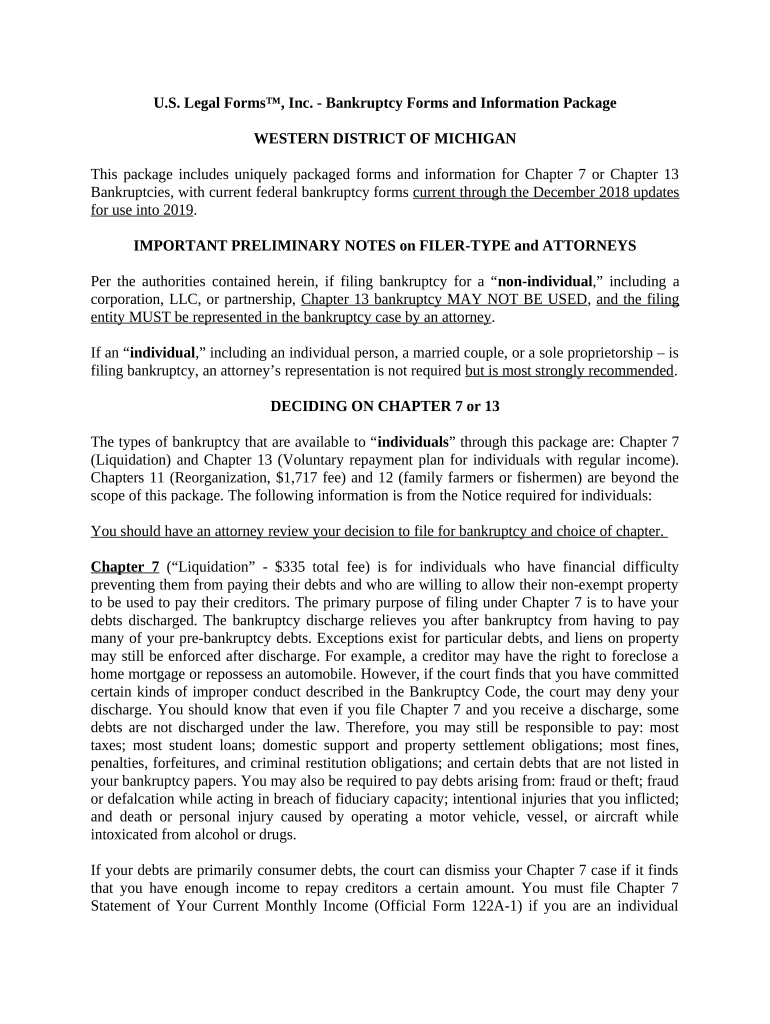
The Michigan Bankruptcy Form refers to the set of federal bankruptcy documents completed by debtors who file in the U.S. Bankruptcy Court for districts in Michigan. Documents include the voluntary petition, schedules of assets and liabilities, statement of financial affairs, and means test paperwork required for Chapter 7 or Chapter 13 cases; filings are submitted through the court’s electronic filing system and follow Federal Rules of Bankruptcy Procedure along with local district rules.

Why Accurate Completion Matters

Completing Michigan bankruptcy forms accurately preserves legal protections, ensures timely trustee review, and reduces the risk of dismissal, sanctions, or allegations of fraud. Accurate forms also speed trustee evaluations and creditor notifications while supporting claims for discharge or plan confirmation.

Why Accurate Completion Matters

Who Typically Prepares and Signs These Forms

The forms are prepared by individual debtors, attorneys, bankruptcy trustees, and court clerks for cases filed in Michigan federal bankruptcy courts.

  • Individual debtors who must disclose all assets and liabilities before filing.
  • Bankruptcy attorneys who draft petitions, review means tests, and represent debtors at hearings.
  • Trustees and court clerks who review filings, administer estates, and schedule the 341 meeting.

Core Parts of a Complete Michigan Bankruptcy Filing

A professionally prepared filing includes the petition, complete schedules, financial statements, and required certificates. Each component supports trustee review, creditor notification, and the court’s ability to issue a discharge or confirm a repayment plan.

Voluntary Petition

Initial filing that opens the case and identifies debtor(s), case type, and relief sought; includes signature under penalty of perjury and jurisdiction details.
Schedules A/B

Detailed inventory of real property, personal property, and assets with values and locations; accurate valuations inform exemptions and potential sales.

Schedules D/E/F

Lists secured creditors (D), priority claims (E), and unsecured creditors (F) with addresses and claim amounts to ensure proper notice and claim prioritization.

Statement of Financial Affairs

Narrative disclosures about recent income, transfers, lawsuits, and standard of living items; critical for trustee inquiries and means test scrutiny.

Means Test

Calculates disposable income for Chapter 7 eligibility or Chapter 13 plan feasibility; includes monthly income, allowable deductions, and local median comparisons.

Plan / Confirmation Docs

For Chapter 13, the proposed repayment plan, payment schedule, and related notices demonstrating ability to fund payments and satisfy secured/priority claims.

Step-by-Step: Completing and Submitting the Michigan Bankruptcy Form

Follow these steps to prepare a complete filing and reduce the likelihood of trustee review or court objections.

  • 01
    Gather documents: Collect pay stubs, tax returns, deeds, and most recent bank statements.
  • 02
    Complete schedules: Fill petition and schedules A–F with accurate asset and creditor details.
  • 03
    Run means test: Calculate disposable income for Chapter selection and plan feasibility.
  • 04
    File electronically: Submit via CM/ECF and provide copies to trustee and listed creditors.

Configuring an Electronic Filing Workflow

Set up a clear digital workflow to collect signatures, attach schedules, and route documents to the court and trustee automatically.

Field Configuration
Document upload PDF | Use court-ready PDF/A where possible
Auto-fill Templates | Pre-populate debtor name and case number
Authentication Email+SMS | Verify signer identity via code
Routing order Trustee > Attorney > Debtor | Sequential signing and review

Where to File and Which Parties Receive Copies

Bankruptcy documents are filed with the federal court and served to the trustee and creditor list; routing must follow local court submission rules.

  • U.S. Bankruptcy Court: File via CM/ECF in the correct Michigan district and pay filing fee.
  • Bankruptcy Trustee: Send complete schedules and statement of financial affairs for trustee review.
  • Creditors: Serve named creditors listed on schedules for claim filing notification.
  • U.S. Trustee: Notified through court filing; may request additional information or hearings.

Key Deadlines and Timing to Track

Monitor statutory and procedural deadlines to avoid dismissals, missed discharges, or plan confirmation delays.

Mandatory Credit Counseling:

Complete within 180 days before filing, per federal bankruptcy requirements.

341 Meeting of Creditors:

Typically scheduled about 20–40 days after the petition filing.

Chapter 7 Discharge Timing:

Often issued 60–180 days after filing, depending on objections or litigation.

Chapter 13 Plan Duration:

Repayment plans generally run 36–60 months before discharge.

Means Test at Filing:

Submit current monthly income and supporting documents with the petition.

Milestone Timeline for a Typical Bankruptcy Case

This sequential view highlights the principal milestones from preparation through case resolution.

01

Prepare Filing Package

Assemble schedules, counseling certificate, and income documentation prior to filing.

02

File Petition

Submit petition and pay the filing fee to open the federal case.

03

341 Meeting

Appear at trustee’s meeting to answer questions about schedules and transfers.

04

Resolution / Discharge

Trustee issues recommendations; court grants discharge or confirms plan.

Essential Data Elements to Include

Debtor Name: Full legal name
Social Security: SSN or last four
Residency Address: Street, city, state, ZIP
Income Details: Recent pay stubs or tax returns
Assets: Property and account values
Debt List: Creditor names and balances

Consequences of Inaccurate or Incomplete Filings

Perjury Risk: Criminal exposure for false statements
Case Dismissal: Court may dismiss for material omissions
Loss of Discharge: Fraud can bar discharge of debts
Sanctions: Attorney or filer may face sanctions
Creditor Challenges: Increased objections and adversary actions
Delay Costs: Extra attorney fees and trustee time

Common Mistakes to Avoid When Preparing Forms

  • Omitting assets or recent transfers — trustees often investigate undisclosed transfers and may file adversary proceedings.
  • Using inconsistent names or SSNs — mismatches delay trustee verification and can require amended filings.
  • Failing to attach required certificates — credit counseling and payment documentation must accompany the petition in many districts.
  • Relying on handwritten scans without legibility — poor scans increase trustee questions and slow review.

Comparing eSignature Vendor Pricing and Capabilities

Common eSignature plan criteria are shown below to help evaluate vendor costs and compliance features relevant to legal filings and secure document workflows.

signNow DocuSign Adobe Sign PandaDoc HelloSign
Starting Price $8/user/mo $15/user/mo $14/user/mo $19/user/mo $15/user/mo
Free Trial 7-day free trial No No Yes, limited Yes, limited
Bulk Send Yes Yes Yes Yes No
Audit Trail Yes Yes Yes Yes Yes
HIPAA Compliant Yes Yes Yes No No
Envelope Cap No cap 100 envelopes/user/year Varies Varies Varies

Practical Use Cases from Legal and Healthcare Organizations

Organizations in legal and healthcare sectors use electronic signing and compliant workflows to collect debtor signatures, manage disclosure documents, and maintain audit trails for court review.

BIS (Dan Rotelli)

A mid-sized legal services firm needed SOC 2-level compliance and reliable ESIGN/UETA adherence for court filings.

  • Adopted secure e-sign workflows to centralize signatures and maintain audit trails.
  • We felt most comfortable with airSlate SignNow given their SOC 2 certification and strict focus on ESIGN and UETA act compliance.

Fertility Centers (John Butler)

A healthcare provider required HIPAA-aware signature collection for sensitive releases.

  • Implemented secure online signing with record retention and access controls.
  • The airSlate SignNow team has been exceptional, responsive, the API has been great, and we're extremely happy that we chose airSlate SignNow as a company.

Technical Requirements and Supported Formats for eFiling

Ensure your eSignature and filing tools support court-acceptable formats, secure authentication, and archiveable audit trails before submission.

  • File formats: PDF, DOCX
  • Integrations: Salesforce, NetSuite, Box
  • Authentication: Email + SMS code

Frequently Asked Questions About the Michigan Bankruptcy Form

Answers to common questions about signatures, e-filing, timing, and supporting documents for Michigan bankruptcy filings.


Need help? Contact support

be ready to get more
Join over 28 million airSlate SignNow users