Establishing secure connection…Loading editor…Preparing document…

Minnesota Motion

This template is fully customizable. Edit the text, fill out the fields, and send it for signature. Give it a try!
Minnesota Motion

What the Minnesota Motion Is

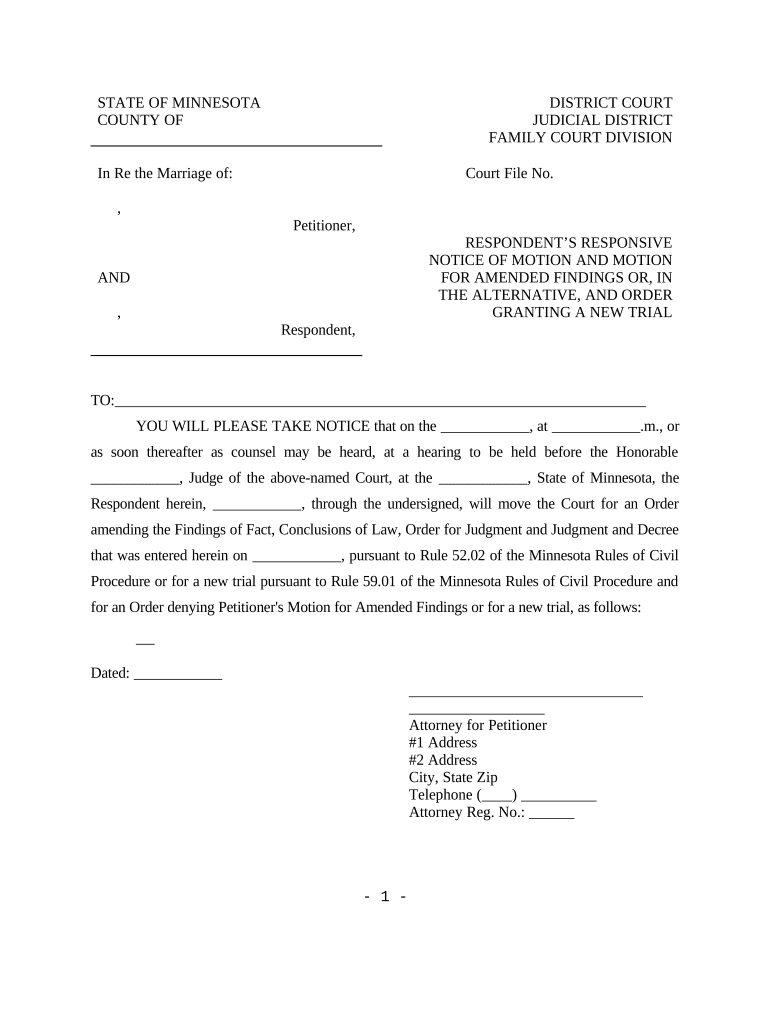
The Minnesota Motion is a formal written request filed in Minnesota state trial courts asking the judge to take specific action—examples include motions to dismiss, motions for summary judgment, motions to continue, or requests for temporary relief. A complete motion contains a case caption, a concise statement of facts, a legal argument citing controlling statutes and case law, a list of exhibits or affidavits when needed, and a proposed order. Motions must follow the Minnesota Rules of Civil Procedure and applicable local rules for formatting, service, and timing to avoid clerical rejection or judicial delay.

Why a Clear Minnesota Motion Matters

A properly drafted Minnesota Motion focuses issues for the court, preserves claims or defenses, and requests specific relief in a way that allows prompt judicial review and predictable case management.

Why a Clear Minnesota Motion Matters

Who Prepares and Uses a Minnesota Motion

The Minnesota Motion is used across litigation types by attorneys and self-represented parties to seek rulings or procedural relief.

  • Plaintiffs and defendants in civil litigation seeking dispositive or interim orders from state trial courts.
  • Attorneys drafting motions that must comply with Minnesota Rules and local court administrative orders.
  • Self-represented litigants who must follow caption, service, and signature rules when requesting judicial action.

Step-by-Step: Preparing and Filing a Minnesota Motion

Use the sequence below to draft, verify, serve, and file a Minnesota Motion in compliance with court procedures.

  • 01
    Draft: Prepare motion, exhibits, and proposed order.
  • 02
    Review: Check citations, formatting, and caption accuracy.
  • 03
    Serve: Serve papers per Minnesota Rules of Civil Procedure.
  • 04
    File: Submit to clerk and obtain stamped conformed copies.

Setting Up an Online Workflow for Minnesota Motions

Configure document, routing, and retention settings to support reproducible filings and auditable service.

Field Configuration
File Format PDF/A preferred; include exhibits in a single bookmarked file
Signer Authentication Email link with optional SMS code or stronger methods
Routing Order Sequential signing by counsel and pro se parties as required
Retention Encrypted storage with access logs and exportable audit trail

How an eSigned Minnesota Motion Moves Through the System

A typical eSubmission workflow includes document preparation, signer authentication, service to opponents, filing, and judicial review.

  • Upload Document: Convert to PDF and attach exhibits.
  • Place Fields: Add signature, date, and initial fields when e‑signing.
  • Serve Opposing Party: Use permitted service methods and record delivery.
  • Court Review: Judge reviews motion and may schedule a hearing.

Technical Requirements for eSigning and eSubmission

eSubmission and eSignature require secure file formats, appropriate authentication, and retention capabilities to meet court and federal standards.

  • Formats: PDF, PDF/A preferred
  • Authentication: Email, SMS, or higher-strength options
  • Integrations: Court e-filing and cloud storage

Common Deadlines and Timing Considerations

Timing for filing, response, and hearings depends on the motion type and local rule; observe court-set schedules closely.

Standard Service Deadline:

Serve papers per Minnesota Rules and local court deadlines.

Motion Response Time:

Opposing party has time set by local rule or court order.

Hearing Scheduling:

Court may set hearing dates; allow several weeks for scheduling.

Proposed Order Submission:

Attach proposed order when submitting the motion to aid the clerk.

Emergency Motions:

File ex parte motions with supporting affidavit and notice when appropriate.

Milestone Sequence from Filing to Judicial Decision

Use this milestone view to track key stages of a Minnesota Motion from preparation through the court's ruling.

01

Draft and Review

Prepare motion, exhibits, and proposed order; check citations and formatting.

02

Service and Filing

Serve opponents and file with clerk; obtain conformed copy for the record.

03

Hearings and Briefing

Complete briefing and appear at scheduled hearing if the court requires oral argument.

04

Decision and Order

Judge issues ruling or order; file any timely post‑decision motions if necessary.

Practical Tips for Accurate and Efficient Motions

Adopt these practical steps to improve clarity, reduce procedural risk, and help the court resolve issues efficiently.

Follow Local Rules Precisely
Consult the district court's local rules for formatting, page limits, and filing procedures. Noncompliance often leads to rejection or order to refile; include required certificates of service and proposed orders to avoid clerical delays.
Use Clear Headings and Citations
Organize arguments with numbered headings, short paragraphs, and pinpoint citations to statutes and cases. Judges review motions quickly; concise legal points with supporting record citations improve judicial uptake and reduce confusion.
Include Factual Support and Exhibits
Attach sworn affidavits or documentary exhibits referenced in the motion. Number exhibits and cite them in the text so the judge and opposing counsel can verify the factual assertions efficiently.
Check Signature and Service Blocks
Ensure the signature block contains bar number or pro se contact details, date, and address. Include a correct certificate of service showing method and date of service on all parties to meet procedural requirements.

Common Mistakes to Avoid When Preparing a Minnesota Motion

  • Failing to include a proposed order or certificate of service often causes clerks to return filings or delays in docketing.
  • Incomplete captions, wrong case numbers, or mismatched party names lead to misfiling and can render the motion ineffective.
  • Overlong, unfocused arguments without proper citations reduce persuasive force and increase the chance of summary denial.
  • Neglecting local page limits, required fonts, or signature requirements frequently results in rejections or orders to refile.

Potential Consequences of an Incorrect Motion

Denial of Relief: Court may deny motion for noncompliance
Delay in Proceedings: Clerical defects can postpone hearings
Sanctions: Rule 11 or court sanctions for frivolous filings
Waiver of Issues: Failure to preserve arguments may forfeit claims
Increased Costs: Opposing party may recover fees or costs
Perjury Risk: False affidavits risk criminal or contempt proceedings

Security and Compliance Considerations

Encryption: TLS 1.2/1.3 in transit; AES-256 at rest
Audit Trail: Timestamped events, IP address logging
Authentication: Email, SMS codes, or advanced methods
HIPAA Support: BAA required for protected health information
Retention Controls: Configurable retention and legal holds
Certifications: SOC 2 Type II and ISO 27001 available

Comparison: eSignature Pricing and Key Features

Basic vendor pricing and feature availability for eSignature platforms; signNow is listed first per table conventions.

signNow DocuSign Adobe Sign PandaDoc HelloSign
Starting Price $8/user/mo $15/user/mo $14/user/mo $19/user/mo $15/user/mo
Free Trial 7-day free trial Unknown Unknown Unknown Unknown
Bulk Send Yes Yes Yes Yes No
Audit Trail Yes Yes Yes Yes Yes
HIPAA Compliant Yes Yes Yes Unknown Unknown
Envelope Cap No cap 100 envelopes/user/year Unknown Unknown Unknown

Frequently Asked Questions About Minnesota Motions

Answers to common procedural, eSignature, and notarization questions when preparing a Minnesota Motion.


Need help? Contact support

be ready to get more
Join over 28 million airSlate SignNow users