Establishing secure connection…Loading editor…Preparing document…

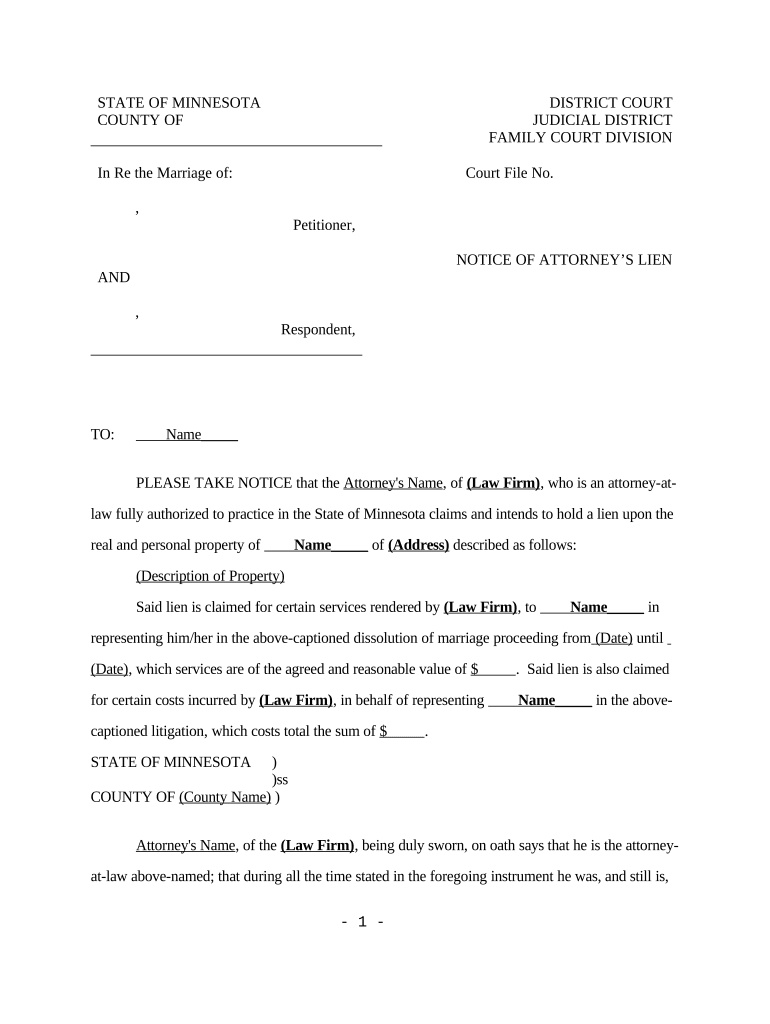
Minnesota Notice of Lien

This template is fully customizable. Edit the text, fill out the fields, and send it for signature. Give it a try!
Minnesota Notice of Lien

What a Minnesota Notice of Lien Is and when it applies

The Minnesota Notice of Lien is a formal, written statement used to assert a claim against real property or improvements when a party has supplied labor, materials, or services but has not been paid. In Minnesota this typically takes the form of a construction or mechanics' lien under state statute; it informs property owners and potential buyers of the claimant’s interest and preserves the right to enforce payment through foreclosure of the lien. Preparing and filing a correctly completed Notice of Lien starts the statutory timeline and creates a public record of the claim.

Why filing a Notice of Lien matters for payment protection

A Minnesota Notice of Lien protects a supplier’s or contractor’s payment rights by placing a public claim on the property, alerts lenders and buyers, and preserves the right to enforce collection. Proper preparation reduces the risk of forfeiting lien rights under state law.

Why filing a Notice of Lien matters for payment protection

Who typically prepares or receives a Notice of Lien

Primary users include subcontractors, suppliers, general contractors, property owners, and legal counsel who manage payment claims and property encumbrances.

  • Subcontractors asserting unpaid labor or services on a construction project within Minnesota.
  • Material suppliers claiming unpaid invoices for goods delivered to a jobsite or project.
  • Property owners and lenders reviewing encumbrances before sale, refinance, or closing actions.

Stepwise checklist to prepare and file a Notice of Lien

Follow these steps to complete and file a Minnesota Notice of Lien correctly, from preparation through recording or service.

  • 01
    Prepare: Gather contracts, invoices, delivery tickets.
  • 02
    Describe: Enter property legal description and parcel ID.
  • 03
    Calculate: Total unpaid amounts and applicable interest.
  • 04
    File: Record with county recorder or serve owner per statute.

Typical routing: from claim creation to recording and notice

This overview shows common routing for Notices of Lien: preparing the claim, submitting to the recorder, notifying the owner, and preserving enforcement rights.

  • Prepare: Compile evidence and invoices supporting claim.
  • Record: File the notice with the county recorder's office.
  • Notify: Serve the property owner and construction parties as required.
  • Enforce: Preserve lien rights; consult counsel before foreclosure.

How to configure an online Notice of Lien workflow

Configure an online Notice of Lien workflow to automate field population, signer roles, notifications, and county-specific recording steps.

Field Configuration
Signer Order Claimant signs first, then owner or representative.
Required Attachments Invoices, contracts, delivery receipts, and purchase orders attached.
Authentication Email link or SMS code; stronger ID for high-value claims.
Recording Method Electronic recording where available; otherwise submit paper originals.

Technical considerations for eSigning and eFiling lien notices

Ensure the e-signature platform supports state-compliant audit trails, PDF exports, RON where necessary, and secure storage for recorded liens.

  • File Formats: PDF/A and DOCX supported.
  • Integrations: Connects to title and county systems via API.
  • Security: TLS and AES-256 encryption at rest and transit.

Primary risks and consequences of incorrect filing

Loss of Lien: Forfeiture of lien rights if untimely.
Invalid Notice: Incorrect description may be rejected.
Penalties: Possible court costs and attorney fees.
Tax Consequences: Liens do not remove tax obligations.
Liability Risk: False claims may trigger legal sanctions.
Recording Costs: Filing fees and recording charges apply.

Common mistakes to avoid when preparing a Notice of Lien

  • Omitting the precise legal property description leads to improper recording and potential challenge to the lien’s scope; always use parcel ID or recorded legal description.
  • Failing to attach invoices or delivery receipts undermines the evidentiary basis of the claim and can result in dismissal at enforcement stage.
  • Using an incorrect claimant name or corporate entity will hinder service and may prevent title companies from recognizing the lien during closings.
  • Missing statutory deadlines or service requirements—such as posting or mailing notices—can terminate lien rights; verify county rules and state statute.

Essential elements every professional Minnesota Notice of Lien should include

A professional Minnesota Notice of Lien includes precise property identification, claimant details, itemized amounts, basis of claim, signature, and proper recording instructions.

Property ID

Include street address, legal description, parcel number, and county. Inaccurate descriptions can result in rejection or an improperly indexed record that fails to encumber correct title.
Claimant Info

Provide full legal name, business registration, contact details, and remittance instructions. Clear claimant identity prevents service issues and facilitates verification by recorders and title insurers.

Amount

List principal, retainages, interest, and any agreed recoverable costs; itemize by date and invoice to aid verification and reduce disputes during enforcement proceedings.

Basis

Describe the contracts, change orders, dates of performance, material deliveries, and purchase orders that substantiate the monetary claim on the project.

Attachments

Attach supporting documents such as invoices, lien waivers, delivery receipts, and contracts; index exhibits and reference them in the notice for clarity.

Recording

Specify county recorder details, filing format, and required notary or RON acknowledgment; follow county clerk instructions to ensure the lien is properly recorded.

Practical tips to improve accuracy and speed recording

Practical tips reduce errors and speed recording; follow these best practices when preparing a Minnesota Notice of Lien.

Verify full legal property description and parcel ID
Confirm the municipal parcel number, recorded legal description, and street address with the county assessor or recorder before filing; using a mistaken description is a leading cause of rejection and can invalidate the lien against intended property.
Attach clear supporting documentation and itemized invoices
Include time-stamped delivery receipts, signed change orders, and itemized invoices linked to contract line items. Organize exhibits, label pages, and reference attachment identifiers in the body of the notice to streamline title examiner review.
Confirm signer authority and notarization
Ensure the person who signs has corporate authority or power of attorney; if notarization is required, complete an in-person notary or RON session that meets county acceptance rules. Keep notary journal entries for audit.
Check statutory deadlines and service rules
Review Minnesota statutes and county recorder instructions for exact filing windows and owner service methods. Missing notice, filing, or service deadlines commonly void liens; document delivery attempts and maintain certified mailing receipts for proof.

Examples of practical use and outcomes

Real-world examples show how accurate Notices of Lien preserve payment rights and accelerate resolution when combined with secure e-signing and efficient recording workflows.

Martin Properties — Tim Martin

Martin Properties used online lien forms and digital signatures to document contractor claims after project completion when invoices went unpaid.

  • Saved time and established public record quickly.
  • By attaching precise property descriptions and invoices, and recording with the county promptly, the firm preserved its lien priority and reduced litigation exposure; the signed, time-stamped PDF and audit trail supported enforcement actions when required.

Optica Ventures — Brian Fitzgibbons

Optica Ventures integrated electronic lien workflows to manage supplier claims across multiple job sites and centralize supporting documents for each project.

  • Centralized records simplified title searches and audits.
  • Standardized notices with attached invoices and notarized signatures reduced back-and-forth with owners and helped the company negotiate settlements without costly litigation; retained copies satisfied title company inquiries during closing.

eSignature vendor comparison for filing and signing lien notices

Compare common vendor criteria relevant to signing and filing Minnesota Notices of Lien; signNow is listed first for parity with other solutions.

signNow DocuSign Adobe Sign PandaDoc HelloSign
Starting Price $8/user/mo $15/user/mo $14/user/mo $19/user/mo $15/user/mo
Free Trial 7-day free trial Varies by vendor Varies by vendor Varies by vendor Varies by vendor
Bulk Send Yes Yes Yes Yes No
Audit Trail Yes Yes Yes Yes Yes
HIPAA Compliant Yes Yes Yes No No
Envelope Cap No cap 100 envelopes/user/year Varies Varies Varies

Frequently asked questions and troubleshooting for Notices of Lien

Answers to common questions about preparing, filing, and enforcing a Minnesota Notice of Lien, and how to avoid procedural mistakes.


Need help? Contact support

be ready to get more
Join over 28 million airSlate SignNow users