Establishing secure connection…Loading editor…Preparing document…

Montana Easement

This template is fully customizable. Edit the text, fill out the fields, and send it for signature. Give it a try!
Montana Easement

What a Montana Easement Is and when it’s used

A Montana Easement is a formal legal instrument that grants one party the right to use or access a portion of another party’s real property for a specified purpose. Typical easements include right-of-way, utility corridors, ingress/egress, and conservation or access easements. In Montana, like other U.S. jurisdictions, easements are documented with a precise legal description of the servient and dominant tenements, clear statement of rights granted, duration or termination conditions, and are usually recorded at the county recorder to provide notice to third parties and affect title.

Why a properly drafted Montana Easement matters

A clear easement reduces boundary disputes, preserves property values, and protects both grantor and grantee rights. Proper drafting and recording create public notice, enable title insurance, and support enforceability in court or arbitration.

Why a properly drafted Montana Easement matters

Who typically prepares or signs a Montana Easement

Multiple parties commonly engage with easements: property owners, utility companies, developers, and title professionals are the primary users when creating or accepting an easement.

  • Private landowners and homeowners seeking access or protections for adjacent parcels.
  • Utilities and telecom companies creating permanent or temporary corridors for infrastructure.
  • Title companies, surveyors, and real estate attorneys reviewing and recording easement documents.

Delegating drafting or review to a licensed attorney or title professional reduces risk and helps ensure the easement matches the parties’ intent and recording requirements.

Essential components of a professional Montana Easement

A complete easement contains discrete sections that define the parties, property, scope, duration, obligations, and recording instructions; each element supports enforceability and clarity for future owners.

Parties

Full legal names and entity types for grantor(s) and grantee(s), including signer capacity and contact information for notices.
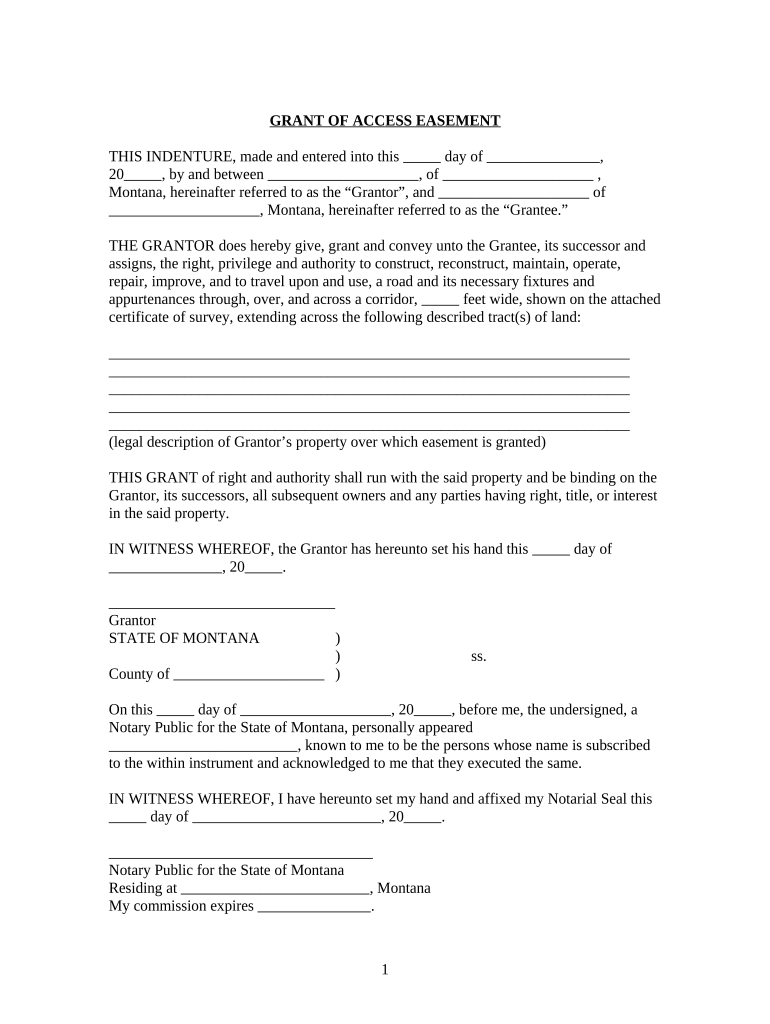
Legal Description

Precise metes-and-bounds or lot/parcel reference describing servient and dominant tenements for county recording and title clarity.

Grant Language

Specific rights granted (access, utilities, maintenance), limitations, exclusive/non-exclusive status, and permitted uses.

Duration

Term defined as perpetual, for a number of years, or conditioned on stated events with clear termination mechanics.

Consideration & Obligations

Monetary amount or other consideration (if any), maintenance responsibilities, indemnities, and allocation of taxes or assessments.

Recording Instructions

County recorder details, return-to address, and any required reference to book/page or document numbers for chain-of-title integration.

Required information to include on the easement form

Grantor Name: Full legal name
Grantee Name: Full legal name
Property ID: Parcel / legal description
Easement Purpose: Use specified
Effective Date: MM/DD/YYYY
Recording County: County, state

Step-by-step: preparing and executing a Montana Easement

Follow a structured sequence: draft with legal description, have parties review, obtain notarization and signatures, then record at the county level.

  • 01
    Draft: Assemble parties, legal description, and grant language.
  • 02
    Review: Have title company or attorney confirm accuracy.
  • 03
    Sign and Notarize: Obtain all required signatures and notary acknowledgment.
  • 04
    Record: File with county recorder; obtain stamped copy for records.

Where to send, file, and who receives recorded copies

Recording and distribution follow a predictable flow: after signing and notarization, record with the county recorder; then distribute copies to stakeholders and title professionals.

  • County Recorder: Primary filing location for public notice and title effects.
  • Title Company: Send stamped recorded copy for chain-of-title updates.
  • Grantee/Grantor: Provide signed and recorded copies to both parties.
  • Lienholders / Mortgagee: Notify if required by loan covenants or priorities.

Electronic signing and platform considerations

Electronic execution and e-submission streamline easement workflows but must meet legal and recording requirements in the relevant jurisdiction.

  • Supported Formats: PDF, DOCX are accepted by most platforms.
  • Integrations: Salesforce, NetSuite, Google Workspace, Box integration available.
  • Authentication: Email link, SMS code, or advanced ID verification.

Risks and adverse outcomes from an incorrect easement

Unenforceable Interest: Grant may be void
Boundary Disputes: Increased litigation risk
Recording Rejection: Clerical defects delay notice
Title Insurance Issues: Insurer may exclude coverage
Tax Consequences: Unexpected property tax changes
Litigation Costs: Attorney fees and damages

Common mistakes when preparing a Montana Easement

  • Using a vague legal description or incorrect parcel ID that leads to an ambiguous servient/dominant tenement boundary and recording rejection.
  • Failing to specify maintenance or access obligations, which can produce future disputes about responsibilities and costs.
  • Not obtaining proper notarization or witness acknowledgements where required by the recorder, resulting in non-acceptance or title gaps.
  • Skipping title company review or failing to request endorsement, leaving the grantee exposed to prior unresolved encumbrances.

Timing and deadlines to keep in mind

Timely execution and recording preserve priority and notice; follow local recording office timelines and lender or contract deadlines.

Recording Promptly:

Record as soon as feasible to establish priority and notice

Notary Retention:

Notary journals or RON recordings retained per state rules

Title Endorsement:

Request endorsement before closing to avoid coverage gaps

Tax Reporting:

Report consideration changes if required by tax counsel

Contract Deadlines:

Meet any easement-related contractual closing dates

Notarization, witnessing, and RON procedural checklist

Follow these procedural steps when obtaining notarization or remote online notarization to ensure recorder acceptance and evidentiary integrity.

01

Identify Parties

Confirm legal names and authority to sign before the session.

02

Prepare Document

Include clear signature blocks and notary acknowledgement language.

03

Consent to Electronic Records

Obtain express signer consent where ESIGN consumer disclosure is required.

04

Signer Authentication

Use email, SMS, KBA, or credential analysis per recorder standards.

05

Notary Acknowledgement

Notary signs and dates; include notary seal and county.

06

RON Recording

If used, retain audio/video per state rules and recorder acceptance.

07

Submit to Recorder

File original or e-record per county instructions.

08

Distribute Copies

Provide certified recorded copy to parties and title insurer.

eSignature vendor pricing and feature snapshot for easement workflows

Compare common pricing and feature dimensions to evaluate digital signing platforms suitable for executing and storing easement documents at scale.

signNow DocuSign Adobe Sign PandaDoc HelloSign
Starting Price $8/user/mo $15/user/mo $14/user/mo $19/user/mo $15/user/mo
Free Trial 7-day trial Varies Varies Varies Varies
Bulk Send Yes Yes Yes Yes No
Audit Trail Yes Yes Yes Yes Yes
HIPAA Compliant Yes Yes Yes No No
Envelope Cap No cap 100 envelopes/user/yr Varies Varies Varies

Frequently asked questions about Montana Easements and e-signing

Answers to common concerns about validity, recording, corrections, notarization, revocation, and electronic submission for Montana easements.


Need help? Contact support

be ready to get more
Join over 28 million airSlate SignNow users