Establishing secure connection… Loading editor… Preparing document…
Navigation

Fill and Sign the Motion Summary Judgment Defendant Form

Fill and Sign the Motion Summary Judgment Defendant Form

How it works

Open the document and fill out all its fields.
Apply your legally-binding eSignature.
Save and invite other recipients to sign it.

Rate template

4.4
40 votes
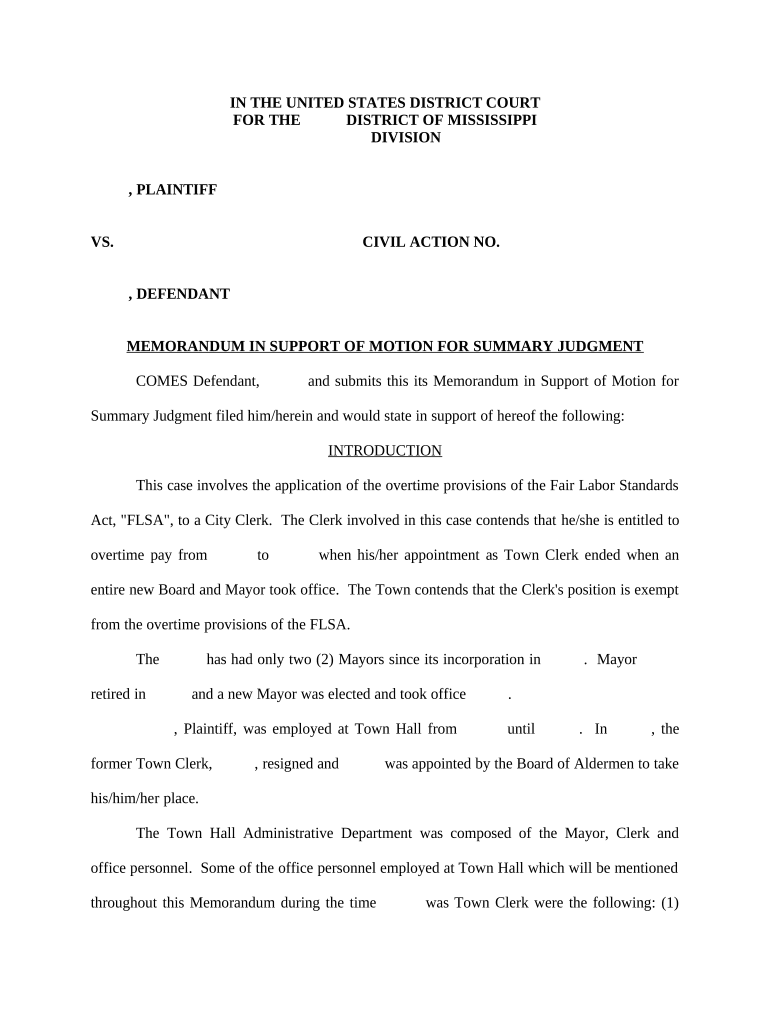
IN THE UNITED STATES DISTRICT COURT FOR THE       DISTRICT OF MISSISSIPPI       DIVISION       , PLAINTIFF VS. CIVIL ACTION NO.             , DEFENDANT MEMORANDUM IN SUPPORT OF MOTION FOR SUMMARY JUDGMENT COMES Defendant,       and submits this its Memorandum in Support of Motion for Summary Judgment filed him/herein and would state in support of hereof the following: INTRODUCTION This case involves the application of the overtime provisions of the Fair Labor Standards Act, "FLSA", to a City Clerk. The Clerk involved in this case contends that he/she is entitled to overtime pay from       to       when his/her appointment as Town Clerk ended when an entire new Board and Mayor took office. The Town contends that the Clerk's position is exempt from the overtime provisions of the FLSA. The       has had only two (2) Mayors since its incorporation in       . Mayor       retired in       and a new Mayor was elected and took office       .       , Plaintiff, was employed at Town Hall from       until       . In       , the former Town Clerk,       , resigned and       was appointed by the Board of Aldermen to take his/him/her place. The Town Hall Administrative Department was composed of the Mayor, Clerk and office personnel. Some of the office personnel employed at Town Hall which will be mentioned throughout this Memorandum during the time       was Town Clerk were the following: (1)       Receptionist and Water Bill Clerk (       to       ), (2)       , In-house Bookkeeper and Accountant Clerk (       to       ), (3)       , Computer Operator, (       to       ), (4)       , Secretary to       (       to       ), and (5)       , Permit Clerk (       to       ). Other employees employed at various times during the time       was Town Clerk were       , water bill clerk,       to       ,       , receptionist and water bill clerk,       to       ,       , daughter of       and part-time employee,       , daughter of       and part-time employee,       ,       to       and       , water clerk,       to       . Some of the cites herein are subject to a separately bound record of portions of depositions, documents and other material submitted in support of Plaintiff's Motion. Each page is "bates numbered" and cites are subject to the relevant bates number. The relevant portions of the record cited are highlighted in yellow. FACTS       was appointed as Town Clerk of       by Mayor       and the Board of Aldermen on or about       . Minutes of       . He/She served in that position until the new Mayor and Board of Aldermen were elected in       and took office on       .       alleges in his/her Complaint that he/she is entitled to overtime compensation from the date of his/her appointment until him/her appointment ended. He/She claims       hours "at work" overtime and       hours "at home" overtime. (S)he maintained no records for the "at home" overtime and the records maintained "at work" were incomplete. On       , the outgoing Mayor and Board of Aldermen met in its final meeting. At that meeting       requested that the outgoing Mayor and Board pay his/her overtime and an Order was entered providing that       ,       and       be paid for overtime. See Complaint, page 4. There is no mention in the record of the amount of overtime to be paid and the tape recording of the meeting has been destroyed by       . See       Deposition, page       , Lns.       . Subsequent to the       meeting Mayor       and the Board were advised by their attorney and accountant that overtime pay to       and       would be improper because these employees were exempt from FLSA and therefore payment of overtime would be an unlawful gift. See letter from       ; Letter from       ,       , who was secretary to       , received his/her overtime pay. Based upon the advice given, Mayor       refused to sign a check that was presented to him/her by       in the amount of $       and no payment was made to       . On             instituted suit against       in this Court alleging that he/she was entitled to the following relief: (A) Judgment for       hours of overtime at $       per hour for a total of $       . (B) Liquidated damages of $       . (C) Overtime pay for hours worked at home.       (D) Judgment for       hours of regular time at $       per hour for $       . (E) Attorney's fees, costs and pre-judgment interest. The Town of       contends that       is exempt from the FLSA as an executive or administrative employee and that the position of Town Clerk is a position established by statute as an elective office which became appointive by in accordance with state law action of the Mayor and Board. The Defendant also contends that Plaintiff's action is partially barred by the applicable statute of limitations.       supports its contention that       is exempt from the FLSA by the following facts: 1.       was paid on a salary basis. 2.       's duties as Town Clerk primarily consisted of managing the administrative department of the Town. 3.       customarily and regularly directed the work of two or more employees under his/her department. 4.       hired employees and made recommendations concerning hiring, advancement and salaries of other employees. 5.       received compensation on a salary basis at not less than $       per week. 6.       received the same amount of pay each pay period without reduction because of variations in the quality or quantity of his/her work. 7.       received his/her full salary each week regardless of the days or hours worked. 8.       trained other employees and planned and directed the work of employees. 9.       maintained the personnel and employee time records. 10.       handled complaints from employees. 11. Other facts stated below. ARGUMENT The relevant portion of the Fair Labor Standards Act which applies to this case provides: The provisions of...Section 207 of this title shall not apply with respect to -(1) any employee employed in a bona fide executive, administrative, or professional capacity... 29 U.S.C.A. Section 213(A)(1). The Courts apply this exemption narrowly, and the burden of proof to demonstrate that the exemption applies is on the Defendant. Hodgson v. Colonnades, Inc. , 472 F.2d 42, 47 (5th Cir. 1973); Wallen v. General Industries Co. , 330 US 545, 547-48, 67 S.Ct. 883, 884, 91 L.Ed. 108 (1947).       contends that       is exempt under the executive and administrative exemption. A. EXECUTIVE EXEMPTION The relevant section of the Code of Federal Regulations provides in regard to the executive exemption that: The term "employee employed in a bona fide executive       capacity" in section 13(a)(1) of the Act shall mean any employee: (a) Whose primary duty consists of the management of the enterprise in which he is employed or of a customarily recognized department of subdivision thereof; and (b) Who customarily and regularly directs the work of two or more other employees therein; and (c) Who has the authority to hire or fire other employees or whose suggestions and recommendations as to the hiring or firing and as to the advancement and promotion or any other change of status of other employees will be given particular weight; and (d) Who customarily and regularly exercises discretionary powers; and (e) Who does not devote more than 20 percent... of his hours of work in the workweek to activities which are not directly and closely related to the performance of the work described in paragraphs (a) through (d) of this section...; and (f) Who is compensated for his service on a salary basis at a rate of not less than $       per week...: Provided, That an employee who is compensated on a salary basis at a rate of not less than $       per week... and whose primary duty consists of the management of the enterprise in which the employee is employed or of a customarily recognized department or subdivision thereof, and includes the customary and regular direction of the work of two or more other employees therein, shall be deemed to meet all the requirements of this section. 29 C.F.R. § 541.1 (1986) The above regulations establish a long and short test for establishing the executive exemption. The short test has four requirements that must be met before an employee is deemed an "executive." These requirements are that (1) The employee must be paid "on a salary basis"; (2) The employee's primary duty consists of the management of the enterprise in which he/she is employed or of a customarily recognized department thereof; (3) The employee customarily and regularly directs the work of two or more other employees therein; and (4) The employee is paid not less than $       per week. B. EXECUTIVE SHORT TEST FACTORS (i) SALARY BASIS Under both the Executive and administrative exemption the employee must be paid on a salary basis. The relevant code provision provides in this regard the following: An employee will be considered to be paid "on a salary basis" within the meaning of the regulations if under his employment agreement he regularly receives each pay period on a weekly, or less frequent bases, a predetermined amount constituting all or part of his compensation, which amount is not subject to reduction because of variations in the quality or quantity of the work performed. Subject to the exceptions provided below, the employee must receive his full salary for any week in which he performs any work without regard to the number of days or hours worked. This policy is also subject to the general rule that an employee need not be paid for any workweek in which he performs no work. 29 C.F.R. § 541.118(a) 1986. The salary must be $       per week or more for the short test to apply.       , was paid on a salary basis by his/her own admission.       Deposition, page       , Lns.       . R.       . See also       Deposition, page       , Ln.       . R..       received $       semi-monthly when she was appointed as Town Clerk on       and received a salary increase to $       semi-monthly on       , fourteen (14) days after his/her appointment.       Deposition, page       . Minutes of Board,       . R.. On       he/she received an "       % salary increase". Minutes of Board,       . R.. On       he/she was increased to $       monthly.       Deposition, page       . (ii) CUSTOMARILY RECOGNIZED DEPARTMENT OR SUBDIVISION THIM/HEREOF [T]he phrase "a customarily recognized department or subdivision" is intended to distinguish between a mere collection of men assigned from time to time to a specific job or series of jobs and a unit with permanent status and function... [The employee] must be in charge of and have as his primary duty the management of a recognized unit which has a continuing function. 29 C.F.R. § 541.104(a)       contends that       was in charge of the Administrative Department of Town Hall which includes employees who work in Town Hall. The regulations recognize that the customarily recognized department is generally an easy question and that the difficulty arises when the employee works outside their employer's establishment. 29 C.F.R. §541.104(b). It is undisputed that       worked in the Administrative Department of the Town. Thus, the question is where       was in charge of that department, not whether that department existed. (iii) MANAGEMENT OF DEPARTMENT Being "in charge" of a department is determined by the employee's management of that department. The following relevant activities are considered to be managerial duties: (1) The training of employees; (2) The planning and directing of the work of employees; (3) Maintaining records for use in supervision and control; (4) Appraising worker productivity and efficiency for the purpose of recommending promotions or other changes in worker status; and (5) The handling of complaints. 29 C.F.R. § 541.102(b) (1986) The code section provides in part that management consists of the following: Interviewing, selecting, and training of employees; setting and adjusting their rates of pay and hours of work; directing their work; maintaining their production or sales records for use in supervision or control; appraising their productivity and efficiency for the purpose of recommending promotions or other changes in their status; handling their complaints and grievances and disciplining them when necessary; planning the work; determining the techniques to be used; apportioning the work among the workers; determining the type of materials, supplies, machinery of tools to be used or merchandise to be bought, stocked and sold; controlling the flow and distribution of materials or merchandise and supplies; providing for the safety of the men and the property. 29 C.F.R. § 541.102.       was in charge of the employees at Town Hall who worked in the administrative department of the Town. His/Her primary duty consisted of managing these office personnel. These people consisted of a receptionist, secretary to       , accountant; permit clerk and other office personnel. All of these people reported to       . He/She trained employees, planned and directed their work, maintained employee records, and handled complaints.       testified that he/she performed the duties listed on a document entitled "Job Description, Town Clerk", which was produced by his/her at his/her deposition.       deposition, Exhibit "A" R. This Exhibit consists of many duties of the Clerk and provides, in part, that he/she prepared Tax Collector and Town Clerk related journal entries, reviewed account payable invoices, received and reviewed payroll time sheets, coordinated bond payments to banks, calculated building permits, attended to all financial matters, answered correspondence as needed, worked on special projects, maintained Town and office records, public relations, prepared budget, maintained Voter Registration Rolls, etc. Defendant refers the Court to the Exhibit for the complete list. R...       performed all these duties by his/her own admission.       deposition, page       , Lns.       . R.. It is important to note that       's salary was paid       percent (       %) from the water department account and       percent (       %) from the general fund. Affidavit of       . R. The reason for this was because the duties of the Clerk included management of some water department employees and he/she was in charge of water bills and payments. This is clearly illustrated in the chain of command for the water department enacted by the Board. Minutes of Board       . R. According to the testimony of       , Secretary to       , the following facts are true: 1.       was interviewed, selected and trained by       as his/her secretary.       Deposition, page       .R.. See also Minutes of       . R.. 2.       reported directly to       .       Deposition, page       , Lns.       .R.. 3.       prepared board minutes from tape recordings and notes and was instructed on how to do same by       .       would review the minutes prior to approval by the Board and make changes (s)he desired.       Deposition, page       . R. . 4. Prices of items to be purchased for the Town would be obtained by       and       would review them with       .       would instruct him/her where to buy the item and would sign a purchase order for the item.       Deposition, p       , Lns.       R. . 5.       was in charge of all purchasing for the Town, including the Police, fire and public works department. The purchase orders were approved by       .       Deposition, page       . R. . 6.       did not consult with the Mayor on all purchase orders but sometimes the police, public works and fire departments would go directly to the Mayor.       Deposition, page       , Lns.       . R.. 7.       was in charge of all books for the departments and personnel would come to him/her to determine how much money was in their budget.       Deposition, page       . R. . 9. Proof reports of water bills were generated by computer and reviewed and corrected at the direction of       .       Deposition, page       . R. . 10. Cut-off lists for delinquent water customers were reviewed by       and he/she determined who to cut-off.       Deposition, page       . R. . See also, Interdepartmental Memo from       to       R.. 11.       was the key punch operator who generated the water bills. He/She was under the supervision of       and was hired by       and the Mayor.       recommended       to the Board.       Deposition, page       . R. . 12.       was the building permit clerk and was under the supervision of       and reported to       .       Deposition, page       R.. 13.       , internal accountant for the Town, reported to       and       directed his/her work.       Deposition, page       , Lns.       R.. 14. Mr./Ms.       set up the budgets for each department of the Town.       Deposition, page       , Lns.       . R.. 15. The employee records and time sheets were kept by       in his/her office.       Deposition, page       , Lns.       R.. 16.       would allow employees who needed to take time off to work extra time (i.e. through lunch) to build up time to take off.       a Deposition, page       , Lns.       , page       , Lns.       . R.. 17.       approved time off for the employees at Town Hall.       Deposition, page       , Lines       . R.. 18.       , receptionist,       ,       and       would obtain approval for overtime work from       .       Deposition, page       , Lns.       . R.. 19. Employees with disputes would go to the Mayor or       or if to the Mayor he/she would send them to       for him/her to handle the dispute.       Deposition, page       , Lns.       . R..       made the decisions regarding disputes between employees.       Deposition, page 62. R.. 20. The Town's CPA and Engineers consulted with       and primarily dealt with       to solve problems.       Deposition, page       and       . R.. 21.       , receptionist and water bill clerk reported directly to       .       Deposition, page       , Lns.       . R.. 22.       and Mayor       would conduct office meetings.       a Deposition, page       , Lns.       .       , Mayor of the Town of       during the entire employment of       , testified regarding the following matters. 1.       was next in command to the Mayor.       Deposition, page       . 2.       's duties were to supervise work of other employees and designate what tasks other employees would perform.       Deposition, page       .       was the immediate supervisor of all employees of Town Hall.       Deposition, page       , Lns.       . 3. Mayor       never instructed       to keep up with his/her time or extra time that he/she worked and never told him/her that he/she would be paid for time over and above his/her salary.       Deposition, page       , Lns.       page       , Lns.       . R.. 4.       would interview prospective employees, introduce them to the Mayor and recommend to the Mayor what person he/she felt was best for the job.       deposition, page       , Lns.       , page       , Lns.       _. 5.       was responsible for building permits,       deposition, page       , Lns.       , financial records of the Town,       deposition, page       , Lns.       , claims docket,       deposition, page       , Lns.       , page       , Lns.       , maintaining tax rolls, conducting tax sales and investing the Town's money,       deposition, page       , Lns.       . See also Minutes of       authorizing       to invest money of the Town. R.. 6.       was in charge of water payments.       deposition, page       , Lns.       . 7.       , accountant, was under       's supervision. p       . 8.       had authority to sign purchase orders and did so without consulting the Mayor on every order.       deposition, page       , Lns.       , page       , Lns.       . 9.       was authorized to access the Town safe deposit box.       deposition, page       , Lns.       . 10.       was in charge of the Certificates of Deposit of the Town and would shop around for the best interest rates upon renewal and make the decision of where to place the Town's money.       deposition, page       , Lns.       . 11.       would make the decision on a day-to-day basis of how much money to put into the operating accounts of the Town and how much to leave in Certificates. p       . 12. The majority of       's time was spent supervising his/her employees of the Town and directing the details of their work to see that they were doing it to please him/her . p       . 13. Mayor       checked with Attorney,       who he/she considered to be an expert in the field of the FLSA and received advice and a letter that       would be exempt form the act.       deposition, page       , Lns.       , pages       . 14. The Mayor and Board went along with anyone that       recommended for employment.       deposition, page       , Lns.       , page       , Lns.       . 15.       was recommended by       .       deposition, Lns.       . The minutes of the Board clearly demonstrate that       recommended a salary increase for       , the accountant, on       . R.. On       ,       was appointed as office manager of the Town as provided in the Minutes. The personnel Policies and Procedures Manual of the Town of       provides that "these rules shall be administered by the City Clerk with the approval of the Mayor and under the direction of the Mayor and Board". R.       . It also provides that "the City Clerk shall be responsible for the recruitment examination, and record keeping for all applicants for positions with the Town". R.       . It also provides that the Clerk shall "publicize vacancies", R.       , and that he/she is "charged with maintenance of the position classification plan so that it will reflect the duties performed by each employee" and that "it is his/her duty to examine the nature of the positions as they are created and to make such changes as necessary in the classification plan, with approval of the Mayor and Board." R.       . It also provides that "The City Clerk shall establish and maintain a system of employee performance appraisals, with the approval of the Mayor and Board of Aldermen." R.       . Information regarding employee insurance and retirement was maintained and available from the Clerk. R.       . The Clerk also recorded, processed and maintained all personnel records and transactions involving employees, positions and dates of pay of employees. R       . It is the Clerk's duty to document all employee data and keep the records up to date. R.       . The statutes of the State of Mississippi also establish duties and responsibilities of City Clerks: 1. The officers of all Municipalities by statute include the "City or Town Clerk". Miss. Code Ann. § 21-3-3 (1985). 2. The City Clerk office may become appointive by action of the Mayor and Board of Aldermen. Miss. Code Ann. § 21-3-3 (1985). 3. The compensation of appointive officers including the City Clerk is fixed by the Mayor and Board. Miss. Code Ann. § 21-3-5 (1988). 4. The City Clerk has the duty to keep Municipal minutes as well as an Ordinance Book. Miss. Code Ann. § 21-15-17 (1966). 5. The City Clerk is the custodian of the Municipal Seal. Miss. Code Ann. § 21-15- 17 (1966). 6. The City Clerk also has a statutory duty to keep a claims docket in a Municipal Docket Book and to enter all claims and accounts to be acted upon by the governing authorities. The Clerk also has the duty to examine the statutes of the state and ordinance of the Municipality to ascertain the subjects requiring or proper to be acted upon at the following meeting and shall docket all such matters. All books and records as may be provided for by ordinance of the Board shall be on file in the Clerk's office and the Clerk has the duty to preserve all such records. Miss. Code Ann. § 21-15-19 (Miss. 1950). 7. The City Clerk is the auditor of the Municipality. As auditor, the City Clerk has the duty to keep a well-bound book and to enter an preserve all accounts and funds of the City. The Treasurer or depository of the Town shall not receive any money from any source until it has been reported to the Clerk and audited and a receipt warrant issued. Miss. Code Ann. § 21- 15-21 (1950). (iv) DIRECTS WORK OF TWO OR MORE EMPLOYEES       directed the work of more than two people. The discussion above clearly demonstrates that he/she supervised and directed the work of the following people: 1.       receptionist and water bill clerk. See       Deposition, page       , Lns.       2.       secretary to       . 3.       , permit Clerk. 4.       , computer operator. 5.       , accountant. The other people who worked at Town Hall also reported to       .       was employed at Town Hall from       until       . He/She was the receptionist and received water bill payments. In his/her resignation letter to       he/she stated:             . R.       was employed as permit clerk from       to       . This position was filled by       . In a letter written by       , he/she admitted that he/she was       's supervisor when he/she stated "I was his/her immediate supervisor and then after myself is our accountant,       ". R. (V) CONCLUSION Based upon the facts above,       clearly meets the short test for establishing the executive exemption. He/She also meets the long test based upon the same facts. C. ADMINISTRATIVE EXEMPTION The relevant portion of the code provides in regard to the administrative exemption the following: The term "employee employed in a bona fide       administrative       capacity" in section 13(a)(1) of the act shall mean any employee: (a) Whose primary duty consists of either: (1) The performance of office or non-manual work directly related to management policies or general business operations of his employer or his employer's customers, or (2) The performance of functions in the administration of a school system, or educational establishment or institution, or of a department or supervision thereof, in work directly related to the academic instruction or training carried on therein: and (b) Who customarily and regularly exercises discretion and independent judgment; and (c) (1) Who regularly and directly assists a proprietor, or an employee employed in a bona fide executive or administrative capacity (as such terms are defined in the regulations of this subpart), or (2) Who performs under only general supervision work along specialized or technical lines requiring special training, experience, or knowledge, or (3) Who executed under only general supervision special assignments and tasks; and (d) Who does not devote more than       percent... of his/her worked in the workweek to activities which are not directly and closely related to the performance of the work described in paragraphs (a) through (c) of this section; and (e) (1) Who is compensated for his services on a salary or fee basis at a rate of not less than $       per week..., exclusive or board, lodging, or other facilities, or (2) ... Provided, Than an employee who is compensated on a salary or fee basis at a rate of not less that $       per week ..., exclusive of board, lodging, or other facilities, and whose primary duty consists of the performance of work described in paragraph (a) of this section, which includes work requiring the exercise of discretion and independent judgment, shall be deemed to meet all the requirements of this section. 29 C.F.R. § 541.2 Under this regulation there is also a long and short test for determining exemption status. In order to fall under the short test the employee must (1) be paid a salary of $       per week and (2) have as his or her primary duty the performance of office or non-manual work directly related to management policies or general business operations of his or her employer which includes work requiring the exercise of discretion and independent judgment. If the employee "qualifies for exemption under this proviso, it is not necessary to test that employee's qualifications in detail under paragraphs (a) through (f) of § 541.1 of this Part." 29 C.F.R. § 541.119. E. ADMINISTRATIVE SHORT TEST EXEMPTION (i) SALARY BASIS This is the same requirement as under the executive exemption which       clearly meets. (ii) DISCRETIONARY DUTIES The employee must have as his or him/her primary duty the performance of office or non-manual work directly related to management policies or general business operations of his or him/her employer which includes work requiring the exercise of discretion and independent judgment. According to 29 C.F.R. 541.207(e)(1): . . . decisions made as a result of the exercise of discretion and independent judgment may consist of recommendations for action rater that the actual taking of action. The fact that an employee's decision are revised or reversed after review does not mean that the employee is not exercising discretion and independent judgment within the meaning of the regulations in Subpart A of this part. 29 C.F.R. § 541.207(e)(1) Section 541.103 states that this determination depends "on all the facts in a particular case," but that a "good rule of thumb" is that an employee who spends over fifty percent of his time in administrative duties would satisfy the requirement. However, "time alone . . . is not the sole test." An employee who spends less than fifty per cent of his time in administrative duties would satisfy the requirement if "other pertinent factors" support a conclusion that administrative matters constitute his primary duty. These other factors include: (1) the relative importance of the administrative duties as compared with other types of duties; (2) the frequency with which the employee exercises discretionary powers; (3) his relative freedom from supervision; and (4) the relationship between his salary and the wages paid other employees for the same type of non-exempt work. This guide is stated in the regulations as follows: The amount of time spent in the performance of the managerial duties is a useful guide in determining whether management is the primary duty of an employee, In the ordinary case it may be taken as a good rule of thumb that primary duty means the major part, or over 50 percent, of the employee's time. Thus, and employee who spends over 50 percent of his time in management would have management as his primary duty. Time alone, however, is not the sole test, and in situations whim/here the employee does not spend over 50 percent of his time in managerial duties, he might nevertheless have management as his primary duty if the other pertinent factors support such a conclusion. Some of these pertinent factors are the relative importance of the managerial duties as compared with other types of duties, the frequency with which the employee exercises discretionary powers, his relative freedom from supervision, and the relationship between his salary and the wages paid other employees for the kind of nonexempt work performed by the supervisor. 29 C.F.R. § 541.103. Based upon the same discussion under the executive exemption,       is clearly exempt under the administrative exemption.       , secretary to       , testified that       spent the largest portion of him/her day dealing with other people in the office.       Deposition, page       , Lns.       , page       , Lns.       . F. STATUE OF LIMITATIONS The relevant statute provides that causes of action under the Federal Labor Standards Act must be commenced within two (2) years after the cause of action accrued unless the cause of action arises out of a willful violation which may be commenced within three (3) years after the cause of action accrued. 29 U.S.C.§ 255. In the case at hand,       seeks compensation for overtime back to       .       's Complaint was filed       . Thherefore, his/her action for overtime prior to       is barred pursuant to the statute cited. F. CONCLUSION Plaintiff clearly falls within the executive and administrative exemptions to the FLSA and therefore he/she has no cause of action against       pursuant to the act. No genuine issues as to any material facts exist and summary judgment is proper. RESPECTFULLY SUBMITTED, ________________________________________       ATTORNEY FOR DEFENDANT       CERTIFICATE OF MAILING I,       , do hereby certify that I have mailed this day by U.S. Mail, postage prepaid, a true and correct copy of the above and foregoing Motion for Summary Judgment to       Attorney at Law, Dated this the       day of       , 20       . __________________________      

Valuable advice on preparing your ‘Motion Summary Judgment Defendant’ online

Are you fed up with the inconvenience of managing paperwork? Look no further than airSlate SignNow, the top eSignature platform for individuals and businesses. Bid farewell to the lengthy process of printing and scanning documents. With airSlate SignNow, you can effortlessly complete and endorse paperwork online. Leverage the powerful tools included in this user-friendly and cost-effective platform and transform your method of document management. Whether you require to authorize forms or collect electronic signatures, airSlate SignNow takes care of everything efficiently, needing just a few clicks.

Adhere to this detailed guide:

  1. Access your account or register for a complimentary trial with our service.
  2. Select +Create to upload a document from your device, cloud storage, or our form repository.
  3. Open your ‘Motion Summary Judgment Defendant’ in the editor.
  4. Click Me (Fill Out Now) to set up the document on your end.
  5. Add and assign fillable fields for others (if necessary).
  6. Continue with the Send Invite settings to solicit eSignatures from others.
  7. Save, print your version, or convert it into a reusable template.

No need to worry if you want to collaborate with your colleagues on your Motion Summary Judgment Defendant or send it for notarization—our platform has everything you require to accomplish such tasks. Sign up for airSlate SignNow today and enhance your document management to a new standard!

Here is a list of the most common customer questions. If you can’t find an answer to your question, please don’t hesitate to reach out to us.

Need help? Contact Support

The best way to complete and sign your motion summary judgment defendant form

Save time on document management with airSlate SignNow and get your motion summary judgment defendant form eSigned quickly from anywhere with our fully compliant eSignature tool.

How to Sign a PDF Online How to Sign a PDF Online

How to fill out and sign paperwork online

In the past, coping with paperwork took lots of time and effort. But with airSlate SignNow, document management is quick and easy. Our powerful and user-friendly eSignature solution enables you to easily complete and eSign your motion summary judgment defendant form online from any internet-connected device.

Follow the step-by-step guidelines to eSign your motion summary judgment defendant form template online:

  • 1.Register for a free trial with airSlate SignNow or log in to your account with password credentials or SSO authorization option.
  • 2.Click Upload or Create and import a file for eSigning from your device, the cloud, or our form catalogue.
  • 3.Click on the file name to open it in the editor and utilize the left-side toolbar to fill out all the empty areas appropriately.
  • 4.Put the My Signature field where you need to approve your sample. Type your name, draw, or import a photo of your handwritten signature.
  • 5.Click Save and Close to finish modifying your completed document.

After your motion summary judgment defendant form template is ready, download it to your device, save it to the cloud, or invite other parties to electronically sign it. With airSlate SignNow, the eSigning process only requires a few clicks. Use our powerful eSignature solution wherever you are to manage your paperwork productively!

How to Sign a PDF Using Google Chrome How to Sign a PDF Using Google Chrome

How to fill out and sign forms in Google Chrome

Completing and signing paperwork is simple with the airSlate SignNow extension for Google Chrome. Installing it to your browser is a fast and productive way to manage your paperwork online. Sign your motion summary judgment defendant form sample with a legally-binding eSignature in a couple of clicks without switching between programs and tabs.

Follow the step-by-step guidelines to eSign your motion summary judgment defendant form template in Google Chrome:

  • 1.Navigate to the Chrome Web Store, find the airSlate SignNow extension for Chrome, and install it to your browser.
  • 2.Right-click on the link to a form you need to eSign and choose Open in airSlate SignNow.
  • 3.Log in to your account using your credentials or Google/Facebook sign-in buttons. If you don’t have one, you can start a free trial.
  • 4.Use the Edit & Sign menu on the left to complete your sample, then drag and drop the My Signature field.
  • 5.Add an image of your handwritten signature, draw it, or simply type in your full name to eSign.
  • 6.Make sure all data is correct and click Save and Close to finish modifying your paperwork.

Now, you can save your motion summary judgment defendant form sample to your device or cloud storage, send the copy to other people, or invite them to electronically sign your document via an email request or a protected Signing Link. The airSlate SignNow extension for Google Chrome improves your document processes with minimum effort and time. Try airSlate SignNow today!

How to Sign a PDF in Gmail How to Sign a PDF in Gmail How to Sign a PDF in Gmail

How to complete and sign forms in Gmail

Every time you receive an email with the motion summary judgment defendant form for approval, there’s no need to print and scan a document or download and re-upload it to a different tool. There’s a better solution if you use Gmail. Try the airSlate SignNow add-on to rapidly eSign any paperwork right from your inbox.

Follow the step-by-step guide to eSign your motion summary judgment defendant form in Gmail:

  • 1.Go to the Google Workplace Marketplace and find a airSlate SignNow add-on for Gmail.
  • 2.Set up the program with a related button and grant the tool access to your Google account.
  • 3.Open an email containing an attached file that needs signing and use the S sign on the right panel to launch the add-on.
  • 4.Log in to your airSlate SignNow account. Choose Send to Sign to forward the document to other parties for approval or click Upload to open it in the editor.
  • 5.Place the My Signature option where you need to eSign: type, draw, or import your signature.

This eSigning process saves efforts and only requires a few clicks. Utilize the airSlate SignNow add-on for Gmail to adjust your motion summary judgment defendant form with fillable fields, sign paperwork legally, and invite other individuals to eSign them al without leaving your inbox. Improve your signature workflows now!

How to Sign a PDF on a Mobile Device How to Sign a PDF on a Mobile Device How to Sign a PDF on a Mobile Device

How to fill out and sign documents in a mobile browser

Need to quickly complete and sign your motion summary judgment defendant form on a smartphone while working on the go? airSlate SignNow can help without the need to install additional software programs. Open our airSlate SignNow tool from any browser on your mobile device and add legally-binding electronic signatures on the go, 24/7.

Follow the step-by-step guide to eSign your motion summary judgment defendant form in a browser:

  • 1.Open any browser on your device and follow the link www.signnow.com
  • 2.Register for an account with a free trial or log in with your password credentials or SSO option.
  • 3.Click Upload or Create and pick a file that needs to be completed from a cloud, your device, or our form library with ready-to go templates.
  • 4.Open the form and fill out the blank fields with tools from Edit & Sign menu on the left.
  • 5.Place the My Signature area to the form, then type in your name, draw, or add your signature.

In a few easy clicks, your motion summary judgment defendant form is completed from wherever you are. When you're finished editing, you can save the document on your device, create a reusable template for it, email it to other people, or invite them electronically sign it. Make your documents on the go prompt and effective with airSlate SignNow!

How to Sign a PDF on iPhone How to Sign a PDF on iPhone

How to complete and sign forms on iOS

In today’s business community, tasks must be accomplished quickly even when you’re away from your computer. With the airSlate SignNow mobile app, you can organize your paperwork and approve your motion summary judgment defendant form with a legally-binding eSignature right on your iPhone or iPad. Install it on your device to conclude agreements and manage documents from anywhere 24/7.

Follow the step-by-step guidelines to eSign your motion summary judgment defendant form on iOS devices:

  • 1.Open the App Store, search for the airSlate SignNow app by airSlate, and install it on your device.
  • 2.Launch the application, tap Create to add a form, and select Myself.
  • 3.Select Signature at the bottom toolbar and simply draw your autograph with a finger or stylus to eSign the sample.
  • 4.Tap Done -> Save right after signing the sample.
  • 5.Tap Save or use the Make Template option to re-use this paperwork in the future.

This method is so simple your motion summary judgment defendant form is completed and signed within a few taps. The airSlate SignNow application works in the cloud so all the forms on your mobile device are kept in your account and are available whenever you need them. Use airSlate SignNow for iOS to boost your document management and eSignature workflows!

How to Sign a PDF on Android How to Sign a PDF on Android

How to complete and sign forms on Android

With airSlate SignNow, it’s simple to sign your motion summary judgment defendant form on the go. Install its mobile application for Android OS on your device and start boosting eSignature workflows right on your smartphone or tablet.

Follow the step-by-step guidelines to eSign your motion summary judgment defendant form on Android:

  • 1.Open Google Play, find the airSlate SignNow app from airSlate, and install it on your device.
  • 2.Sign in to your account or create it with a free trial, then add a file with a ➕ button on the bottom of you screen.
  • 3.Tap on the uploaded document and choose Open in Editor from the dropdown menu.
  • 4.Tap on Tools tab -> Signature, then draw or type your name to eSign the template. Fill out blank fields with other tools on the bottom if required.
  • 5.Use the ✔ key, then tap on the Save option to end up with editing.

With an easy-to-use interface and full compliance with major eSignature requirements, the airSlate SignNow app is the perfect tool for signing your motion summary judgment defendant form. It even works without internet and updates all form adjustments once your internet connection is restored and the tool is synced. Complete and eSign forms, send them for approval, and generate multi-usable templates whenever you need and from anyplace with airSlate SignNow.

Sign up and try Motion summary judgment defendant form
  • Close deals faster
  • Improve productivity
  • Delight customers
  • Increase revenue
  • Save time & money
  • Reduce payment cycles