Establishing secure connection…Loading editor…Preparing document…

Motion to Suppress

This template is fully customizable. Edit the text, fill out the fields, and send it for signature. Give it a try!
Motion to Suppress

What a Motion to Suppress Is and When It Applies

A Motion to Suppress is a pretrial filing used in criminal cases to ask the court to exclude evidence obtained in violation of a defendant's constitutional or statutory rights. Common grounds include unlawful searches and seizures under the Fourth Amendment, involuntary statements under the Fifth Amendment, chain-of-custody defects, or violations of statutory warrant requirements. The motion sets out facts, legal arguments, and supporting exhibits or affidavits and typically requests an evidentiary hearing so a judge can decide whether the evidence must be excluded at trial.

Why Filing a Motion to Suppress Matters

A successful Motion to Suppress can remove critical evidence from the prosecution’s case, reduce charges, or lead to dismissal; it protects constitutional rights and narrows the factual record before trial.

Why Filing a Motion to Suppress Matters

Core Parts of a Professional Motion to Suppress

A clear motion organizes facts, law, supporting evidence, and a precise request for relief; structure improves judicial review and hearing preparation.

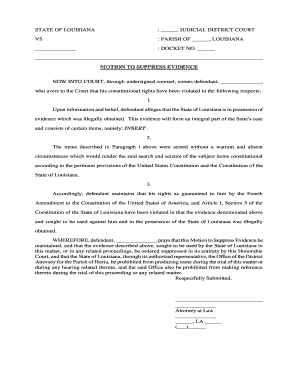
Caption and Case Info

Complete court caption, case number, parties, and judge. Accurate caption ensures proper docketing and linkage to criminal file.
Statement of Facts

Chronological, specific factual narrative describing the search, seizure, or custodial interaction with dates, times, locations, and identifying officers.

Legal Argument

Concise application of controlling law (constitutional provisions, statutes, and controlling case law) explaining why the evidence is legally inadmissible.

Supporting Exhibits

Attach affidavits, police reports, body-worn camera transcripts, search warrants, and any documents or recordings that corroborate factual claims.

Request for Relief

Specify precisely what should be suppressed and request any necessary evidentiary hearing or findings of fact and conclusions of law.

Verification and Signature

Signed by counsel or the defendant (if pro se), dated, and followed by a certificate of service showing how opposing counsel and the court were served.

Step-by-Step: Preparing the Motion to Suppress

Follow these sequential steps to assemble a defensible and procedurally sound motion.

  • 01
    Identify Evidence: List items and facts you seek to exclude; prioritize the most prejudicial items.
  • 02
    Gather Support: Collect police reports, body-cam, affidavits, and witness statements tied to each fact.
  • 03
    Draft Legal Argument: Cite constitutional provisions, controlling precedent, and apply law to your facts.
  • 04
    File and Serve: File per local rules, certify service, and request an evidentiary hearing if needed.

How to Complete and Customize the Motion Online

Configure your electronic workflow to capture signatures, attach exhibits, and preserve an audit trail for court submission.

Field Configuration
Document Format PDF/A preferred for court e-filing; embed exhibits as separate labeled PDFs.
Signature Type Use typed or drawn e-signature where allowed; follow court rules for attorney signature blocks.
Authentication Select email confirmation or multi-factor when e-filing requires verified signer identity.
Retention Settings Enable automatic audit trail retention and exportable certificate of completion for the court record.

Where to File, Serve, and Submit Your Motion

Filing and service steps vary by jurisdiction; use the court clerk's e-filing portal where available and follow local service rules.

  • File with Clerk: Submit to the trial court clerk via e-filing portal or in-person per local rules.
  • Serve Opposing Counsel: Serve the prosecutor and defense counsel by the method required in local rules (email, e-service, or hand-delivery).
  • Request Hearing: Request an evidentiary hearing or set the motion for oral argument if facts require live testimony.
  • Upload Exhibits: Attach exhibits as separate, clearly labeled PDF files in the e-filing system.

Digital Signing and eSubmission: Technical Requirements

Courts accept electronic filings and signatures under ESIGN/UETA where local rules allow; ensure format and authentication meet the court’s standards.

  • Accepted Formats: PDF or PDF/A; separate exhibits as attachable PDFs.
  • Authentication: Email verification or multi-factor where required by the e-filing system.
  • Integrations: Connectors to common tools (e.g., Microsoft 365, Google Workspace, court e-filing portals) streamline filing.

Typical Timing Rules and Filing Deadlines

Timing and cutoffs are governed by local rules and pretrial schedules; always confirm with the court calendar and local criminal rules before filing.

Pretrial Cutoff:

Many courts require suppression motions before the pretrial or discovery cutoff; check scheduling orders.

Notice Periods:

Local rules may require service a set number of days before a hearing; verify exact days locally.

Expedited Issues:

If critical evidence would be destroyed or altered, request expedited consideration or emergency relief.

Hearing Scheduling:

A judge sets an evidentiary hearing date if the motion raises disputed factual issues.

Continuances:

Ask for continuance if you need additional discovery to support suppression grounds.

Key Milestones in the Suppression Motion Timeline

This sequence outlines common milestones from incident to final trial preparation.

01

Incident and Evidence Collected

Document when and how challenged evidence was obtained; collect recordings and reports.

02

Draft and File Motion

Prepare motion with exhibits and file per local clerk rules before pretrial cutoff.

03

Evidentiary Hearing

Court may receive testimony, documents, and cross-examination on disputed factual matters.

04

Court Ruling and Trial Preparation

Judge issues order; excluded evidence shapes trial strategy and plea considerations.

Essential Information to Include in the Motion

Defendant Name: Full legal name
Docket Number: Court case number
Incident Details: Date, time, location
Officers Identified: Names and badge numbers
Evidence Description: Itemized list of evidence
Relief Requested: Specific suppression outcome

Common Mistakes to Avoid When Preparing a Motion to Suppress

  • Relying on conclusory assertions without documentary or testimonial support leads judges to deny the motion.
  • Failing to attach or identify exhibits (reports, video timestamps, affidavits) prevents the court from assessing factual disputes.
  • Citing inapplicable precedent or older caselaw without demonstrating its fit to your facts weakens legal arguments.
  • Missing local filing or service requirements can result in waiver or procedural denial of the motion.

Risks and Consequences of an Incorrect or Untimely Motion

Waiver Risk: Missed deadlines can forfeit suppression claims
Sanctions: Bad-faith filings may prompt court sanctions
Procedural Default: Improper service can nullify the filing
Adverse Findings: Unfounded factual assertions may harm credibility
Limited Relief: Partial suppression may leave key evidence admissible
Appeal Complexity: Unpreserved issues complicate appellate review

Illustrative Use Cases Where a Motion to Suppress Changed the Case

These two concise examples show how factual and legal focus can yield different outcomes depending on the record and relief sought.

Illegal Stop Example

Intro: Police detained a driver without reasonable suspicion and searched the vehicle.

  • Point: Key drugs seized during that search.
  • Outro: Court suppressed the drug evidence after an evidentiary hearing, substantially weakening the prosecution’s case and leading to a favorable plea offer.

Unlawful Interrogation Example

Intro: Defendant made statements after custodial questioning without Miranda warnings.

  • Point: Statements formed basis for key charges.
  • Outro: Judge excluded statements as involuntary and unwarned, which removed the prosecution’s primary admissions and narrowed available charges.

Who Typically Signs or Files a Motion to Suppress

Defense Attorney

A licensed defense lawyer or public defender signs and files the motion on behalf of the defendant, certifies service, and represents the client at any evidentiary hearing.

Pro se Defendant

A defendant representing themselves may draft, sign, and file a suppression motion but must follow local rules and may be held to procedural requirements the court enforces.

How a Motion to Suppress Differs from Similar Pretrial Motions

Compare suppression motions with other pretrial filings to ensure you select the correct remedy for the legal problem you seek to resolve.

Criteria Motion to Suppress Motion to Dismiss
Primary Grounds fourth/fifth amendment statutory or jurisdictional defects
Timing pretrial evidence challenge often pretrial or post-indictment
Typical Remedy exclude evidence dismiss charges or counts
Hearing Type evidentiary hearing common legal briefing; hearing possible

Representative eSignature Pricing and Feature Comparison

Compare signNow with common alternatives on starting price and key feature availability to assess eSignature options for filing and serving motions.

signNow DocuSign Adobe Sign PandaDoc HelloSign
Starting Price $8/user/mo $15/user/mo $14/user/mo $19/user/mo $15/user/mo
Free Trial 7-day trial Varies by vendor Varies by vendor Varies by vendor Varies by vendor
Bulk Send Yes Yes Yes Yes No
Audit Trail Yes Yes Yes Yes Yes
HIPAA Compliant Yes Yes Yes No No

Practical Tips for Accurate and Efficient Motions to Suppress

Follow these practical recommendations to improve clarity, procedural compliance, and the chance of favorable judicial review.

Document the Record
Attach contemporaneous reports, video timestamps, and affidavits. A well-documented factual record enables the judge to resolve disputed events without unnecessary continuances.
Cite Controlling Law
Use jurisdictional precedent and statutory authority; distinguish adverse cases and explain why your facts compel suppression under controlling decisions.
Meet Local Rules
Confirm page limits, formatting, filing method, and service rules in local criminal procedure or the court’s e-filing guidelines to avoid rejection.
Prepare for Hearing
Have witnesses and exhibits organized by exhibit number and prepare direct examination questions and cross-designations to support the factual record at a hearing.

Frequently Asked Questions About Motions to Suppress

Answers to common procedural and practical questions about drafting, filing, and litigating suppression motions in U.S. criminal courts.


Need help? Contact support

be ready to get more
Join over 28 million airSlate SignNow users