Establishing secure connection…Loading editor…Preparing document…

Mississippi Protective Order

This template is fully customizable. Edit the text, fill out the fields, and send it for signature. Give it a try!
Mississippi Protective Order

What a Mississippi Protective Order Is and When It Applies

A Mississippi Protective Order is a court-issued decree intended to protect individuals from domestic violence, stalking, harassment, or threats by restricting an alleged perpetrator's contact or proximity. The order can be issued on an emergency (ex parte) basis or after a hearing, and it may include provisions for temporary custody, possession of the residence, no-contact directives, and surrender of specified firearms. Protective orders are civil in origin but can have criminal consequences for violations; they must be filed with the appropriate state court and served on the respondent according to Mississippi rules of civil procedure.

Why a Protective Order Matters for Safety and Legal Protection

A Protective Order provides immediate legal tools to restrict contact, formalizes safety planning, and creates enforceable restraints that law enforcement can act on. While court procedures vary, ESIGN (15 U.S.C. ch. 96) and UETA support electronic records generally, but courts control filing and signature requirements for court orders.

Why a Protective Order Matters for Safety and Legal Protection

Who Typically Prepares or Requests a Protective Order

Access to court clerks, legal aid, or victim advocacy services can streamline completion and ensure procedural requirements are met for filing and service.

  • Petitioners or alleged victims seeking immediate protection and legal enforcement.
  • Family law and civil attorneys who prepare filings and represent petitioners or respondents.
  • Domestic violence advocates and victim-services organizations helping with paperwork and safety planning.

Core Sections You’ll Find in a Mississippi Protective Order

A complete protective order includes identification, factual allegations, relief requested, duration, service details, and enforcement provisions that officers must follow.

Case Caption

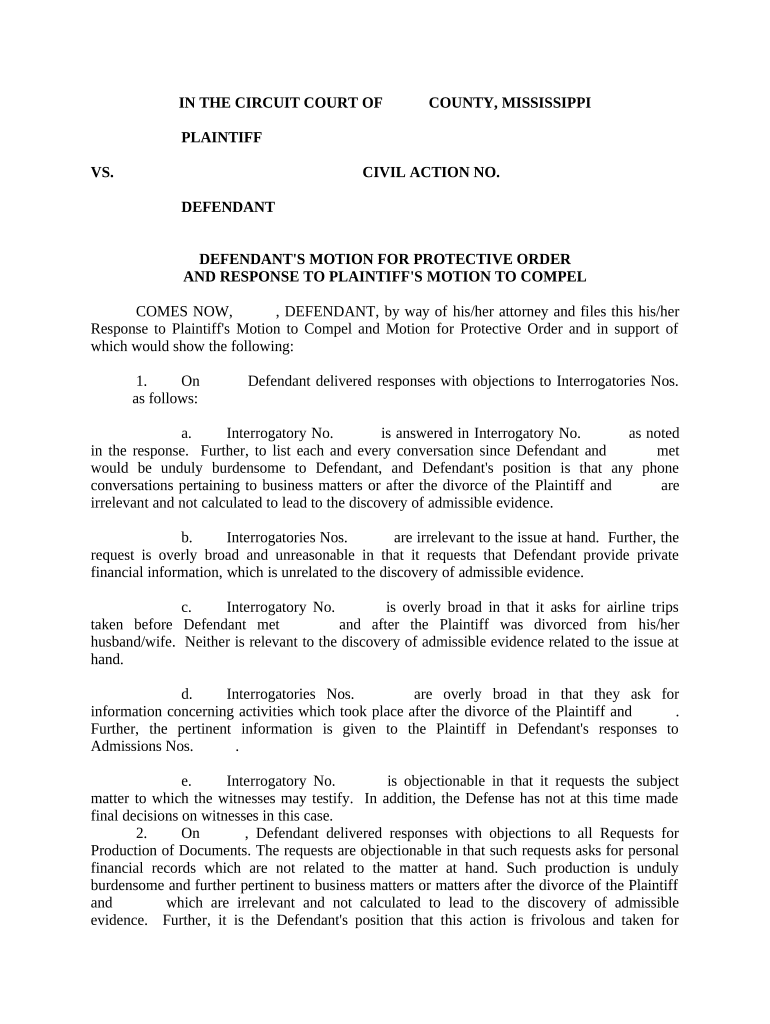
Lists court name, case number, and party names so the document is docketable and legally associated with the correct file.
Allegations

Concise factual statements describing incidents, dates, locations, and witnesses that support the need for an ex parte or full hearing order.

Relief Requested

Specific remedies such as no-contact, stay-away distances, temporary custody, or exclusive use of a residence, stated clearly and legally.

Duration

Specifies whether the order is emergency, temporary, or permanent and sets explicit expiration or review dates for enforcement clarity.

Service Directions

Identifies how the respondent will be served—law enforcement, private process server, or certified mail—and documents attempts and completion.

Enforcement Terms

Includes instructions for law enforcement action on violations, weapons surrender provisions if applicable, and avenues to report noncompliance.

Step-by-Step: Filing a Mississippi Protective Order

Follow these sequential steps to prepare and file a petition for a protective order with the court.

  • 01
    Prepare Petition: Complete form with clear factual details.
  • 02
    Seek Immediate Order: Ask for an ex parte order if danger is imminent.
  • 03
    File with Court: Submit petition to county clerk or e-filing portal as allowed.
  • 04
    Serve Respondent: Arrange lawful service and document attempts.

Configuring an Online Workflow for the Petition

Digital preparation tools can streamline filling, signing, and routing before court submission where e-filing is permitted.

Field Configuration
Document Type PDF or DOCX accepted for upload
Signature Method Electronic or wet signature per court rule
Authentication Email or SMS verification for signers
Delivery Automatic copy to petitioner and court clerk

Where to File and How the Filing Usually Proceeds

Protective orders are filed in state court; some counties permit e-filing while others require in-person submission at the clerk’s office.

  • Local Clerk: Primary filing point for petitions in many counties.
  • E-filing Portal: Used where courts accept electronic filings.
  • Law Enforcement: May assist with emergency referrals and service.
  • Victim Services: Provides support, safety planning, and filing help.

Technical Requirements for Electronic Completion and Submission

Confirm court-specific e-filing rules and whether the court accepts electronically signed petitions; if the court requires wet signatures or in-person filing, follow local procedure.

  • File Formats: PDF and DOCX supported
  • Integrations: Salesforce, Microsoft 365, Google Workspace
  • Security: TLS 1.2/1.3 and AES-256

Typical Timelines and Hearing Expectations

Timeframes differ by jurisdiction; the following are common stages from filing to hearing and issuance of a final order.

Emergency (Ex Parte) Order:

May be issued the same day upon a petitioner’s sworn statement.

Temporary Order Duration:

Often lasts until a full hearing is held, commonly within 7–30 days.

Full Hearing Date:

Set by the court; scheduling depends on docket and local rules.

Final Order Length:

Duration varies—short-term to multi-year orders depending on findings.

Appeal or Modification:

Deadlines for objections or modifications are set by court rules.

Common Mistakes to Avoid When Preparing a Petition

  • Vague incident descriptions that lack dates or locations, making judicial findings difficult.
  • Providing inaccurate respondent details, which can delay service and enforcement.
  • Failing to check local court rules on e-filing, signature format, or necessary attachments.
  • Not documenting prior incidents or evidence such as police reports, photos, or witness names.

Consequences of Filing Errors or False Statements

Service Failure: Case dismissal risk
Contempt: Penalties for violating an issued order
Perjury Exposure: Criminal consequences for knowingly false testimony
Delayed Protection: Administrative mistakes can defer immediate relief
Enforceability Issues: Improper signature or filing may weaken enforcement
Privacy Risks: Improper distribution could expose sensitive information

Practical Tips for Accurate and Efficient Completion

Follow these practices to improve filing accuracy and minimize delays.

Collect Evidence Before Filing
Gather police reports, photos, text messages, and witness contacts to support allegations and to provide the court with a complete record.
Use Precise Language
Avoid vague terms; state concrete facts, dates, times, and locations to help the judge determine necessity and scope of relief.
Confirm Local Rules
Check the county clerk’s requirements for filing, e-filing availability, signature format, and any required forms or attachments.
Secure and Limit Distribution
Share copies only with law enforcement, attorneys, school officials, or others who need it for enforcement or safety planning.

Frequently Asked Questions About Mississippi Protective Orders

Answers to common questions about filing, electronic signatures, enforcement, and modification of protective orders.


Need help? Contact support

be ready to get more
Join over 28 million airSlate SignNow users