Establishing secure connection…Loading editor…Preparing document…

Nevada Small Estate Affidavit

This template is fully customizable. Edit the text, fill out the fields, and send it for signature. Give it a try!
Nevada Small Estate Affidavit

What the Nevada Small Estate Affidavit Is

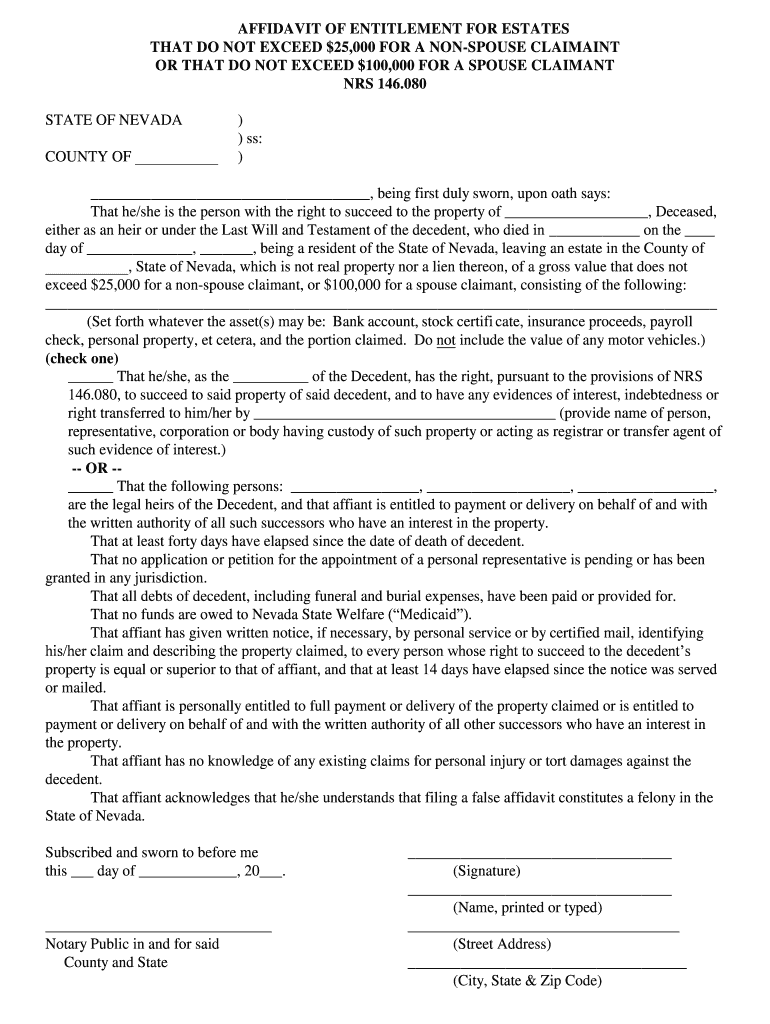
The Nevada Small Estate Affidavit is a sworn statement used to collect or transfer certain personal property following a decedent's death without formal probate. It provides a simplified court-adjacent procedure for low-value estates by allowing an heir or creditor to claim assets when statutory thresholds are met. The affidavit summarizes decedent information, heirs, assets, and outstanding debts and typically must be presented to banks, vehicle agencies, or other custodians of property. Use of this affidavit varies by county; verify local court rules and eligibility before submission.

Why the Affidavit Matters for Small Estates

Use the Nevada Small Estate Affidavit to avoid full probate when the estate meets statutory criteria. It reduces delay, lowers filing complexity, and can permit direct transfer of personal property to beneficiaries or claimants without a probate hearing in many cases.

Why the Affidavit Matters for Small Estates

Who Typically Prepares and Submits This Affidavit

Common users include close family members, appointed representatives, and creditors seeking transfer of small-value personal property under local court procedures.

  • Heirs and beneficiaries who will receive personal property under the affidavit process.
  • Creditors with valid claims seeking repayment from non-probate estate assets.
  • Personal representatives when formal probate is unnecessary or to clear specific accounts.

Step-by-Step: Preparing and Submitting the Affidavit

Follow this step-by-step sequence to prepare and present a Nevada Small Estate Affidavit accurately and in compliance with local rules.

  • 01
    Gather Information: Collect decedent and heir details, asset lists, and death certificate.
  • 02
    Confirm Eligibility: Verify estate qualifies under Nevada small estate thresholds and local procedures.
  • 03
    Complete Affidavit: Enter factual information, declare assets, and state claimant interest clearly.
  • 04
    File and Deliver: Notarize if required and present to the custodian or county clerk.

Required Information and Essential Fields

Full Legal Name: Decedent's name as on death certificate
Date of Death: Date of death in MM/DD/YYYY format
Heir/Claimant Name: Full name and relationship
Asset Description: Account numbers, VINs, locations
Value Estimate: Fair market value or 'unknown'
Signature and Date: Signer name, signature, and date

Key Sections of a Professional Affidavit

A complete Nevada Small Estate Affidavit includes decedent details, claimant identification, asset lists, value statements, declaration of entitlement, and required signatures or notarizations.

Decedent Data

Provide full legal name, date of death, last residence, and any identifying numbers. Accurate decedent data prevents processing delays and mismatches with official records such as social security number.
Claimant Identity

List claimant name, relationship to decedent, address, and contact information. Include copies of photo ID and proof of relationship when requested by custodians or county clerk.

Asset Details

Describe each asset with account numbers, VINs, serial numbers, or precise locations. Attach recent statements or titles to support identification and value assertions when available.

Value Statements

Provide estimated fair market values and note any encumbrances. When uncertain, state 'unknown' and include supporting documentation or appraisal reports if available.

Declarations

Include a clear attestation of entitlement, any creditor notice statements, and confirmation that information is true under penalty of perjury as required by affidavit law.

Signatures

All signers must print name, sign, and date. If notarization is required, include the notary block and any witness signatures specified by local rules or statutes.

Typical Submission and Acceptance Flow

This sequence shows typical routing and acceptance steps when submitting a Nevada Small Estate Affidavit to custodians and courts.

  • Prepare Document: Complete affidavit with attachments and identity documents.
  • Notarize If Needed: Sign before a notary or follow RON procedures where available.
  • Present to Custodian: Submit affidavit to bank, DMV, or other holder of property.
  • Record or File: File with county clerk if local rules require public notice.

Digital Filing and Platform Considerations

Digital submission and eSignature use require compatible file formats, identity verification, and integrations with custodial systems when available.

  • File Formats: PDF and DOCX widely accepted
  • Integrations: Salesforce, NetSuite, Google Workspace
  • Authentication: Email, SMS, or stronger MFA methods

eSignature Vendor Comparison for Affidavit Signing

Comparing common eSignature vendors for signing and submitting Nevada Small Estate Affidavits. Vendor capabilities and pricing vary by plan and billing terms.

signNow DocuSign Adobe Sign PandaDoc HelloSign
Starting Price $8/user/mo $15/user/mo $14/user/mo $19/user/mo $15/user/mo
Free Trial 7-day free trial Varies Varies Varies Varies
Bulk Send Yes Varies by plan Varies by plan Varies by plan Varies by plan
Audit Trail Yes Yes Yes Yes Yes
HIPAA Compliant Yes Yes Yes No No

Common Preparation Errors to Avoid

  • Incomplete asset descriptions such as missing account numbers or VINs often cause custodians to refuse release and require additional documentation.
  • Using informal names or nicknames for the decedent or claimant leads to identity mismatches with bank records and can delay processing.
  • Failing to notarize when required or misusing remote notarization procedures can render the affidavit unacceptable to certain custodians.
  • Overstating asset values or omitting liens invites creditor challenges and may trigger court intervention or additional documentation requests.

Risks and Consequences of Errors

Rejected by Custodian: Asset release delayed
Civil Liability: Possible creditor disputes
Perjury Risk: Criminal penalties if false
Tax Consequences: IRS reporting issues
Probate Requirement: Court may require full probate
Notary Noncompliance: Invalid without required notarization

Frequently Asked Questions about Nevada Small Estate Affidavits

Common questions about eligibility, notarization, and documentation for Nevada Small Estate Affidavits are answered below to reduce filing errors and processing delays.


Need help? Contact support

be ready to get more
Join over 28 million airSlate SignNow users