Establishing secure connection…Loading editor…Preparing document…

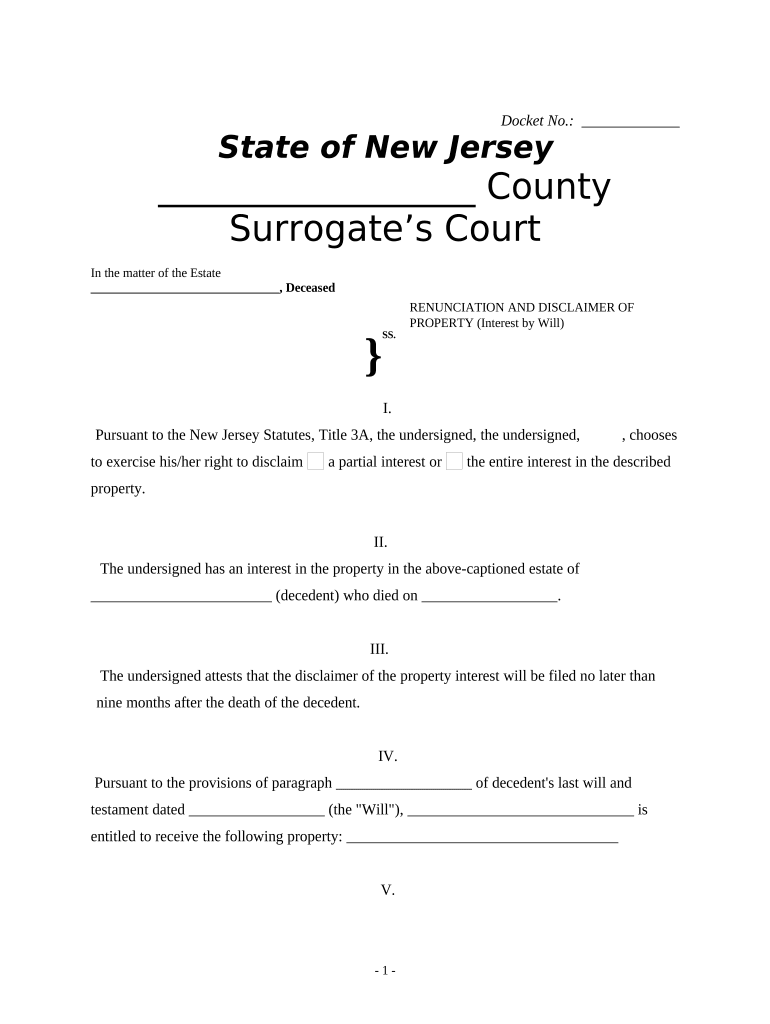
New Jersey Renunciation and Disclaimer of Property

This template is fully customizable. Edit the text, fill out the fields, and send it for signature. Give it a try!
New Jersey Renunciation and Disclaimer of Property

What the New Jersey Renunciation and Disclaimer of Property Is

The New Jersey Renunciation and Disclaimer of Property is a written legal instrument by which a person formally declines to accept an interest in property — for example an inheritance or lifetime gift — so that the interest passes as if the person predeceased the decedent or transferor. Disclaimers are typically used in probate, estate planning, and tax planning to redirect property to alternate beneficiaries or avoid adverse tax consequences. New Jersey follows UETA principles for electronic records and signatures where permitted; the form must be signed, delivered, and meet any statutory timing and form requirements to be effective.

Why a Proper Renunciation or Disclaimer Matters

A valid renunciation or disclaimer prevents unintended acceptance of property, can preserve benefits for other heirs, and may limit tax exposure when executed within applicable statutory windows; accuracy and proper delivery are essential to ensure courts and tax authorities recognize the disclaimer.

Why a Proper Renunciation or Disclaimer Matters

Who Typically Prepares or Signs This Form

Work with counsel or court clerks when in doubt; courts may require specific wording, notarization, or filing to give full legal effect.

  • Beneficiaries who decline an inheritance in favor of alternate heirs or to qualify for tax planning
  • Personal representatives or executors who record disclaimers in probate files
  • Estate planning attorneys preparing or advising on disclaimers to meet statutory requirements

Typical Signers and Their Roles

Beneficiary

An individual who would otherwise receive property but chooses to renounce it. The beneficiary must sign to evidence intent; in many circumstances the renunciation must be unconditional and timely to be effective.

Personal Representative

The executor or administrator may receive and record a disclaimer and should ensure it complies with court procedures and any relevant tax-timing rules; they do not make the renunciation on behalf of a beneficiary unless authorized.

Essential Information the Form Should Contain

Full Legal Name: Complete legal name of the renouncing party
Property Description: Specific description of the interest being disclaimed
Decedent/Transferor: Name of the person whose property is disclaimed
Date of Death/Transfer: Relevant effective date of transfer or death
Signature Block: Signature and printed name of the renouncing person
Delivery Statement: Record of how and to whom the disclaimer was delivered

Key Parts of a Professional Renunciation and Disclaimer

A clear, properly structured disclaimer protects the renouncing party and any successor beneficiaries. Include these elements to reduce ambiguity and facilitate acceptance by probate courts or other recipients.

Title

Clear label such as 'Renunciation and Disclaimer of Property' with venue or case reference to identify the instrument.
Statement of Intent

A concise declaration that the signer knowingly and voluntarily disclaims the described interest, with no conditions attached.

Property Identification

Specific legal description or account identifiers to avoid mistaken renunciations of unrelated assets.

Effective Date

A clear date of execution and, where relevant, the decedent's date of death or date of transfer that triggers the disclaimer.

Signature and Attestation

Signature line, printed name, date, and attestation that the signer is competent and not under undue influence.

Delivery and Filing

Statement of who received the disclaimer and any recording or filing details (probate court, personal representative, or other custodian).

Step-by-Step: Filling Out and Executing a Renunciation

Follow this sequence to prepare, execute, and deliver a valid renunciation or disclaimer of property in New Jersey.

  • 01
    Review Estate Plan: Confirm what interest is at issue and whether renunciation achieves your intent
  • 02
    Complete Form: Enter names, property description, dates, and the unconditional renunciation statement
  • 03
    Sign and Authenticate: Sign in presence of required witnesses or notary where applicable
  • 04
    Deliver and File: Provide the signed instrument to the personal representative and file with probate if required

How to Set Up an Online Renunciation Workflow

Configure a simple digital workflow to collect signatures, evidence delivery, and maintain an audit trail for court or tax review.

Field Configuration
Signature Type Allow e-signature and wet signature options
Authentication Use email+SMS or ID verification for signer identity
Audit Trail Capture IP, timestamp, and delivery receipt
Recipient Routing Auto-send copy to personal representative and counsel

Where to Send or File the Completed Document

Proper routing ensures the renunciation is effective and that interested parties have notice; follow local probate procedures when required.

  • Personal Representative: Deliver original or certified copy for inclusion in the estate file
  • Probate Court Clerk: File if local rules require recording of disclaimers in the estate docket
  • Account Custodian: Send to banks or trustees to prevent distribution to renouncing party
  • Tax Advisor: Share to confirm any federal tax reporting implications

Digital Signing and eSubmission Considerations

New Jersey transactions generally fall under UETA principles; ensure your eSignature provider supports strong authentication and maintains tamper-evident records.

  • Authentication: Use reliable signer verification such as email+SMS, ID analysis, or multi-factor
  • Record Retention: Retain a reproducible record with audit trail for courts and tax records
  • Integrations: Connect with cloud storage and case management systems

Principal Risks of an Incorrect or Untimely Disclaimer

Loss of Rights: Unrecoverable disclaimed interest
Tax Consequences: May affect estate or gift tax treatment
Invalid Execution: Improper form or delivery can void disclaimer
Creditor Claims: Creditors may still reach interests under some rules
Timing Failure: Late disclaimers may not qualify for desired tax treatment
Dispute Risk: Ambiguities invite contested probate litigation

Common Preparation Errors to Avoid

  • Using vague property descriptions that fail to identify the exact interest
  • Signing but not delivering the instrument to the appropriate party or clerk
  • Adding conditions or contingencies that transform the disclaimer into an acceptance
  • Failing to check state-specific timing or witness/notary requirements

eSignature Vendor Comparison for Executing Disclaimers (signNow First)

Common eSignature features and starting prices for comparison; choose a provider that supports required authentication, audit trails, and retention for legal instruments.

signNow DocuSign Adobe Sign PandaDoc HelloSign
Starting Price $8/user/mo $15/user/mo $14/user/mo $19/user/mo $15/user/mo
Free Trial 7-day free trial, no credit card Varies by vendor Varies by vendor Varies by vendor Varies by vendor
Bulk Send Yes Yes Yes Yes No
Audit Trail Yes Yes Yes Yes Yes
HIPAA Compliant Yes Yes Yes No No

Frequently Asked Questions About New Jersey Renunciations and Disclaimers

Answers to common questions regarding validity, execution, filing, and electronic signing of disclaimers in New Jersey and related jurisdictions.


Need help? Contact support

be ready to get more
Join over 28 million airSlate SignNow users