Establishing secure connection…Loading editor…Preparing document…

North Carolina Acknowledgment of Satisfaction

This template is fully customizable. Edit the text, fill out the fields, and send it for signature. Give it a try!
North Carolina Acknowledgment of Satisfaction

What the North Carolina Acknowledgment of Satisfaction is and when it matters

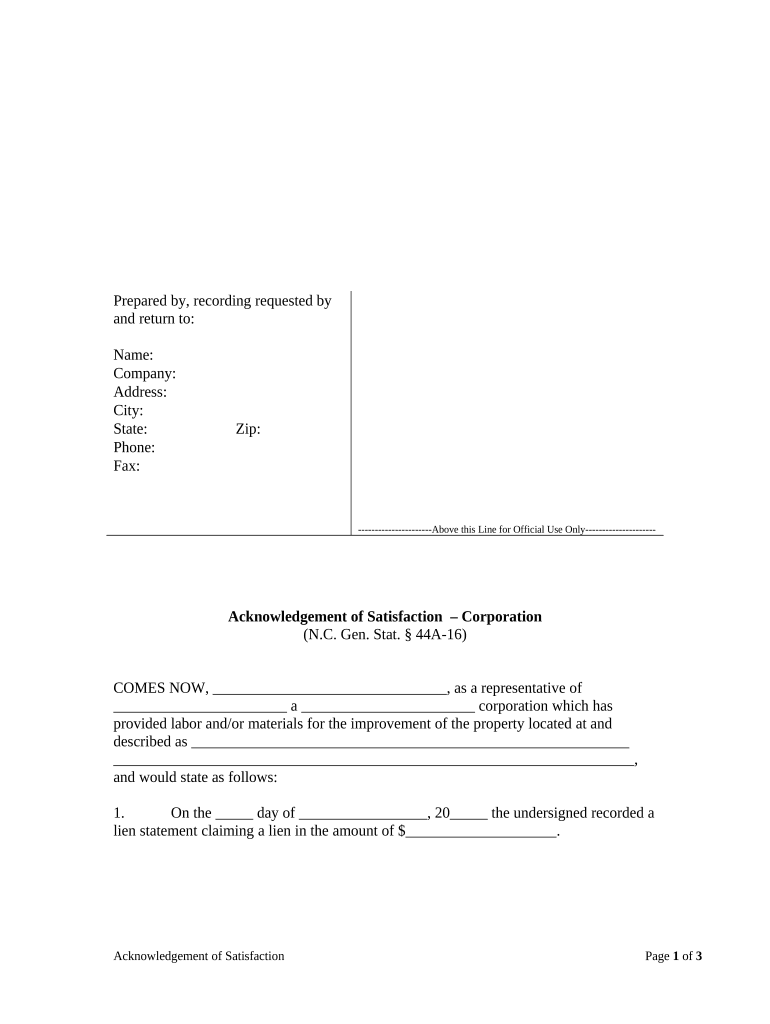
The North Carolina Acknowledgment of Satisfaction is a recorded statement that a mortgage, deed of trust, lien, or other encumbrance has been satisfied or released. It is typically prepared by the lender or lienholder after full payment, signed and notarized, and then recorded in the county Register of Deeds to clear title. Proper preparation and timely recording ensure the public land records reflect that the debt or encumbrance no longer clouds the property title and enable refinancing, resale, or clean title searches without disputed lien status.

Why this document matters for property title and transactions

Recording an accurate Acknowledgment of Satisfaction resolves encumbrances in the public record, prevents future title disputes, and enables clean transfers or refinances. It protects both the former borrower and subsequent purchasers by formally evidencing release of the lien.

Why this document matters for property title and transactions

Who typically prepares, signs, and benefits from this document

Several parties engage with an Acknowledgment of Satisfaction at different stages of a loan lifecycle.

  • Lenders and servicers preparing the release after payoff to clear their security interest and update records.
  • Title companies and closing attorneys verifying release status for refinances and property transfers.
  • Homeowners and buyers relying on recorded satisfaction to confirm the absence of recorded liens.

Each party has different responsibilities: lenders draft and record the release; title professionals confirm recordation; property owners keep copies as proof of satisfaction.

Step-by-step: completing and recording the Acknowledgment of Satisfaction

Follow these sequential steps to prepare, sign, notarize, and record a valid acknowledgment to clear the county land records.

  • 01
    Prepare form: Complete lender, borrower, instrument reference, property description and satisfaction date.
  • 02
    Authorized signature: Have an authorized officer or agent sign; include printed name and title.
  • 03
    Notarize: Sign before a notary public who completes an acknowledgment and signs and seals the form.
  • 04
    Record with county: Submit to the Register of Deeds in the county where the property is located and pay recording fees.

Typical workflow for issuance and public record update

This flow describes the practical path from payoff to recorded release and how each actor contributes.

  • Loan payoff: Borrower pays lender in full or lender applies borrower funds to satisfy the debt.
  • Document preparation: Lender prepares the Acknowledgment of Satisfaction referencing the original instrument.
  • Execution and notarization: Authorized lender signatory signs before a notary who completes the acknowledgment.
  • Filing and recording: The document is submitted to the county Register of Deeds and recorded to update title records.

Configuring an online completion workflow

When using an electronic platform, set up fields and authentication to parallel paper signing and to meet recording requirements.

Field Configuration
Signature block Require signer name, title, date, and notary block placement.
Required fields Make lender, borrower, instrument reference, and property description mandatory.
Authentication Use email plus SMS or knowledge-based authentication for signer verification.
Audit trail Enable complete audit trail capture: timestamps, IP, and signer actions.

Digital signing and submission: technical and legal considerations

Electronic completion is legally permitted for many steps, but the recorded form must meet county requirements for recordation.

  • eSign legality: ESIGN and UETA allow electronic signatures provided intent, consent, attribution, and retention requirements are satisfied.
  • Notary and RON: If using remote online notarization, ensure the notary and technology meet the state's RON rules and county acceptance.
  • File format: Submit a legible, tamper-evident PDF or other format accepted by the county Register of Deeds.

Confirm county recording rules before e-submission; some registers accept electronically signed PDFs while others require physical submission or additional notarization protocols.

Common eSignature platform pricing and capability snapshot

Compare starting prices and common capabilities across vendors. signNow is listed first per comparison conventions; verify vendor plans for enterprise or site-license pricing before purchase.

signNow DocuSign Adobe Sign PandaDoc HelloSign
Starting Price $8/user/mo $15/user/mo $14/user/mo $19/user/mo $15/user/mo
Free Trial Yes, 7-day free trial Varies by vendor Varies by vendor Varies by vendor Varies by vendor
Bulk Send Yes (Premium) Yes Yes Yes No
Audit Trail Yes Yes Yes Yes Yes
HIPAA Compliant Yes Yes Yes No No
Envelope Cap No cap 100 envelopes/user/year No cap No cap No cap

Security and compliance criteria for electronic completion and storage

Encryption in transit: TLS 1.2 / 1.3
Encryption at rest: AES-256
Federal e-sign laws: ESIGN Act and UETA compliance
Healthcare compliance: HIPAA-supporting (BAA required)
Audit and controls: SOC 2 Type II
Regulated records: 21 CFR Part 11 availability

Key risks and consequences of incorrect or late acknowledgments

Clouded title: Improper or unrecorded satisfaction can leave a lien appearing on title searches
Refinance delays: Missing or incorrect recording often prevents timely refinancing or sale closings
Reputational risk: Lender or servicer errors may result in customer disputes and corrective filings
Recording rejection: County clerks may reject forms lacking notarization or required references
Additional fees: Corrective recordings, affidavits, or attorney involvement increase cost and time
Legal exposure: Failure to follow statutory release procedures can trigger litigation to clear title

Common mistakes to avoid when preparing the acknowledgment

  • Using an informal or abbreviated borrower name that does not match the recorded instrument
  • Omitting the original instrument book/page or recording number that ties the release to the lien
  • Failing to notarize in the presence of the signer or using an out-of-state notary without RON acceptance
  • Submitting the form to the wrong county Register of Deeds, causing recording delays

Practical tips for accurate and efficient completion

Adopt these checks to reduce rejections and speed recordation.

Verify names
Confirm lender and borrower names against the original recorded instrument and use exact legal spellings.
Link records
Always include the original instrument reference (book/page or document number) to connect the satisfaction to the lien.
Use standard templates
Employ county-accepted or attorney-reviewed templates to reduce the chance of county clerk rejection.
Keep audit evidence
Retain the signed original, notary acknowledgment, and electronic audit trail for future title or audit questions.

Real-world examples of clearing title with an acknowledgment

Illustrative cases show how accurate releases smooth transactions and reduce follow-up work.

Martin Properties

Tim Martin led electronic satisfactions for multiple rentals to speed closings

  • The team used notarized online signing and immediate recording
  • As a result they processed closings without in-person signings and kept title commitments clean for purchasers and lenders, reducing turnaround time and follow-up corrections.

Fertility Centers of Illinois

John Butler described secure online execution for administrative releases

  • The organization captured signed, notarized releases with an audit trail
  • This approach centralized records, ensured HIPAA-aware handling where necessary, and simplified title searches for facility property transactions.

Who can sign and attest to the satisfaction

Lender Officer

An officer or authorized agent of the lender who has authority to release the lien should sign. The signature block should show the signer’s printed name, title, and the entity they represent; a corporate resolution may be retained to confirm authority.

Notary Public

A notary public must acknowledge the signer’s identity and witness the signature for recordation. If using remote online notarization, ensure the notary complies with state RON rules and retains required audio-video records.

Notarization and recording steps you should complete without delay

Follow these authentication and recording steps to ensure the acknowledgment is accepted and indexed correctly by the county.

01

Sign in presence

Signer must execute the document in the physical presence of the notary unless RON is permitted and used.

02

Notary acknowledgment

Notary completes the acknowledgment block with seal and signature as required by state law.

03

RON verification

If using RON, ensure identity-proofing, audio-video recording, and retention meet state RON requirements.

04

Attach exhibits

Attach a copy of the original instrument reference or exhibit if the county requires it for cross-reference.

05

Pay fees

Include the correct recording fee and any county surcharges when submitting the document.

06

Deliver to register

Send the document to the Register of Deeds in the property’s county by the accepted method (electronic or paper).

07

Obtain recorded copy

Request a stamped recorded copy or confirmation number to confirm public indexing.

08

Distribute copies

Provide recorded copies to borrower, title company, and internal loan records to close administrative files.

Frequently asked questions about the North Carolina Acknowledgment of Satisfaction

Answers to common questions about completion, notarization, and recording to help prevent delays or rejections.


Need help? Contact support

be ready to get more
Join over 28 million airSlate SignNow users