Establishing secure connection…Loading editor…Preparing document…

Notice of Termination or Abandonment - Corporation

This template is fully customizable. Edit the text, fill out the fields, and send it for signature. Give it a try!
Notice of Termination or Abandonment - Corporation

What this Notice is and when it's used

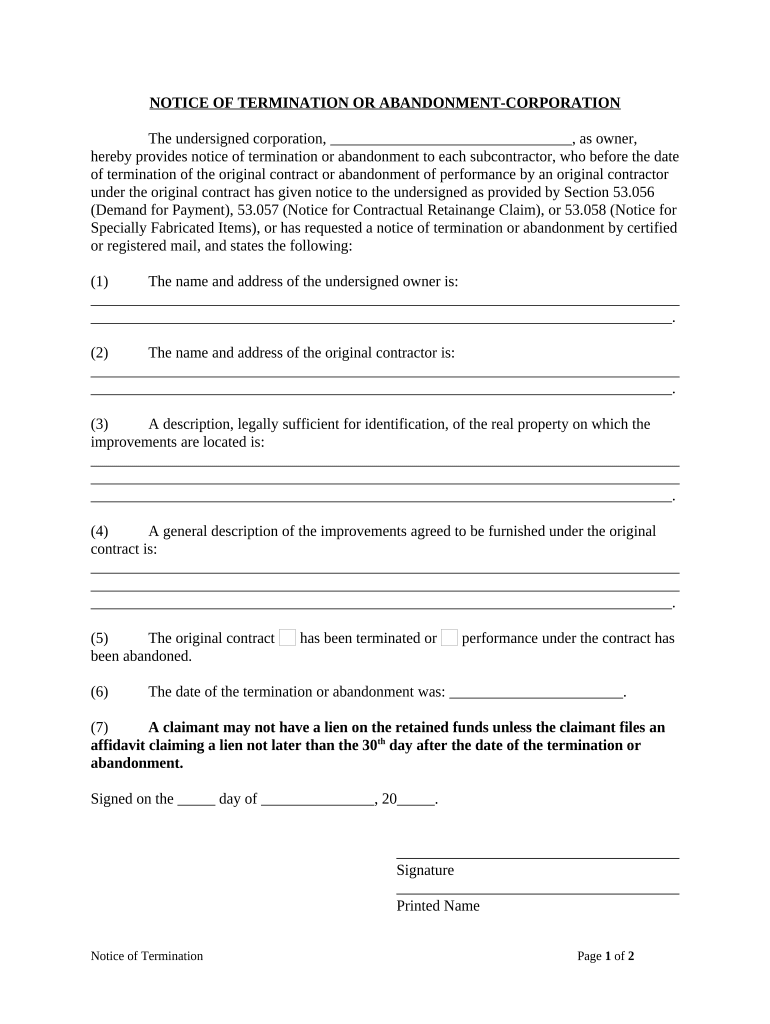
A Notice of Termination or Abandonment - Corporation is a formal written statement used by a corporate entity to notify counterparties, recorders, lienholders, or regulators that the corporation is terminating a contractual relationship, abandoning property or an asset, or ceasing a specific activity. The notice documents the effective date, the corporate party's authority to act, the property or contract being terminated or abandoned, and the distribution and filing instructions needed to create a clear administrative and legal record.

Why issuing a clear notice matters

A clear, documented notice reduces ambiguity about rights and obligations, preserves evidence for disputes, and helps avoid unintended liability. Electronic execution of the notice is generally enforceable under the federal ESIGN Act (15 U.S.C. ch.96) and state UETA statutes (1999) when execution, consent, attribution, and record retention requirements are met.

Why issuing a clear notice matters

Who typically prepares and receives this notice

Common parties prepare and receive corporate termination or abandonment notices depending on the context—internal governance, real estate, contracts, or regulatory filings.

  • Corporate officers and in-house counsel handling formal termination or dissolution communications.
  • Property managers, trustees, or asset controllers serving notice of abandonment or transfer.
  • Third parties such as lessors, lenders, lienholders, and governmental recorders who must be informed.

Step-by-step: preparing and sending the notice

Follow a consistent sequence: collect authority and facts, fill the notice accurately, obtain required approvals and signatures, then serve and file according to contract and law.

  • 01
    Gather records: Collect corporate resolution, contract references, and asset identifiers.
  • 02
    Draft notice: State parties, effective date, and clear description of terminated/abandoned interest.
  • 03
    Authorize signature: Confirm signer authority per bylaws or board resolution.
  • 04
    Serve and file: Deliver to all parties and file with any required government office.

Configuring an online workflow for this notice

Set up a repeatable online workflow that collects approvals, captures signatures, and archives the completed notice with its audit trail.

Field Configuration
Signature order Sequential or parallel routing based on internal approvals
Authentication Email link, SMS code, or stronger verification as required
Document retention Automatic archival with searchable metadata
Certificate capture Enable audit trail capture for IP, timestamp, and actions

Typical e-submission flow

An online process reduces manual handling: upload the template, place fields, add signers, then send and archive signed copies automatically.

  • Upload document: Add PDF or Word file to the signing platform.
  • Place fields: Insert signature, date, and recipient fields where needed.
  • Assign signers: Specify signer order and authentication level.
  • Send & record: Deliver notices and store audit trail with signed PDF.

Technology and platform considerations

Choose a platform that supports the document formats, signer authentication, audit trails, and integrations your workflow requires.

  • Supported formats: PDF, DOCX, and fillable templates
  • Integrations: Salesforce, NetSuite, Microsoft 365, Google Workspace
  • Authentication options: Email link, SMS code, KBA, or SSO

Timing considerations and contractual deadlines

Timing depends on contract terms and applicable law; follow all specified notice periods and allow time for service and filing to avoid disputes.

Contract notice window:

Serve within the timeframe the contract requires.

Effective date effect:

Effective date may trigger cure or notice periods.

Filing triggers:

File with state agencies if corporate records require amendment.

Service proof:

Retain certificate of service showing date and method.

Statutory limits:

Observe statute-of-limitations implications when choosing dates.

Key milestones from preparation to archival

Track milestones in order: approval, execution, delivery, official filing, and retention to ensure the notice creates enforceable and searchable records.

01

Board/Officer Approval

Obtain internal authorization before executing the notice.

02

Execution and Signing

Collect authorized signatures with required authentication.

03

Service to Recipients

Deliver to all required parties and capture proof.

04

Filing and Archival

File with any required recorder and archive the signed notice.

Essential components to include in a professional notice

A complete notice combines identity, authority, a precise description of what is being terminated or abandoned, effective timing, signatures, and proof of delivery to create a defensible record.

Header information

State the document title, the issuing corporation's full legal name, state of incorporation, and any entity identifier to ensure clear matching with official records and contracts.
Parties identified

List the counterparty names, addresses, and roles (lessor, lender, servicer) so recipients and recorders can identify affected interests without further inquiry.

Detailed description

Provide a concise but specific description of the property, contract, or interest being terminated or abandoned including identifiers like addresses, parcel numbers, or contract clauses.

Effective date

Specify the exact effective date in MM/DD/YYYY format and state whether the date is the notice date, the termination date, or the abandonment date for clarity.

Signature block

Include the printed name, title, and authority citation for each signer; indicate whether a board resolution or corporate certificate supports signatory authority.

Certificate of service

Document recipients, delivery methods (mail, email, hand, filing), and dates served; this is critical evidence in disputes and for satisfying contractual notice provisions.

Mandatory data elements to collect

Corporate Name: Exact legal name
Entity ID: State registration number
Authorized Signer: Name and title
Effective Date: MM/DD/YYYY format
Subject Description: Asset or contract ID
Service List: Recipients and addresses

Consequences of an incorrect or incomplete notice

Invalid service: Notice may not bind recipients
Authority challenge: Signatures may be contested
Contract breach: Risk of damages or cure obligations
Filing rejection: Recorders may return defective filings
Lien exposure: Unreleased liens or claims may persist
Regulatory penalties: Potential fines if filings are required but missed

Common preparation mistakes to avoid

  • Using an informal or ambiguous description of the asset or contract that leaves room for interpretation and later dispute.
  • Failing to confirm the signer has corporate authority, including board resolutions or bylaws that authorize the specific action.
  • Serving only some parties or using an unaccepted delivery method that does not meet contractually required service procedures.
  • Neglecting to retain the certificate of service, signed copy, and audit trail, which are often decisive in enforcement or litigation.

Common eSignature provider pricing and capabilities for notices

Representative per-user starting prices and feature availability for common eSignature providers. Choose a plan that supports required authentication, audit trails, and any compliance needs.

signNow DocuSign Adobe Sign PandaDoc HelloSign
Starting Price $8/user/mo $15/user/mo $14/user/mo $19/user/mo $15/user/mo
Free Trial 7-day free trial Varies Varies Varies Varies
Bulk Send Yes Yes Yes Yes Yes
Audit Trail Yes Yes Yes Yes Yes
HIPAA Compliant Yes Yes Yes No No

Real-world scenarios where this notice is used

Two practical scenarios illustrate different uses: contract termination for corporate operations and property abandonment tied to asset disposition.

Commercial Lease Termination

A corporation notifies a landlord it will terminate a commercial lease at the end of a notice period.

  • The notice cites lease section and effective date.
  • The document includes the corporate resolution authorizing termination, identifies the unit and lease number, states the effective termination date, and records methods of service to prevent later tenant-landlord disputes.

Asset Abandonment Notice

A company documents abandonment of obsolete equipment or fixtures and transfers liability.

  • The notice lists assets and location identifiers.
  • The notice attaches photos, serial numbers, the board authorization, and a certificate of service sent to landlord, lender, and insurance, preserving evidence for creditor inquiries and environmental responsibilities.

Practical tips for reliable and defensible notices

Small changes improve clarity and reduce disputes: standardize templates, verify authority, and preserve audit trails for every notice sent.

Confirm authority
Obtain and attach the corporate resolution or officers' certificate that authorizes the signer to act, and record the basis of authority in the notice itself.
Use precise identifiers
Reference exact contract clause, parcel ID, or account number; vague descriptions lead to enforcement and filing problems.
Capture proof of service
Include a signed certificate of service listing recipients, delivery method, and date; preserve delivery receipts and platform audit logs.
Preserve signed record
Archive the signed notice with an immutable audit trail, and store in a records system that supports retention scheduling and search.

Frequently asked questions and quick answers

Answers address common execution, service, and enforceability questions to help you prepare a valid and defensible notice.


Need help? Contact support

be ready to get more
Join over 28 million airSlate SignNow users