Establishing secure connection…Loading editor…Preparing document…

New York LLC Dissolution

This template is fully customizable. Edit the text, fill out the fields, and send it for signature. Give it a try!
New York LLC Dissolution

What the New York LLC Dissolution document is

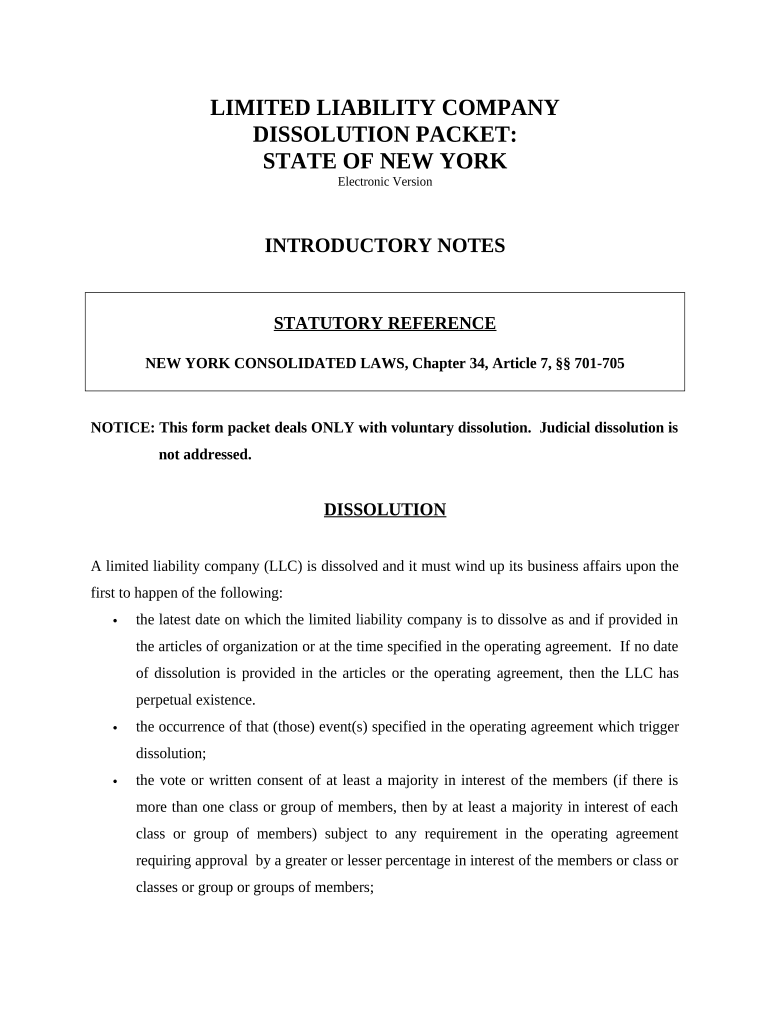
A New York LLC Dissolution documents the formal process of closing a limited liability company formed or registered in New York. It generally includes a member or manager resolution to dissolve, the Certificate of Dissolution filed with the New York Department of State, steps to wind up business affairs, final tax filings, and distribution of remaining assets to members. Proper completion ends ongoing state reporting obligations, notifies creditors, and helps avoid future personal or entity-level liabilities if handled according to New York law and the LLC’s operating agreement.

Why completing a formal dissolution matters

Filing a proper dissolution closes legal and tax obligations, provides clear notice to creditors and tax authorities, documents asset distribution, and limits continued state fees and penalties for an inactive LLC.

Why completing a formal dissolution matters

Who typically completes a New York LLC Dissolution

The following profiles most often prepare and file LLC dissolution paperwork in New York.

  • Members or managers who vote to dissolve and coordinate winding up activities.
  • Corporate attorneys or business law firms advising on statutory and contract requirements.
  • Accountants or tax professionals who prepare final federal and state tax returns.

In many cases these roles overlap; small LLCs often use a single advisor to manage legal filings, tax clearances, and creditor notifications.

Step-by-step: complete and file your dissolution

Follow these core steps to dissolve a New York LLC and wind up its affairs.

  • 01
    Authorize dissolution: Record member/manager vote per the operating agreement.
  • 02
    Prepare resolution: Draft and approve written dissolution resolution and meeting minutes.
  • 03
    File Certificate: Submit Certificate of Dissolution to NY Department of State.
  • 04
    Wind up affairs: Notify creditors, pay liabilities, file final tax returns, distribute assets.

Set up an efficient online filing workflow

Configure a digital workflow to collect signatures, attach supporting documents, and route copies to stakeholders.

Field Configuration
Upload Document Use PDF for consistent formatting and signatures.
Signature Order Set to collect manager signatures first, then member acknowledgment.
Authentication Method Choose email + SMS code for stronger signer attribution.
Notifications Send final signed copy to members, accountant, and attorney.

Where to file and who to notify

Dissolution requires filing the state form and completing tax and creditor notifications; follow this routing sequence.

  • NY Filing: File the Certificate of Dissolution with NY Department of State.
  • IRS Notification: File final federal tax returns and check the dissolution box.
  • State Tax Agency: Notify New York State Department of Taxation and Finance as required.
  • Creditors and Vendors: Send written notices and settle or provide claims procedures.

Digital signing and submission: platform basics

Choose a platform that supports legally enforceable eSignatures, secure uploads, and audit trails for recordkeeping.

  • File Formats: PDF and DOCX accepted
  • Integrations: Salesforce, NetSuite, Google Workspace
  • Authentication: Email, SMS code, or multi-factor

Ensure the chosen service preserves an audit trail (timestamps, IPs, signer attribution) and supports secure storage that meets legal retention needs.

Typical eSignature vendor pricing and capability snapshot

Compare common commercial plans and capabilities when selecting an eSignature provider for dissolution paperwork and records retention.

signNow DocuSign Adobe Sign PandaDoc HelloSign
Starting Price $8/user/mo $15/user/mo $14/user/mo $19/user/mo $15/user/mo
Free Trial Yes, 7-day free trial Varies by plan Varies by plan Varies by plan Varies by plan
Bulk Send Yes Yes Yes Yes No
Audit Trail Yes Yes Yes Yes Yes
HIPAA Compliant Yes Yes Yes No No

Security and compliance considerations

Encryption: TLS 1.2/1.3 in transit; AES-256 at rest
HIPAA: BAA required for protected health information
ESIGN / UETA: Meets U.S. e-signature legal standards
Audit Trail: Detailed timestamps and IP address logging
Certifications: SOC 2 Type II and ISO 27001 available
Access Controls: Multi-factor and role-based permissions

Penalties and risks of incorrect dissolution

Late or Missing Filing: May incur state fees and administrative consequences
Unpaid Taxes: Members can face liability for unresolved tax obligations
Creditor Claims: Failure to notify creditors may extend liability exposure
Document Rejection: Errors in name or file number can void the filing
Personal Liability: Improper wind-up can expose managers/members to claims
Recordkeeping Failures: Loss of evidence for future disputes or audits

Common pitfalls to avoid when preparing dissolution

  • Using an incorrect or abbreviated LLC name on the form causes rejections and administrative delays when matching state records.
  • Failing to include the DOS file number or listing a wrong number disconnects the filing from the company record and often requires resubmission.
  • Not obtaining a member or manager resolution in the required form leaves the filing vulnerable to internal challenges and potential legal disputes.
  • Skipping final tax clearances or failing to file final federal and state returns can create penalties and lingering liability for members.

Core components to include with a professional dissolution packet

A complete dissolution packet reduces follow-up requests and helps satisfy state, tax, and creditor requirements.

Certificate of Dissolution

State form that terminates the LLC’s existence; must match the Department of State record and be signed by authorized parties.
Member Resolution

Recorded vote or written consent authorizing dissolution consistent with the operating agreement and state law.

Final Tax Filings

Federal and state final returns marked as final, plus payroll and sales tax closures where applicable.

Creditor Notices

Documentation of notice to known creditors and descriptions of claims procedures or settlements.

Asset Distribution Plan

Clear accounting of asset realization and member distributions, including timing and priority of claims.

Retention Records

Plan for storing signed dissolution documents, financial records, and tax evidence for the statutory retention period.

Key deadlines to remember during dissolution

Dissolution timelines involve corporate steps and independent tax filing deadlines you must meet.

Member Vote Timing:

Follow operating agreement requirements for meeting notice and quorum.

File Final 1099s:

1099-NEC to recipients and IRS due Jan 31

Individual Tax Return:

Form 1040 due April 15 (extension to Oct 15 possible)

File State Forms:

Submit dissolution to NY Department of State per their processing rules

Payroll and Employment:

Final payroll returns and W-2s due Jan 31 to employees

Milestones in the dissolution and wind-up process

Track these sequential milestones to ensure a coordinated and legally safe wind-up.

01

Resolve to Dissolve

Members approve dissolution and document the decision in minutes.

02

File State Certificate

Prepare and submit Certificate of Dissolution to the Department of State.

03

Settle Liabilities

Notify creditors, resolve claims, and pay outstanding obligations.

04

Distribute Assets

Distribute remaining assets to members per the operating agreement.

Practical tips for accurate and efficient dissolution

Use consistent procedures and document controls to reduce errors and audits during dissolution.

Confirm entity details
Verify the LLC name, Department of State file number, and authorized signers against official state records before filing to prevent rejections and processing delays.
Coordinate tax filings
Work with an accountant to file final federal, state, and payroll returns and to determine any required tax clearances to avoid unexpected liabilities to members.
Provide creditor notice
Send written notices to known creditors and establish a claims procedure; document all communications and settlements for future defense against claims.
Preserve records securely
Retain dissolution packets, financial records, and signed documents in encrypted storage with controlled access for the required statutory periods.

Realistic use cases for dissolving a New York LLC

Practical examples show how different LLCs commonly approach dissolution and post-filing steps.

Small Real Estate LLC

A member vote approved closing a single-property LLC

  • Final rent collections and lien clearances completed
  • The group filed a Certificate of Dissolution, settled creditor claims, filed final tax returns, and documented distributions to avoid future liability.

Professional Services LLC

Partners agreed to dissolve after retirement

  • Client contracts reassigned and final invoices issued
  • They filed dissolution paperwork, informed clients and vendors, and retained records for tax and potential malpractice statute-of-limitations purposes.

FAQs — common questions about New York LLC Dissolution

Answers to frequent questions about signatures, filing, tax consequences, and recordkeeping during dissolution.


Need help? Contact support

be ready to get more
Join over 28 million airSlate SignNow users