Establishing secure connection…Loading editor…Preparing document…

Oklahoma Lien Filing

This template is fully customizable. Edit the text, fill out the fields, and send it for signature. Give it a try!
Oklahoma Lien Filing

What an Oklahoma Lien Filing Is and When It Applies

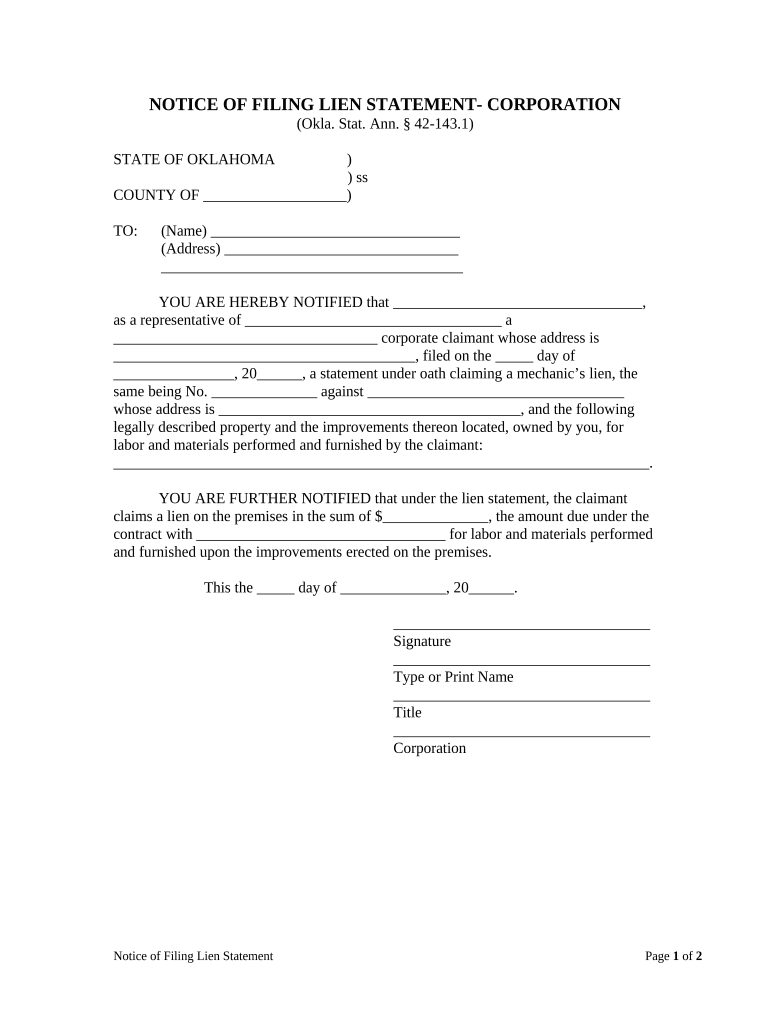
An Oklahoma lien filing is the formal record that secures a party’s financial interest in property or proceeds under state law. Common lien types include mechanic’s liens for construction labor or materials and UCC financing statements for personal property collateral. Filing creates public notice, preserves priority, and establishes an enforceable claim against the identified asset when properly completed and recorded with the appropriate Oklahoma office. Procedures, supporting documentation, and retention obligations vary by lien type and the governing statute; follow local filing office rules to avoid rejection or loss of priority.

Why Filing an Oklahoma Lien Matters

A correct filing preserves legal priority, creates public notice, and enables enforcement remedies. Timely, accurate filings protect payment rights and strengthen negotiating leverage without immediate litigation.

Why Filing an Oklahoma Lien Matters

Who Typically Prepares or Relies on These Filings

Several participant types routinely prepare or monitor Oklahoma lien filings.

  • Contractors and subcontractors who supplied labor or materials on private construction projects and need to preserve mechanic’s lien rights.
  • Lenders and secured creditors filing UCC-1 financing statements to perfect interests in business collateral.
  • Title companies, property owners, and legal counsel that review filings to determine title encumbrances and priority.

Different stakeholders have distinct informational needs — preparers focus on accuracy and timing; reviewers focus on priority and release mechanics.

Filing Steps: Complete an Oklahoma Lien Accurately

Follow a clear sequence to reduce errors and preserve priority when filing any lien in Oklahoma.

  • 01
    Confirm Lien Type: Identify whether it is a mechanic’s lien, UCC-1, or other statutory claim.
  • 02
    Gather Information: Collect party names, legal descriptions, contract dates, and amounts claimed.
  • 03
    Complete Form: Populate the official filing form and attach required exhibits or affidavits.
  • 04
    File and Record: Submit to the designated county clerk or filing office and obtain a stamped copy.

Overview of the Filing and Notice Flow

A typical lien filing workflow moves from document preparation to public recording, then delivery to interested parties.

  • Prepare Filing: Draft the lien statement, include exhibits, and verify party names.
  • Record with Clerk: Submit to county clerk or filing office for official acceptance and stamping.
  • Serve Notice: Where required, deliver statutory notice to the property owner or other required parties.
  • Monitor and Enforce: Track deadlines, record releases, and pursue enforcement if necessary.

Digital Workflow Settings for an Oklahoma Lien Filing

Configure the digital workflow to ensure accurate routing, authentication, and recordkeeping for e-submission and signer access.

Field Configuration
Document Upload PDF/A format preferred for long-term records
Signer Authentication Email + SMS code or ID verification when required
Routing Order Ordered signing for claimant, owner, then attorney
Retention Enable automatic archival and audit trail capture

Technical Options for eFiling and eSigning

Use an eSignature platform that supports required file types, secure authentication, and an auditable trail for legal records.

  • File Formats: PDF, DOCX, and HTML supported
  • Integrations: Salesforce, NetSuite, Google Workspace
  • Authentication: Email, SMS, KBA, or advanced options

Confirm the selected system complies with ESIGN/UETA and local filing-office technical rules before relying on electronic submission.

Key Elements a Professional Oklahoma Lien Filing Should Include

A complete filing contains identification details, precise descriptions, signed attestations, supporting exhibits, proper notarization when required, and clear contact information for service.

Identifying Parties

Full legal names and business entity types for claimant and debtor to avoid ambiguity and support enforcement actions.
Legal Description

A precise real-property legal description or detailed collateral listing that leaves no doubt about the asset subject to the lien.

Claim Basis

A concise statement of the underlying contract, work performed, or secured obligation that gives rise to the lien.

Amount Claimed

Line-item amounts, totals, and supporting calculations so courts and opposing parties can verify the claim quickly.

Signature and Authority

Authorized signature, printed name, title, and date; if signed electronically, provide authentication and consent evidence.

Attachments

Include invoices, contracts, affidavits of service, or proof of completion as required by statute or local filing rules.

Supporting Documents Commonly Attached to an Oklahoma Lien Filing

Attach documents that substantiate the claim and satisfy statutory prerequisites to reduce rejection risk and strengthen enforceability.

Invoices and Statements

Provide dated invoices and account statements showing amounts due, dates of service, and itemized charges to support the claimed sum.

Contract or Purchase Order

Attach the underlying contract, change orders, or purchase order that describes scope of work, pricing, and relevant terms.

Affidavit of Service

When statutory notice is required, include a sworn affidavit demonstrating proper notice to the owner and other interested parties.

Proof of Completion

Delivery receipts, completion certificates, or inspection approvals that corroborate performance or delivery dates.

Security and Compliance Considerations for Electronic Lien Records

Encryption in Transit: TLS 1.2/1.3 encryption
Encryption at Rest: AES-256 encrypted storage
HIPAA Support: BAA available where needed
ESIGN / UETA: Legal e-signature compliance
Audit Trail: Detailed timestamped action history
Certifications: SOC 2 Type II and ISO 27001

Consequences of an Incorrect or Late Oklahoma Lien Filing

Loss of Priority: Priority may be subordinated
Filing Rejection: Clerk may refuse acceptance
Statute of Limitations: Claim may become time-barred
Invalid Enforcement: Court may deny foreclosure
Costly Amendments: Corrections incur fees and delays
Potential Sanctions: Bad-faith filings risk penalties

Common Errors to Avoid When Preparing a Lien Filing

  • Using informal or abbreviated party names instead of full legal names causes mismatches and can invalidate the filing.
  • Submitting incomplete legal descriptions — street addresses alone are often insufficient to identify real property accurately for recording.
  • Failing to attach required statutory notices or affidavits of service can defeat lien rights under state law.
  • Relying on a weak authentication method for e-signatures when stronger verification or consumer consent is required by statute.

Real-World Examples of Lien Filing Use

Practical examples show how accurate filings preserve rights and speed resolution for claimants and reviewers.

Martin Properties

Our team moved all contractor lien filings online to avoid missed deadlines and physical signatures.

  • Quick on-site signing prevented delays by 48 hours.
  • Martin Properties reduced processing friction while maintaining required attestations and secure records, enabling faster resolution of payment disputes without compromising compliance.

Optica Ventures

A small developer centralized UCC and mechanic’s lien records in a single repository for audit readiness.

  • Centralized records simplified searches during closings.
  • Optica Ventures improved transparency for buyers and lenders, reducing last-minute title issues and clarifying priority at the time of sale.

Practical Tips for Accurate Oklahoma Lien Filings

Follow consistent standards and a checklist approach to reduce rejections and preserve enforcement options.

Use Exact Legal Names
Verify claimant and debtor names against government IDs or corporate filings to prevent mismatches and ensure enforceability.
Keep Detailed Records
Retain invoices, contracts, and service affidavits in original form and as searchable digital copies for audits and litigation.
Confirm Local Rules
Consult the county clerk or filing office for formatting requirements, fees, and any notarization or signature acknowledgement procedures.
Plan for Priority
File promptly after the triggering event to protect priority; document the chain of events that supports the claimed date.

Typical eSignature Pricing and Feature Comparison

Comparison of common eSignature plan attributes and availability. Place signNow first in the table for parity with market options.

signNow DocuSign Adobe Sign PandaDoc HelloSign
Starting Price $8/user/mo $15/user/mo $14/user/mo $19/user/mo $15/user/mo
Free Trial 7-day free trial No trial listed No trial listed Yes, limited Yes, limited
Bulk Send Yes Yes Yes Yes No
Audit Trail Yes Yes Yes Yes Yes
Envelope Cap No cap 100 envelopes/user/year Varies by plan Varies by plan Varies by plan

Common Questions About Oklahoma Lien Filings

Answers to frequent questions about preparation, electronic signatures, and filing risks for Oklahoma lien recordings.


Need help? Contact support

be ready to get more
Join over 28 million airSlate SignNow users