Establishing secure connection…Loading editor…Preparing document…

Letter Regarding Return of Late Payment and Denial of Discount

This template is fully customizable. Edit the text, fill out the fields, and send it for signature. Give it a try!
Letter Regarding Return of Late Payment and Denial of Discount

What this Letter Is and When it’s Used

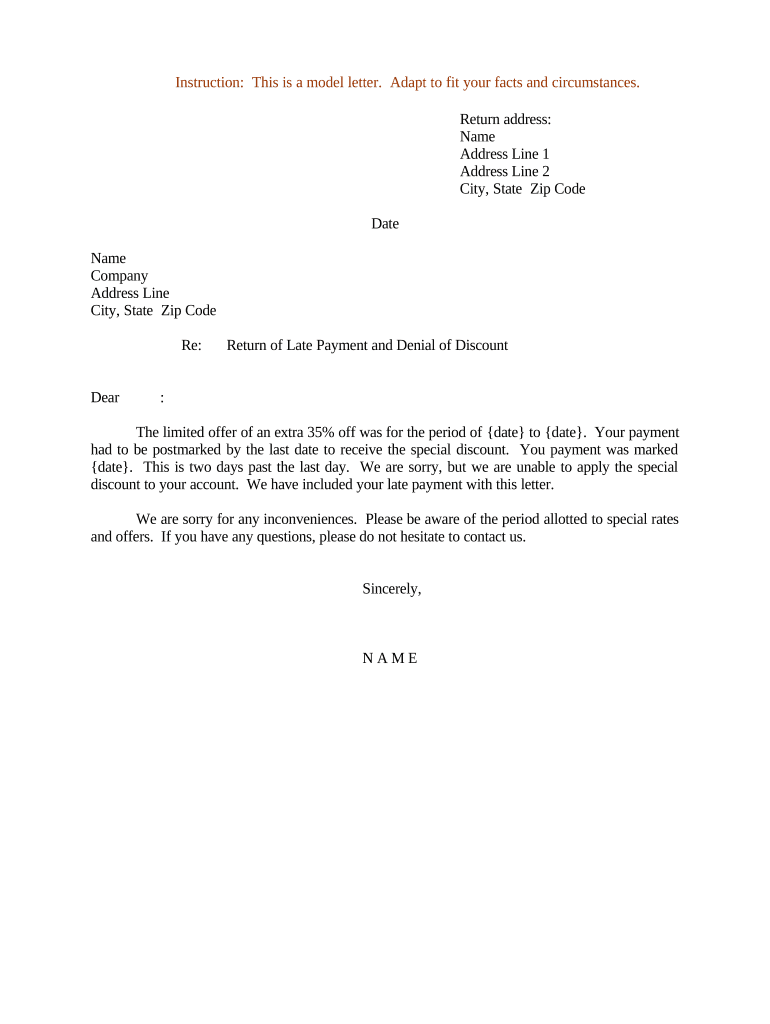
A Letter Regarding Return of Late Payment and Denial of Discount is a formal written notice used by a payee, vendor, or service provider to document the return of a payment that arrived after the contractual due date and to explain why any requested early-payment discount is denied. The letter sets out the payment details, the original discount terms, the reason the payment is disqualified from discount treatment, and any next steps for reconciliation, refund, or dispute resolution. It creates a clear record for accounting, collections, and potential legal review.

Why a Clear Return-and-Denial Letter Matters

This letter preserves an auditable record that explains the payment return and the rationale for denying a discount, reducing downstream disputes and clarifying accounting entries.

Why a Clear Return-and-Denial Letter Matters

Which People and Teams Typically Send This Letter

Teams that commonly prepare this letter include accounts receivable, billing, contract administrators, and legal counsel when contractual discounts are disputed.

  • Accounts receivable teams documenting returned checks, ACH reversals, or late electronic payments to correct ledgers and notify customers.
  • Contract administrators enforcing discount eligibility rules and preserving documentation required by contract audit clauses.
  • Small-business owners and finance managers notifying customers while maintaining evidence for tax and bookkeeping purposes.

Step-by-Step: Preparing and Sending the Letter

Follow these sequential steps to create a defensible letter that documents the return of late payment and denial of a discount.

  • 01
    Verify Transaction: Confirm payment dates, ledger entries, and bank records before drafting.
  • 02
    Draft Explanation: State the reason for returning the payment and cite the discount clause.
  • 03
    Attach Evidence: Include invoice copies, bank notices, or remittance evidence supporting the decision.
  • 04
    Send and Record: Send by recorded delivery or eSignature and file a copy in accounting records.

Digital Workflow Settings for Online Completion

Set up a consistent digital workflow to reduce errors and capture an audit trail when completing this letter electronically.

Field Configuration
Signature Method Use legally compliant eSign with audit trail and signer authentication
Authentication Email link with optional SMS code or SSO for higher assurance
Retention Store signed copy as PDF/A with audit log for required retention period
Notifications Enable sender and recipient delivery receipts and timestamped audit PDFs

Where the Letter Goes and How It’s Processed

Routing the letter efficiently ensures accounting, customer service, and legal teams receive the same information and can act consistently.

  • Accounts Receivable: Files the document and updates the ledger to reflect returned payment.
  • Customer / Payor: Receives the explanation and directions for resolving balance or dispute.
  • Legal Counsel: Reviews for contract interpretation or escalation if contested.
  • Audit File: Permanent copy retained for statutory and internal audit requirements.

Technical Considerations for Digital Signing and Delivery

Choose a platform that produces a tamper-evident signed PDF and captures signer identity data and timestamps.

  • File Formats: PDF, DOCX supported
  • Integrations: Connects to Salesforce, NetSuite, Google Workspace
  • Authentication: Email link, SMS code, SSO options

eSignature Vendor Comparison for Completing the Letter

Common eSignature vendors vary by starting price, trial terms, bulk-send features, audit trail availability, HIPAA support, and envelope limits.

signNow DocuSign Adobe Sign PandaDoc HelloSign
Starting Price $8/user/mo $15/user/mo $14/user/mo $19/user/mo $15/user/mo
Free Trial 7-day free trial Varies by vendor Varies by vendor Varies by vendor Varies by vendor
Bulk Send Yes Yes Yes Yes No
Audit Trail Yes Yes Yes Yes Yes
HIPAA Compliant Yes Yes Yes No No
Envelope Cap No cap 100 envelopes/user/year Varies Varies Varies

Security and Compliance Features to Include

Encryption in Transit: TLS 1.2/1.3
Encryption at Rest: AES-256
HIPAA: BAA required for protected health information
Audit Trail: Timestamped signing events
Regulatory Standards: SOC 2 Type II available
FDA / 21 CFR: 21 CFR Part 11 compliant options

Key Risks and Penalties to Avoid

Tax Penalties: Late or incorrect reporting can trigger IRC §6721 fines
I-9 Violations: Paperwork errors risk DHS fines
Backup Withholding: 24% rate with incorrect TIN
Contract Dispute: Ambiguous letters increase litigation risk
Invalid Signature: Missing intent or retention may invalidate e-sign
Data Breach: Improper storage risks HIPAA/CCPA exposure

Common Preparation Mistakes to Avoid

  • Omitting invoice or payment reference prevents reconciliation and causes confusion.
  • Using vague language about discount criteria leads to disputes and possible chargebacks.
  • Failing to attach supporting bank or remittance records weakens your case.
  • Not retaining a signed copy with an audit trail complicates audits and legal review.

Recommended Timelines and Response Expectations

While exact deadlines are contract-specific, adopt consistent internal deadlines for review, notice, and retention.

Initial Review Period:

Verify payment and ledger within 5 business days of receipt

Issue Letter:

Send the return-and-denial letter within 10 business days after verification

Recipient Response Window:

Allow 15–30 calendar days for recipient to respond or dispute

Escalation:

Escalate to legal or collections after 30 days without resolution

File Retention:

Archive the signed letter per retention policy immediately after sending

Key Processing Milestones from Receipt to Resolution

Track these milestones as a sequence to ensure timely communication and clear auditability.

01

Receipt Confirmation

Record when payment was received and its form

02

Eligibility Check

Compare payment date to discount terms and contract

03

Draft and Approve

Prepare the letter and obtain necessary internal sign-offs

04

Delivery and Archive

Deliver with proof and file the signed record

Essential Elements to Include in a Professional Letter

Ensure the letter contains these six elements to be clear, enforceable, and auditable for both accounting and legal purposes.

Header

Date, sender name, sender address, and recipient name to create an immediate record of parties and timing.
Reference

Clear invoice or payment identifiers tying the letter to specific transactions and account numbers for reconciliation.

Findings

A concise statement of facts: when payment was received, why it’s late, and why discount rules do not apply.

Adjustment

State how the ledger will change, whether funds are returned, or whether a balance remains due after denial.

Supporting Attachments

Attach copies of the invoice, remittance advice, bank notices, and contract discount clause for clarity.

Signature Block

Authorized signatory name, title, signature, and date; include contact info for follow-up questions.

Practical Examples from Real Organizations

These short examples show how companies document returned late payments and explain denial of discounts while preserving compliance and clarity.

Optica Ventures LLC

The finance team issued a dated return letter tied to invoice #20234 and included bank remittance evidence

  • The letter cited the 10-day discount window in the contract
  • This created a clear record that prevented a duplicate credit and allowed a speedy reconciliation with the customer, per the COO's operational needs.

Martin Properties

The founder documented a late rental payment and denied an early-pay discount citing lease section 4.2

  • The letter included ledger screenshots and a signed statement
  • The approach reduced tenant disputes and provided a documented trail for property accounts and potential tax reporting.

Frequently Asked Questions and Practical Answers

Answers to common questions about legally documenting returned late payments and denying discounts, focusing on eSignature, notarization, and evidence preservation.


Need help? Contact support

be ready to get more
Join over 28 million airSlate SignNow users