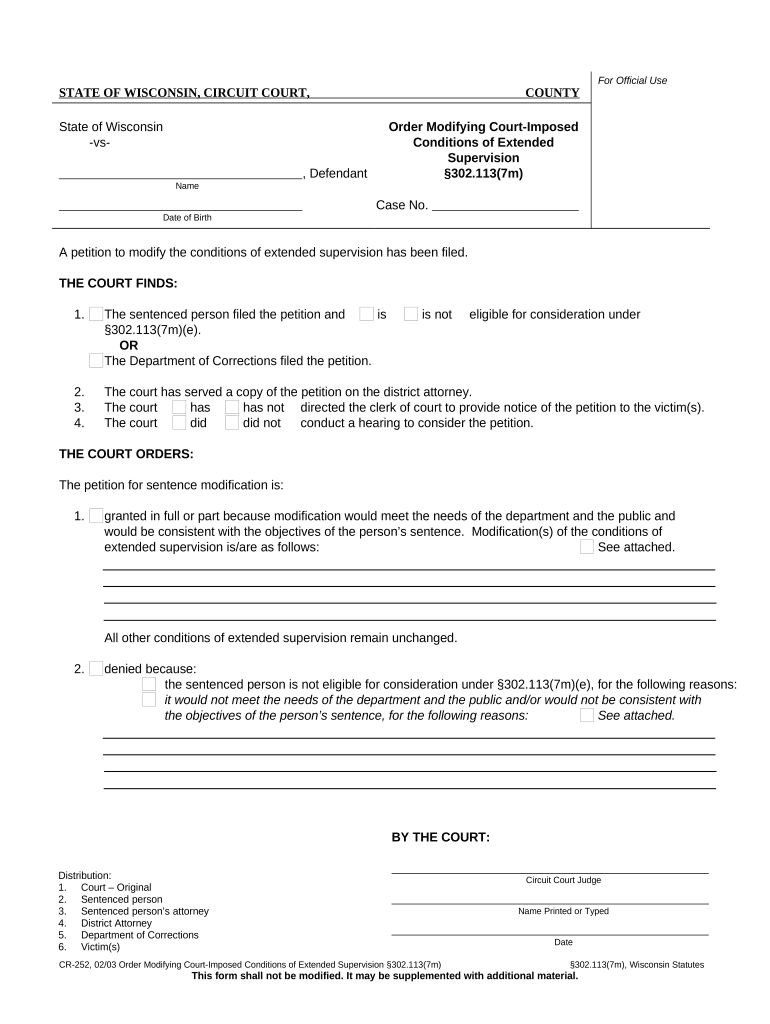
Wisconsin Order Modifying Court-Imposed Conditions of Extended Supervision
What this Wisconsin court order does and when it applies
Why a clear modification order matters
A precise order reduces ambiguity for supervising officers, clarifies lawful authority for monitoring or sanctions, and documents the legal basis for changes that affect risk management, treatment plans, or community safety.
Who typically prepares and relies on this order
Courts, probation departments, supervising agents, and attorneys use this order to document legally binding changes to extended supervision conditions.
- Judges and court clerks — issue, sign, and enter the modification into the official docket and case record.
- Probation and parole agents — recommend adjustments, monitor compliance, and implement court-ordered changes in supervision plans.
- Defense attorneys and prosecutors — file motions, present evidence, and negotiate proposed condition changes or limitations.
Primary roles that interact with the order
Supervision Officer
A probation or extended supervision agent who documents behavior, recommends modifications when circumstances change, and enforces newly ordered conditions. Officers rely on the written order to implement monitoring, arrange treatment referrals, or request sanctions for violations.
Presiding Judge
The judge evaluates petitions or motions to modify conditions, weighs public safety and statutory factors, and signs the order when modification is warranted. The signed order becomes an enforceable part of the sentence and the court record.
Step-by-step: preparing and filing a modification order
-
01Confirm Eligibility: Review statute, judgment, and supervision file for authority to modify conditions.
-
02Draft Motion/Order: Prepare a concise motion and a proposed order with precise condition language.
-
03Serve Parties: Provide required notice to counsel, supervision agent, and prosecutors per local rule.
-
04Hearing & Entry: Attend hearing if required; secure judge’s signature and clerk’s docket entry.
Process flow from request to enforceable order
-
File Motion: Submit a written motion explaining requested changes and supporting facts.
-
Schedule Hearing: Court schedules a hearing or rules on the papers depending on local procedures.
-
Judge Signs Order: Judge reviews evidence and signs the proposed order with explicit condition language.
-
Entry & Service: Clerk enters order on docket and parties receive copies for enforcement.
Digital workflow settings for online preparation and signing
| Field | Configuration |
|---|---|
| Platform | Use court-approved e-filing portal or secure document management system. |
| Authentication | Require email plus SMS or access code for signer verification when possible. |
| Signature Type | Use a judge-signed wet signature or court-accepted electronic signature per local rule. |
| Document Format | Submit as PDF/A when court e-filing requires archival-compatible formats. |
Technical and integration considerations for eSubmission
Ensure the chosen platform supports secure PDF signing, audit trails, and the court’s e-filing format before submitting any order.
- File Formats: PDF, PDF/A, and DOCX accepted by many courts.
- Audit Trail: Capture timestamps, IP, and signer actions.
- Integrations: Connect to case management and cloud storage systems.
Common preparation errors to avoid
- Using vague language when amending conditions, which creates enforcement uncertainty and invites future litigation or clarification requests.
- Failing to include the precise effective date or implementation timeline, resulting in disputes over when obligations or monitoring begin.
- Not serving the modified order promptly on supervising agents and counsel, which can delay enforcement and create compliance gaps.
- Omitting statutory or jurisdictional citations supporting the modification, weakening the legal basis for the change on appeal.
Consequences of defective or improperly entered orders
Typical timing and procedural checkpoints
Motion Filing:
File with clerk; local rules set required notice periods.
Hearing Scheduling:
Court assigns a hearing date or rules without hearing per local practice.
Order Entry:
Clerk enters the signed order on the docket and distributes copies.
Service Deadline:
Serve parties promptly after entry per local procedure.
Record Retention:
Maintain copies according to agency and court retention rules.
eSignature vendor pricing context for signing and distributing court orders
| signNow | DocuSign | Adobe Sign | PandaDoc | HelloSign | |
|---|---|---|---|---|---|
| Starting Price | $8/user/mo | $15/user/mo | $14/user/mo | $19/user/mo | $15/user/mo |
| Free Trial | 7-day trial | Varies by plan | Varies by plan | Varies by plan | Varies by plan |
| Bulk Send | Yes | Yes | Yes | Yes | Varies |
| Audit Trail | Yes | Yes | Yes | Yes | Yes |
| HIPAA Compliant | Yes | Yes | Yes | No | No |
Realistic examples of common modification scenarios
Treatment-Based Modification
A supervision agent moves to add outpatient substance-abuse treatment as a condition of supervision
- Court considers treatment compliance and risk assessment
- The resulting order specifies treatment provider, frequency, verification methods, and an effective date, enabling enforcement and coordination between the agent and provider for monitoring compliance.
Employment-Related Adjustment
Defendant requests removal of an employment restriction that prevents work at certain sites
- Employer verifies job offer and risk mitigation
- The court amends the condition with clear workplace restrictions, reporting requirements, and a sunset clause to allow job stability while preserving public safety.
Practical tips for accurate, enforceable orders
Frequently asked questions about preparing and using the order
-
Can the order be signed electronically?
Yes, electronic signatures are generally legally valid under the federal ESIGN Act (15 U.S.C. §7001) and state UETA provisions where adopted. Verify the local court’s e-signature and e-filing policies before submitting; some courts require wet signatures or specific e-filing procedures.
-
Who must be served with the signed order?
Serve all parties of record, counsel, and the supervising agent per local rules. Prompt service ensures supervising officers can implement changes and preserves notice for any timely challenges or compliance steps.
-
What if the order language is unclear?
Ambiguity can lead to enforcement disputes. If unclear, file a clarification or rehearing motion, or request that the court enter a corrected order with precise, enforceable language.
-
Are notarization or witnesses required?
Court orders are signed by judges and entered by clerks; notary acknowledgments and witnesses are typically not required. Confirm any local administrative rules or statutes that impose additional formalities.
-
How should sensitive health information be handled?
Limit disclosures to the minimum necessary and use HIPAA-compliant processes when sharing protected health information. Obtain releases where appropriate and store records under secure access controls.
-
What records should agencies retain?
Retain the signed order in the case file for the full supervision term plus recommended post-termination retention. Follow federal and state retention rules and preserve records for any potential litigation or audit.