Establishing secure connection…Loading editor…Preparing document…

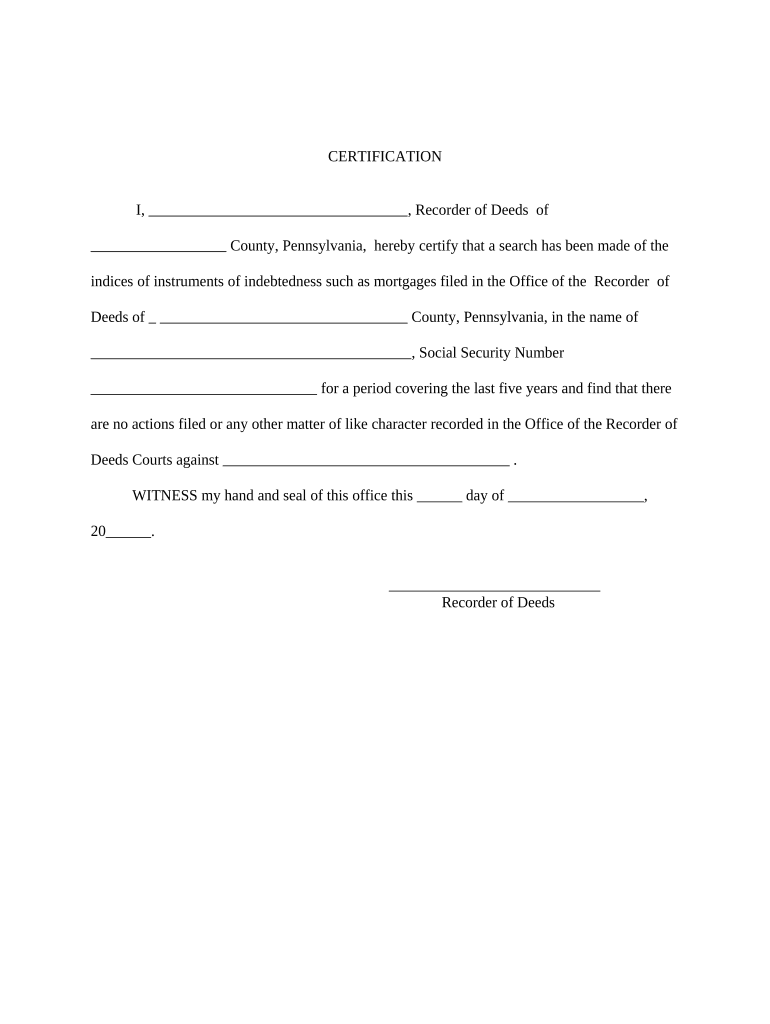
Pennsylvania Certification of No Record

This template is fully customizable. Edit the text, fill out the fields, and send it for signature. Give it a try!
Pennsylvania Certification of No Record

What the Pennsylvania Certification of No Record Is

The Pennsylvania Certification of No Record is an official statement, typically issued or requested to confirm that a named individual or entity has no recorded criminal history or other specified records within a particular agency or jurisdiction. Commonly used for employment screening, licensing, immigration support, or professional credentialing, the certificate documents a negative search result from a central records source. Depending on the issuing authority, the certification can be delivered as a printed certified copy, a sealed paper certificate, or an electronic record suitable for digital transmission and long-term retention.

Why this Certificate Matters for Compliance and Verification

A Certification of No Record provides authoritative evidence that a background search produced no reportable entries, reducing ambiguity for employers, licensing boards, or foreign authorities. It helps streamline onboarding, regulatory checks, and credentialing where a verified absence of records is required.

Why this Certificate Matters for Compliance and Verification

Common users and recipients of the certification

The certificate is also requested by landlords, volunteer coordinators, and international authorities that require official, verifiable evidence of no record.

  • Employers and HR departments verifying applicants before hire or promotion.
  • Licensing and professional boards reviewing fitness and background disclosures.
  • Immigration attorneys and applicants needing proof for visa or residency submissions.

Core parts of a professional Certification of No Record

A complete certificate combines identifying data, the certifying authority's statement, authenticity elements, and retention metadata to ensure reliability and reusability.

Header

Issuing agency name and letterhead or official seal that identifies the source and provides an immediate trust signal for relying parties.
Subject Data

Full legal name, date of birth, and any identifying numbers (e.g., state ID or case number) to tie the certificate to a unique record search and avoid ambiguity.

Search Scope

A concise description of the databases and date ranges searched, clarifying the certificate's limitations and what types of records were considered.

Certification Statement

A signed and dated declaration from an authorized official confirming no record was found and specifying the search date and authority.

Authentication

Notary acknowledgement, official stamp, digital signature, or audit trail that verifies the certificate's integrity and origin.

Retention Metadata

Record ID, issuance date, and instructions for verification or replacement to support future validation and long-term storage.

Step-by-step: obtaining or preparing the certificate

A clear sequential process reduces rework and ensures the certificate will be accepted by relying parties.

  • 01
    Gather IDs: Collect the subject's government ID and any prior name documents.
  • 02
    Complete Request: Fill the application with exact name, DOB, and contact information.
  • 03
    Choose Delivery: Select certified paper, electronic notarization, or secure e-delivery.
  • 04
    Verify Receipt: Confirm the receiving party accepts the chosen format and authentication.

Configuring an online completion workflow

Set up a predictable digital workflow: field validation, signer sequence, and evidence capture to create a legally defensible record.

Field Configuration
Name Field Required; exact-match validation
DOB Field MM/DD/YYYY mask and required
ID Upload Required; accept PDF/JPEG, preserve metadata
Signature Single-signer field with timestamped audit trail

Typical submission and routing steps

Understanding where the document travels after signing helps you prepare supporting items and choose the right authentication.

  • Submit Request: Requestor completes form and uploads ID documents.
  • Agency Search: Issuer runs the search against designated databases.
  • Certification: Authorized official signs or notarizes the result.
  • Delivery: Certificate is returned as certified paper or e-file with audit trail.

Digital signing and eSubmission considerations

Choose a platform that provides audit trails, long-term file integrity, and, when required, HIPAA-ready or BAA‑capable configurations to preserve confidentiality and admissibility.

  • Authentication: Email, SMS, or two-factor options
  • Format Support: PDF and DOCX accepted
  • Integrations: Connectors for record systems

Risks and legal consequences of errors

False Statement: Possible criminal liability
Rejection: Relying party may refuse certificate
Delay: Processing delays affect timelines
Privacy Breach: Improper handling can trigger penalties
Notarization Error: Missed notarization may void the certificate
Identity Mismatch: Incorrect data can lead to invalid search

Common preparation errors to avoid

  • Submitting partial names or nicknames that fail to match official records, causing incomplete or delayed searches and additional verification requests.
  • Uploading low-quality or expired ID documents that the issuing authority cannot accept, which prolongs processing and may require an in-person replacement.
  • Choosing an unsupported delivery format—some relying parties require a sealed paper certificate or specific notarization rather than a simple PDF.
  • Failing to disclose aliases or prior legal names, which can produce false positives or an inability to locate relevant records for verification.

Practical tips for accurate and efficient completion

Adopt straightforward practices to minimize rework and ensure the certificate is accepted by all intended recipients.

Verify Identity Documents
Confirm government-issued photo ID is current and legible; photocopy the front and back when required and store with the request record to support future challenges.
Confirm Recipient Requirements
Ask the receiving organization whether they require notarization, an embossed seal, or a certified paper copy before selecting electronic delivery to avoid re-issuance.
Use Strong Authentication
Choose eSignature solutions that offer multi-factor or KBA when identity proofing is critical; preserve the full audit trail to demonstrate attribution and intent.
Keep a Verification Trail
Retain the request, search logs, signed certificate, and delivery receipts together so you can reproduce the record if a dispute arises later.

Real-world examples of how the certificate is used

These brief examples show typical scenarios where a Certification of No Record supports business or legal processes.

Optica Ventures — Tenant Screening

A property manager requested a certified no‑record for a prospective tenant to satisfy corporate leasing policies.

  • The certified statement confirmed a negative statewide criminal search.
  • The formal certificate accelerated approval and reduced the need for manual follow-up, allowing the lease to proceed without additional background steps.

Martin Properties — Remote Closings

A developer needed proof of no disqualifying records for a contracting party during a remote closing.

  • The issuer provided an electronic certified statement with audit logs.
  • The digitally authenticated certificate met lender and title company requirements and avoided in-person notarization delays.

Sample eSignature vendor comparison for certificate workflows

Compare common plan features and starting prices for typical eSignature providers; signNow appears first to align with integration and compliance considerations.

signNow DocuSign Adobe Sign PandaDoc HelloSign
Starting Price $8/user/mo $15/user/mo $14/user/mo $19/user/mo $15/user/mo
Free Trial 7-day free trial Yes Yes Yes Yes
Bulk Send Yes Yes Yes Yes No
Audit Trail Yes Yes Yes Yes Yes
HIPAA Compliant Yes Yes Yes No No
Envelope Cap No cap 100 envelopes/user/year Varies Varies Varies

Frequently asked questions about the Pennsylvania Certification of No Record

Answers to common questions about e-signing, notarization, issuance, and corrections for this certificate.


Need help? Contact support

be ready to get more
Join over 28 million airSlate SignNow users