Establishing secure connection…Loading editor…Preparing document…

Partnership Interest Purchase Agreement

This template is fully customizable. Edit the text, fill out the fields, and send it for signature. Give it a try!
Partnership Interest Purchase Agreement

What the Partnership Interest Purchase Agreement Is

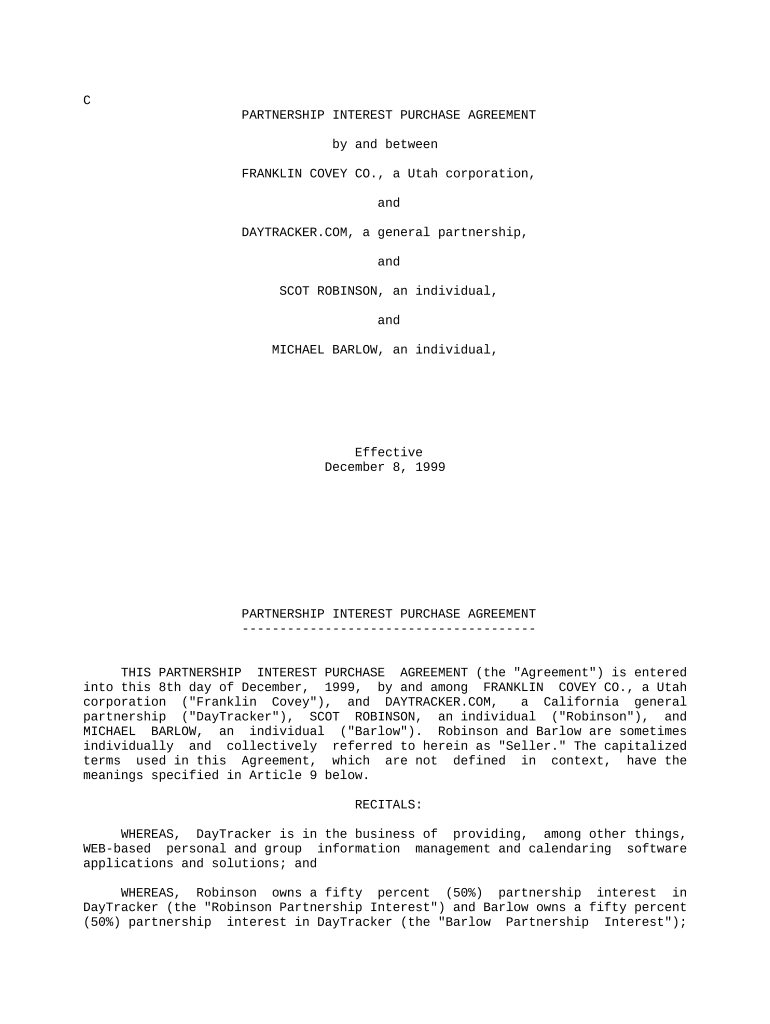
A Partnership Interest Purchase Agreement is a legally binding contract that records the sale, transfer, or assignment of a partner's ownership interest in a partnership. It documents the parties, the specific percentage or units transferred, the purchase price and payment terms, allocation of liabilities, tax treatment, representations and warranties, and any required consents. The agreement allocates rights that previously belonged to the selling partner, and it often triggers regulatory, tax reporting, or filing obligations. Careful drafting reduces disputes and clarifies post-closing governance, distributions, and indemnities for both buyer and seller.

Why a Clear Agreement Matters

A clear Partnership Interest Purchase Agreement protects all parties by defining consideration, transfer mechanics, tax handling, and post-closing obligations. Proper documentation reduces ambiguity that can lead to litigation, adverse tax consequences, or operational disruption.

Why a Clear Agreement Matters

Who Typically Prepares and Signs This Agreement

The agreement is used by current partners transferring all or part of their interest, incoming investors acquiring a stake, and partnership managers facilitating consent and record updates.

  • Selling partner or assignor completing the transfer and providing representations.
  • Purchasing partner or assignee accepting the interest and payment terms.
  • Partnership representatives or managers executing consents and updating books.

Advisors—attorneys, accountants, and tax professionals—are often involved to review tax allocations, buyout mechanics, and amendment of the partnership agreement or certificate of limited partnership.

Who Signs and Why

Selling Partner

Typically the member transferring an ownership interest. Signs to confirm transfer, provide representations and warranties, and acknowledge any noncompetition or post-closing obligations. Often required to deliver tax forms and assist with transition.

Acquiring Party

The individual or entity buying the interest. Signs to accept purchase price terms, assume allocated rights and responsibilities, and confirm any representations needed for admission to the partnership.

Core Elements to Include in a Professional Agreement

A comprehensive Partnership Interest Purchase Agreement contains several standard sections that allocate rights, risks, and procedures between buyer and seller.

Parties

Full legal names of the partnership, seller, and buyer; include entity type and state of formation to avoid ambiguity and confirm authority to transfer interests.
Interest Description

Exact percentage, number of units, or class of partnership interest being transferred, including any limitations on economic or voting rights after transfer.

Purchase Price

Total consideration, payment schedule, escrow instructions if any, and adjustments for liabilities, working capital, or closing account reconciliations.

Representations

Seller and buyer representations about authority, enforceability, title, encumbrances, solvency, and tax status to allocate pre-closing risk and permit indemnity claims.

Closing Conditions

Conditions precedent, required consents (including third-party or lender approvals), required filings, and deliverables to effect a valid transfer.

Post-Closing

Indemnities, tax allocations, covenant not to compete if applicable, admission or non-admission to the partnership, and any voting or distribution adjustments.

Step-by-Step: How to Execute the Transfer

Follow these practical steps to complete a partnership interest sale from preparation through closing and filing.

  • 01
    Prepare Draft: Draft agreement and exhibits reflecting the negotiated terms.
  • 02
    Obtain Consents: Seek required partnership and third-party approvals.
  • 03
    Close Transaction: Exchange documents, funds, and deliverables at closing.
  • 04
    Record and Update: Update partnership ledger, issue amended K-1s, and file any state forms.

Typical Transaction Flow

This sequence summarizes a common workflow from offer to recorded change in the partnership ledger.

  • Offer and Negotiation: Buyer and seller agree key terms and price.
  • Due Diligence: Buyer reviews partnership agreements and financials.
  • Execute Agreement: Parties sign the purchase agreement and related instruments.
  • Post-Closing Steps: Update books, distribute K-1 changes, and notify tax advisors.

Digital Workflow Settings for Online Completion

Configure electronic fields and routing to capture required approvals and preserve an auditable record for tax and legal review.

Field Configuration
Signature Field Require full name, title, and date for each signer
Initials Field Use only where clause-by-clause acknowledgment is needed
Conditional Fields Show escrow instructions only if escrow checkbox is checked
Routing Order Send to seller, then buyer, then partnership manager for countersignature

Digital Signing: Platform and Integration Notes

Use an eSignature platform that supports audit trails, secure storage, and conditional fields to capture transfer-specific data.

  • File Formats: Accept PDF and Word DOCX to preserve formatting and metadata.
  • Integrations: Integrate with cloud storage and accounting systems for recordkeeping and K-1 generation.
  • Authentication: Use email link plus SMS or knowledge-based authentication for higher-assurance signings.

Ensure the chosen platform supports ESIGN and UETA compliance, audit trail export, and secure encryption at rest and in transit to meet regulatory and tax documentation needs.

Key Risks and Penalties to Watch For

Tax Reporting: Incorrect 1099 reporting
Withholding Exposure: Backup withholding risk
Invalid Transfer: No required consent
Title Dispute: Unclear interest description
Notarization Failure: Missing acknowledgement
Intent Misalignment: Ambiguous representations

Common Preparation Mistakes

  • Using inconsistent entity names across documents causes delays and may require corrective amendments to effect a valid transfer.
  • Failing to obtain partnership or lender consent before closing can render the transfer voidable and expose parties to damages.
  • Omitting precise allocation of liabilities and tax responsibilities leads to post-closing disputes and unexpected tax bills.
  • Relying on unsigned exhibits or informal side letters increases litigation risk and complicates enforcement of seller representations.

Practical Tips to Complete the Agreement Efficiently

These tips reduce rework, speed closing, and help maintain compliance with tax and corporate governance obligations.

Standardize Names and IDs
Use the entity or individual name exactly as registered and include taxpayer identification to avoid mismatches for tax reporting and title updates.
Confirm Required Consents Early
Obtain partnership, lender, and third-party consents during negotiation to prevent last-minute delays and conditional closings.
Document Tax Allocations
Specify how income, gain, and tax attributes are allocated for the period of change to guide K-1 preparation and reduce IRS audit risk.
Keep an Audit Trail
Preserve copies of executed agreements, email approvals, and payment records; an auditable record simplifies disputes and regulatory reviews.

eSignature Vendor Comparison for Executing This Agreement

Key platform features and starting prices to consider when choosing an eSignature provider for executing partnership interest transfers. signNow appears first per comparison guidelines.

signNow DocuSign Adobe Sign PandaDoc HelloSign
Starting Price $8/user/mo $15/user/mo $14/user/mo $19/user/mo $15/user/mo
Free Trial 7-day free trial Varies by plan Varies by plan Varies by plan Varies by plan
Bulk Send Yes Yes Yes Yes No
Audit Trail Yes Yes Yes Yes Yes
HIPAA Compliant Yes Yes Yes No No
Envelope Cap No envelope cap 100 envelopes/user/year Varies by plan Varies by plan Varies by plan

Frequently Asked Questions and Troubleshooting

Answers to common legal, technical, and tax questions that arise when preparing or executing a Partnership Interest Purchase Agreement.


Need help? Contact support

be ready to get more
Join over 28 million airSlate SignNow users