Establishing secure connection…Loading editor…Preparing document…

Pennsylvania Lien

This template is fully customizable. Edit the text, fill out the fields, and send it for signature. Give it a try!
Pennsylvania Lien

What the Pennsylvania Lien Is and when it applies

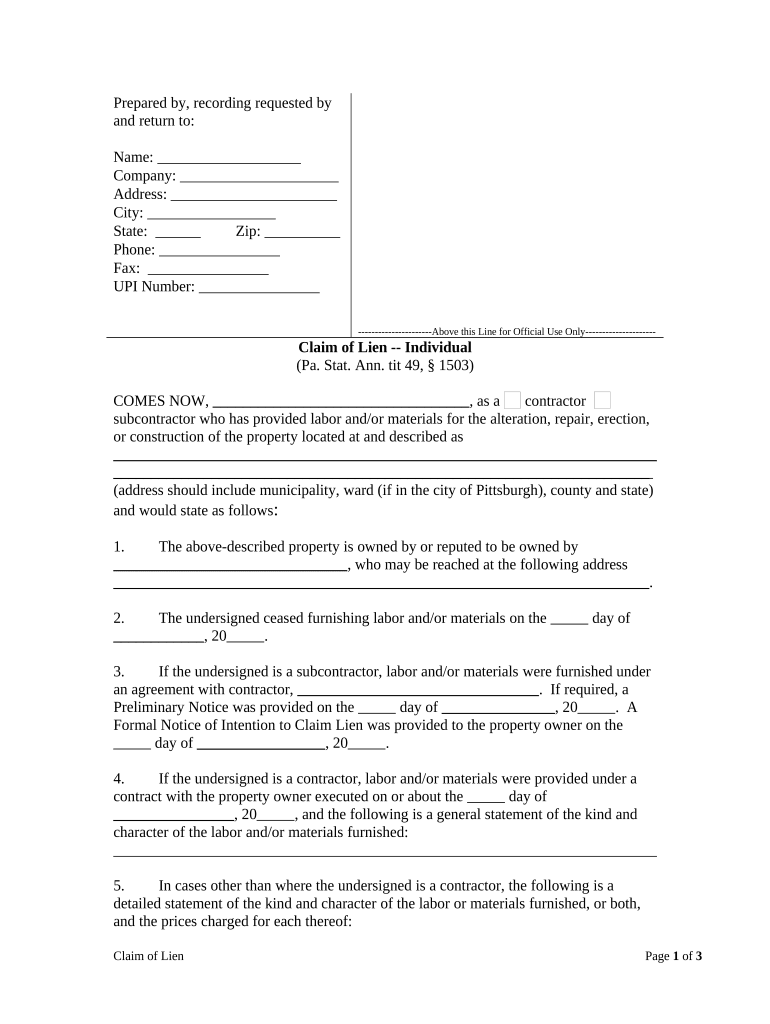
The Pennsylvania Lien is a recorded claim that secures payment or performance tied to real property, a construction project, or a court judgment within Pennsylvania. Common lien types include mechanics' liens, judgment liens, and municipal or tax liens. Filing creates public notice of a creditor's interest, can encumber title, and may trigger remedies such as foreclosure or prioritized payment. Requirements, forms, and procedures vary by lien type and county; confirm local filing office rules before preparing paperwork or serving notice.

Why recording a Pennsylvania Lien matters

A properly prepared Pennsylvania Lien preserves a creditor's claim, creates public notice that can impede property transfers, and establishes priority for payment and enforcement options under state law.

Why recording a Pennsylvania Lien matters

Who files or responds to Pennsylvania Liens

Common parties who file or respond to liens include contractors, subcontractors, suppliers, lenders, property owners, and judgment creditors.

  • General contractors — secure payment for labor and materials on construction projects.
  • Subcontractors and suppliers — file when unpaid to assert a mechanic's lien interest.
  • Judgment creditors — record court judgments to encumber debtor real property and secure collection.

Identifying the correct party helps determine signer authority, required attachments, and applicable filing deadlines for Pennsylvania lien procedures.

Core elements that make a Pennsylvania Lien valid

A professional Pennsylvania Lien includes precise claimant and debtor details, a clear property description, factual basis for the claim, and correct filing and service information to support enforcement.

Claimant

Full legal name and contact information for the party asserting the lien, including business entity details and complete mailing address to ensure proper service and notice.
Debtor

Exact debtor or property owner name, current mailing address, and, where available, tax ID or business registration to avoid mismatches that can invalidate the claim.

Property Description

A legal description or sufficient street address and parcel identifier so the county recorder can index the lien against the correct real property parcel.

Amount Owed

Itemized dollar amount claimed, including unpaid invoices, retainage, interest, and any statutory costs or attorney fees claimed under the contract or statute.

Basis for Lien

Concise factual statement of the work, materials, judgment, or tax basis supporting the lien, citing contract dates, invoice numbers, or judgment docket entries where applicable.

Filing Details

Date of claim, notarization or acknowledgement if required, and county recording office information so the lien is properly indexed and enforceable.

Filing a Pennsylvania Lien: concise step-by-step

Follow these four steps to prepare, sign, and record a Pennsylvania Lien with attention to accuracy and local filing rules.

  • 01
    Prepare Documents: Collect contracts, invoices, and property identifiers supporting the claim.
  • 02
    Complete Lien Form: Populate claimant, debtor, property description, amount, and basis fields precisely.
  • 03
    Authenticate: Have signature notarized or acknowledged if required by the recorder or statute.
  • 04
    Record: File with the county recorder or appropriate office and obtain an official recording receipt.

Where to file and how the recording process flows

Pennsylvania liens are recorded with the appropriate county office or, for certain lien types, filed with a state agency or court; routing depends on lien type.

  • County Recorder: Mechanic's and judgment liens typically record with the county recorder or prothonotary for indexing.
  • State Agency Filings: Municipal or tax liens may require state or county tax office filing procedures.
  • Court Filings: Judgment liens originate from court docket entries; file certified judgments with recording office when required.
  • Recording Effect: Once recorded, the lien becomes public notice and may affect title transfers and financing.

Configuring a digital workflow for lien documents

Common settings help ensure documents are ready for eSignature, notarization, and secure storage across platforms.

Field Configuration
Upload Document PDF or DOCX with embedded exhibits
Signer Authentication Email with SMS code or knowledge-based verification
Notary Option Enable RON or arrange in-person notarization
Retention Save signed PDF/A and audit trail

Digital signing, notarization, and delivery considerations

Electronic workflows must match statutory acceptance, provide signer attribution, and preserve an audit trail for enforcement.

  • File formats: PDF/A, DOCX supported for archival and indexing
  • Integrations: Connect to CRM, cloud storage, and case management
  • Authentication: Email, SMS, KBA, or advanced signer verification

Timing and response expectations for lien actions

Deadlines vary by lien type, jurisdiction, and whether enforcement or release is sought; confirm local statute and county procedures early.

Mechanics' Lien Timing:

File within the statutory period applicable to the project and county; timelines differ by lien category.

Judgment Lien Recording:

Record certified judgments promptly to preserve priority and indexing against debtor property.

Notice / Service:

Serve required notices to owners or contractors per statute before or after recording as required.

Enforcement Window:

Lien enforcement steps, such as foreclosure, proceed under separate statutory timeframes and court rules.

Release or Satisfaction:

Upon payment, prepare and record a lien release or satisfaction to clear the public record.

Typical milestone timeline after nonpayment

A high-level sequence shows when notices, recording, and enforcement commonly occur following a payment default.

01

Nonpayment Identified

Invoice or contractual breach is documented and claimant calculates amounts owed.

02

Notice or Demand

Written demand or preliminary notice is delivered where required by statute or contract.

03

Lien Recorded

Claim filed with recorder and indexing creates public notice of the claim.

04

Enforcement or Release

Settlements, foreclosure, or recorded satisfaction resolve the lien in accordance with law.

Common preparation mistakes that cause rejection or delay

  • Incorrect property description — using an informal address instead of legal parcel identifiers leads to mis-indexing and potential invalidation.
  • Name mismatches — listing a trade name rather than the legal owner or claimant creates grounds for challenge.
  • Missing attachments — failing to include contract, invoice, or judgment references undermines the basis for the claim.
  • Skipping notarization — omitting required notarization or acknowledgement can result in refusal to record or later contest.

Essential data elements to include on the Pennsylvania Lien

Claimant: Full legal name
Debtor: Owner or debtor name
Property: Legal description or parcel ID
Amount: Total claimed
Basis: Contract or judgment reference
Date: Filing and signature dates

Consequences of an incorrect or improperly filed lien

Invalid Filing: Possible removal or not recorded
Priority Loss: Claim may lose priority rights
Penalties: Costs, attorney fees exposure
Statute Risks: Missed deadlines can bar enforcement
Liability: Potential sanctions for false claims
Title Issues: Complicates transfers and financing

How Pennsylvania lien rules compare with nearby states

Selected jurisdiction differences: notarization and witness requirements vary; check local recorder rules for precise procedures.

Criteria Pennsylvania Florida New York
Notarization Required
Witness Count none required two witnesses one witness
Recording Office county recorder county clerk county clerk
Common Lien Type mechanic's lien mechanic's lien mechanic's lien

eSignature vendor pricing and capability snapshot for lien workflows

Compare starting prices and key capabilities relevant to preparing and executing Pennsylvania Liens. signNow appears first per vendor ordering rules.

signNow DocuSign Adobe Sign PandaDoc HelloSign
Starting Price $8/user/mo $15/user/mo $14/user/mo $19/user/mo $15/user/mo
Free Trial 7-day free trial No No Yes, limited Yes, limited
Bulk Send Yes (premium plan) Yes Yes Yes No
Audit Trail Yes Yes Yes Yes Yes
HIPAA Compliant Yes Yes Yes No No

Real-world examples: electronic workflows in property and finance

Sample scenarios show how organizations use electronic signatures and secure workflows to manage lien-related documents.

Optica Ventures LLC

Optica streamlined document signing for property management

  • used standardized templates and remote signing
  • The team reduced turnaround and improved customer convenience while maintaining a clear audit trail for recorded lien claims and releases.

Martin Properties

Martin Properties executed lien waivers and claims online

  • combined mobile signing with secure document storage
  • They processed filings from the field, ensuring accuracy and consistent record retention for title and closing purposes.

Common questions about preparing and filing a Pennsylvania Lien

Answers to frequent questions about validity, electronic signing, notarization, enforcement, and removal of Pennsylvania Liens.


Need help? Contact support

be ready to get more
Join over 28 million airSlate SignNow users