Decedent Details
Provide full legal name, date of death, last residence, and Probate Case information; include death certificate and any prior estate filings to establish jurisdiction and avoid duplicative administration.
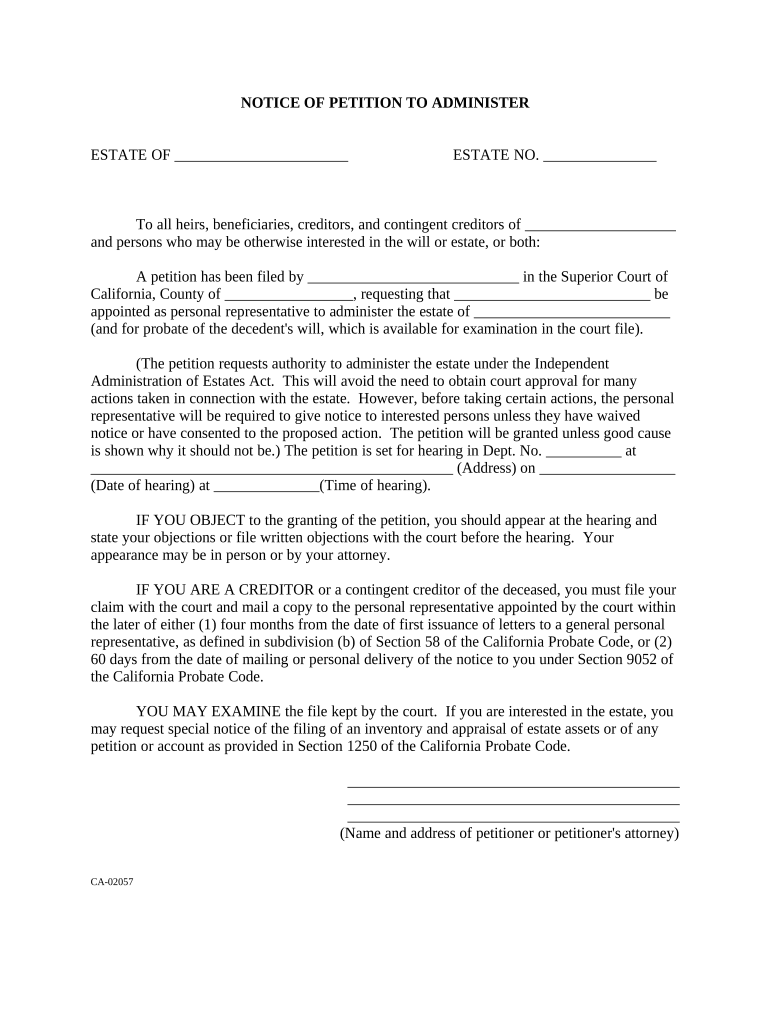
Filing a Petition to Administer Estate opens the formal probate process, clarifies who has authority to act, and provides court-supervised procedures for creditor claims, asset valuation, and distribution. It reduces disputes and creates an official record needed to transfer title and settle obligations.

Common users prepare or submit this petition when starting probate or when a will names an executor needing court appointment.
Clerks and judges review the petition; appointment, bond, and notice requirements proceed under local court rules and state probate law.
| Field Name and Configuration Purpose | How to set and what it controls |
|---|---|
| Signer Roles and Order | Assign petitioner and respondent signing sequence |
| Signature Fields | Attach signature, initial, and date fields |
| Conditional Sections | Show bond/inventory fields when applicable |
| Authentication Settings | Email, SMS code, or advanced auth options |
For eSubmission, verify supported formats, integrations, and signer authentication options offered by your eSignature platform.
Provide full legal name, date of death, last residence, and Probate Case information; include death certificate and any prior estate filings to establish jurisdiction and avoid duplicative administration.
State the petitioner's relationship to the decedent, citizenship or residency, grounds for appointment, and whether the petitioner is named in the will or seeks appointment under intestacy rules.
List identifiable estate assets with estimated values, locations, and documentation; include real property descriptions, account numbers, titles, and any held on behalf assets or jointly owned property.
Detail mortgages, loans, taxes, funeral expenses, and known creditor claims; identify disputed claims and propose procedures or timelines for notice, verification, and resolution under state law.
Specify the powers sought — collection of assets, payment of debts, sale of property, retention of professionals, and authority to distribute; include bond amount if required by statute or court.
Attach proposed creditor and beneficiary notices, proof of service plans, and bond or waiver documentation; show compliance with statutory notice periods to avoid delayed claims or jurisdictional challenges.
Attach an official certified death certificate; courts require a certified copy to prove death and begin probate, and financial institutions will demand certified copies to release funds or close accounts.
Submit the original will if available; attach copies, proof of prior amendments, and a statement regarding safe-keeping to establish testacy and confirm the decedent's final testamentary intent.
Provide recent bank statements, brokerage statements, deeds, titles, and account numbers; supporting documentation verifies asset existence and value and aids clerks in issuing letters of administration.
Attach invoices, loan statements, and tax notices to substantiate known debts; organized creditor proofs streamline claim adjudication and reduce court inquiry into disputed liabilities.
| signNow | DocuSign | Adobe Sign | PandaDoc | HelloSign | |
|---|---|---|---|---|---|
| Starting Price | $8/user/mo | $15/user/mo | $14/user/mo | $19/user/mo | $15/user/mo |
| Free Trial | 7-day trial | Varies | Varies | Varies | Varies |
| Bulk Send | Yes | Yes | Yes | Yes | No |
| Audit Trail | Yes | Yes | Yes | Yes | Yes |
| HIPAA Compliant | Yes | Yes | Yes | No | No |
| Envelope Cap | No cap | 100 envelopes/user/year | Varies by plan | Varies by plan | Varies by plan |
File as soon as practical; schedule first hearing per court calendar.
State statutes set claim windows, often three to six months.
File inventory and periodic accountings as ordered by the court.
Bond may be required pre-appointment; filing sooner reduces bond disputes.
Submit final accounting and petition for discharge to close estate.
Submit petition and pay fee to clerk; schedule initial hearing.
Serve beneficiaries and creditors per statute and record proof.
Judge reviews for qualification, bonds, and objections.
File inventory, pay debts, and prepare final accounting.
Signatures typically require presence of signing parties before notary or witnesses.
Most states require two witnesses for wills; check state law for variations.
Notary adds acknowledgement or jurat per court requirement.
Many states accept remote online notarization; verify state rules.
Attach self-proving affidavit to avoid witness testimony at probate.
Provide certified copies for banks and title transfers.
RON sessions require A/V recording retention per state rules.
Notaries must log act, signers, and ID method per law.
| Comparison Criteria and Petition Types | With Will | Intestate |
|---|---|---|
| Typical Filings | probate | administration |
| Notice Requirements | notice to beneficiaries | notice to heirs |
| Bond Commonality | often waived | often required |
| Distribution Basis | according to will | state intestacy rules |
A surviving spouse filed a simplified petition under small‑estate rules after a decedent left primarily personal property and few creditors.
An executor nominee filed the petition while disputed creditor claims and an unclear beneficiary list required fuller disclosures and a hearing to resolve entitlements.