Establishing secure connection…Loading editor…Preparing document…

Louisiana Community Property Partition

This template is fully customizable. Edit the text, fill out the fields, and send it for signature. Give it a try!
Louisiana Community Property Partition

What a Louisiana Community Property Partition Is

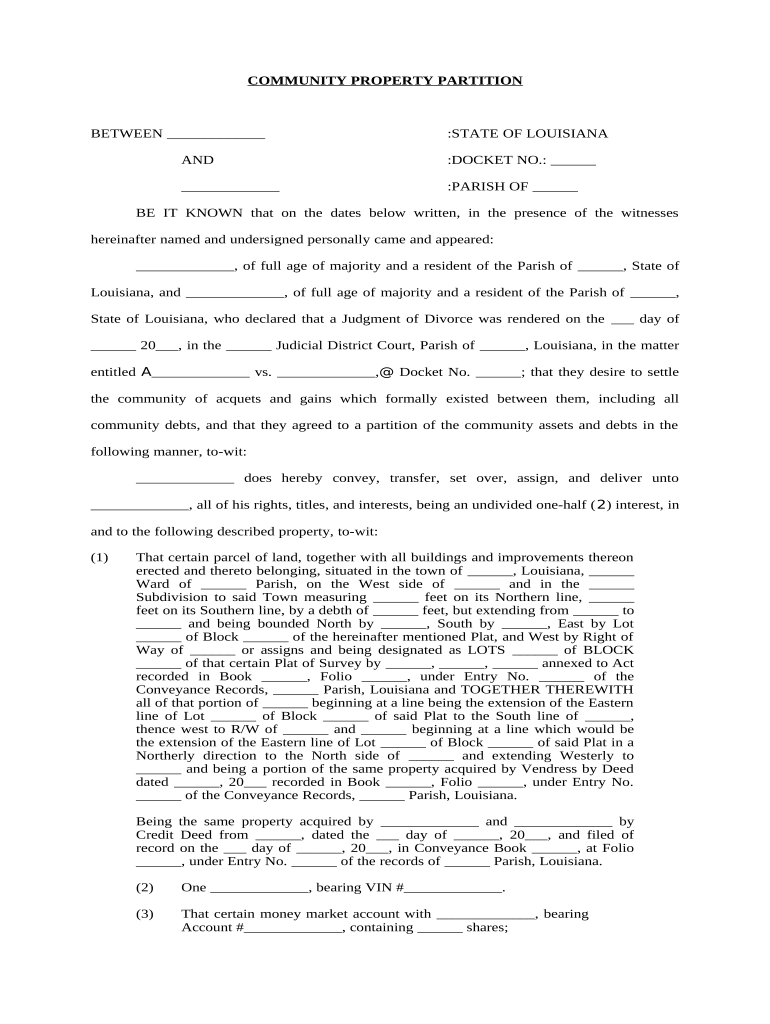
Louisiana Community Property Partition is a legal instrument used under Louisiana civil law to divide, allocate, or convert community property between spouses into separate ownership. It can be created by private agreement, recorded notarial act, or by court-ordered partition in divorce or succession proceedings. The document lists immovable and movable assets, states each party’s share, and specifies title transfers or sale procedures. Proper execution normally involves notarization and required witness formalities and, where applicable, recording with the parish recorder of mortgages and conveyances.

Why a Clear Partition Matters

A properly drafted Louisiana Community Property Partition clarifies ownership, enables clean title transfers, minimizes future disputes, and creates an evidentiary record useful for tax reporting and parish recording offices.

Why a Clear Partition Matters

Who Commonly Uses This Partition

Individuals, attorneys, and title agents use Louisiana Community Property Partition documents to allocate ownership, document transfers, and satisfy recording requirements.

  • Spouses dividing immovable property and household assets during divorce or separation.
  • Estate representatives handling succession and title transfers in parish-level recording offices.
  • Real estate attorneys, notaries, and title companies preparing recorded acts and conveyances.

Typical Parties Involved

Spouse(s)

Parties married under Louisiana law who must identify community and separate property, sign the partition, and consent to transfers. Accurate descriptions and notarized signatures help ensure enforceability and clear title for recording and future conveyancing.

Notary / Attorney

Louisiana notaries or attorneys often prepare partitions, advise on community versus separate classification, draft the notarial act, and manage parish recording to ensure formalities and witness requirements are satisfied.

Required Information and Key Fields

Property description: Legal description, address, parcel ID.
Owner names: Full legal names as on ID.
Ownership shares: Percentage or fraction of ownership.
Consideration: Price or value exchanged, if any.
Notary details: Notary name, commission number, date.
Recording data: Clerk filing date and instrument number.

Key Risks and Potential Consequences

Invalid execution: Missing notarization invalidates act.
Recording omission: Failure to record clouds title.
Tax consequences: Capital gains or gift tax exposure.
Creditor claims: Unpaid debts may attach to assets.
Incorrect descriptions: Ambiguous descriptions cause disputes.
Witness errors: Wrong witness count voids act.

Common Preparation Mistakes

  • Failing to identify separate versus community property clearly, which can lead to later contestation and protracted litigation over ownership.
  • Using informal descriptions instead of precise legal parcel identifiers results in recording rejection or ambiguous title chains needing corrective acts.
  • Omitting required notary acknowledgements or using improper witness procedures under Louisiana civil law undermines enforceability on record.
  • Neglecting to update mortgage and lien records after partition can leave encumbrances attached to supposed separate property.

Core Components of a Professional Partition

A complete Louisiana Community Property Partition combines precise property description, clear transfer language, and formal notarization to effect enforceable title changes and reliable public records.

Legal Description

A complete metes-and-bounds or parish parcel identifier ensures the recorder accepts the instrument; imprecise descriptions are a leading cause of rejection and title ambiguity.
Partition Terms

Explicit allocation of assets, percentages, sale options, buyout terms, and any contingent obligations; defines how community assets convert to separate ownership.

Consideration

State monetary amounts or declared value, if required; noting consideration clarifies tax treatment and supports transfer validity in both private agreements and recorded acts.

Title Transfer

Granting clauses and conveyance language coordinate with recorder requirements to effect ownership changes for immovables and minimize title defects.

Notarial Act

Execution before a Louisiana notary public with required witness statements, attestation, and notary journal entries where applicable to satisfy civil-law formalities.

Recording & Indexing

Timely submission to the parish recorder of mortgages and conveyances with correct instrument formatting, indexing, and recording fees to protect third-party rights and provide public notice.

Step-by-Step: Complete a Partition

Follow these sequential steps to prepare, notarize, and record a Louisiana Community Property Partition correctly and avoid common defects.

  • 01
    Identify assets: List all community and separate property with legal descriptions.
  • 02
    Draft agreement: Set allocation, consideration, and transfer mechanics in clear language.
  • 03
    Notarize & witness: Sign before a Louisiana notary with required witnesses present.
  • 04
    Record instrument: File with parish recorder and obtain instrument number.

Where to File and How It’s Routed

Submit the executed partition to the appropriate parish recorder and, when required, to civil court for confirmation; recording establishes public notice and legal effect.

  • Parish Recorder: Record the act to provide notice and update title records.
  • Clerk of Court: File with court for partitions ordered in judicial proceedings.
  • Tax Authorities: Report transfers for property and income tax purposes.
  • Title Company: Notify insurer to update policies and endorsements.

How to Configure an Online Partition Workflow

Configure an online partition workflow to collect signatures, attach exhibits, and route the document for notarization and recording.

Field Configuration
Signature authentication Email, SMS code, or KBA for identity verification.
Conditional fields Show transfer clauses when sale option selected.
Notary block Include notary signature and witness fields.
Routing order Send to spouse, notary, then recorder.

Digital Signing and eSubmission Considerations

Digital execution and eSubmission for partitions require support for notarized signatures and common file formats.

  • File formats: PDF, DOCX accepted; prefer PDF/A.
  • Integrations: Connectors for NetSuite, Salesforce, Box.
  • Authentication: Multi-factor or knowledge-based options.

eSignature Pricing and Feature Comparison

Compare entry-level pricing and core capabilities relevant to Louisiana Community Property Partition workflows and notarization support.

signNow DocuSign Adobe Sign PandaDoc HelloSign
Starting Price $8/user/mo $15/user/mo $14/user/mo $19/user/mo $15/user/mo
Free Trial 7-day free trial, no card No No Yes, limited Yes, limited
Bulk Send Yes Yes Yes Yes No
Audit Trail Yes Yes Yes Yes Yes
HIPAA Compliant Yes Yes Yes No No

Timing and Filing Deadlines to Watch

Understand critical timing for execution, notarization, recording, tax reporting, and correcting defects to avoid procedural or tax penalties.

Execution timing:

Sign and notarize before witnesses present; date determines effective ownership.

Recording window:

Record promptly with parish recorder to establish public notice.

Tax reporting:

Report transfers on next applicable income tax return.

Corrective filings:

File corrective act immediately upon discovering description errors.

Retention start:

Keep original signed act from execution date forward.

Key Milestones from Draft to Recorded Title

This timeline outlines the principal milestones from drafting a partition agreement through notarization, recording, and title history updates.

01

Draft Agreement

Prepare asset list, allocation terms, and transfer language.

02

Execute & Notarize

Parties sign before notary with required witnesses.

03

Record Act

File with parish recorder and obtain instrument number.

04

Update Title

Submit recorded instrument to title company and insurers.

Real-World Examples of Partition Workflows

Two illustrative examples show how organizations handle partitions, notarization, and recording across multiple properties and teams.

Martin Properties

Martin Properties needed to close partition-related conveyances remotely across multiple properties and time zones without in-person meetings.

  • Used online execution and notary integration.
  • Tim Martin reported processing and executing documents online with full compliance and mobile support, reducing turnaround time and simplifying title updates across parish recorders.

BIS

BIS consolidated partition workflows to centralize security and audit trails across legal and title teams.

  • Leveraged secure eSignature and audit trails.
  • Dan Rotelli emphasized SOC 2 compliance and detailed audit logs as critical for legal defensibility, simplifying dispute resolution and regulatory review by preserving timestamped transaction history.

Frequently Asked Questions

Frequently asked questions addressing execution, notarization, eSignature legality, recording, and steps to correct drafting errors for Louisiana Community Property Partitions.


Need help? Contact support

Practical Tips to Avoid Delays and Disputes

Adopt these practical checks to reduce errors and ensure a smoother partition process across drafting, notarization, and recording.

Verify signer identities and legal names
Match names to government IDs and existing title documents. Inconsistent names trigger recording delays and may require corrective affidavits; include maiden and alternative names where relevant.
Include full metes-and-bounds legal descriptions
Avoid colloquial addresses. Use official parcel numbers, lot and subdivision references, and attach plats or exhibits when helpful to ensure the recorder accepts the instrument without corrections.
Confirm required witness and notary formalities
Understand Louisiana's specific notarial and witness requirements. Ensure witnesses are present, the notary completes journal entries, and the notarial language meets parish conventions to prevent later invalidation.
Record promptly and notify title insurers
File the executed partition quickly with the recorder and supply recorded copies to lenders, title insurers, and relevant tax authorities to update liens, policies, and assessments.
be ready to get more
Join over 28 million airSlate SignNow users