Case Caption
Court name, case number, party names, and title 'Motion to Quash Subpoena Duces Tecum' must match the underlying litigation to ensure proper docketing.
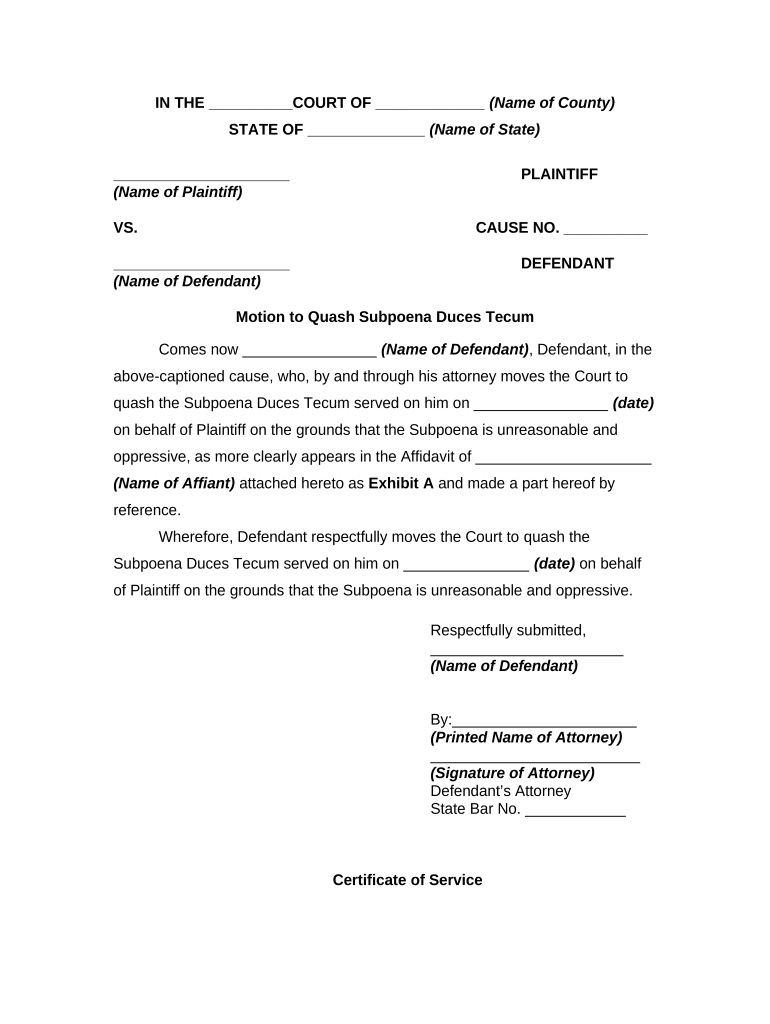
Filing a motion to quash protects parties and nonparties from improper discovery by asserting legal objections and seeking tailored relief from the court.

Attorneys for parties, counsel for nonparty recipients, and compliance officers often draft and file motions to quash when subpoenas demand protected or irrelevant records.
Lead counsel representing the party or nonparty who objects to the subpoena. Drafts the motion, certifies service, and presents oral argument at hearing. The attorney must include legal grounds, supporting facts, and any required declaration or exhibit.
Officer or records custodian for a third party who received the subpoena. Provides factual declaration about burden, search efforts, or privacy concerns and signs any accompanying statements attesting to the production difficulty.
Court name, case number, party names, and title 'Motion to Quash Subpoena Duces Tecum' must match the underlying litigation to ensure proper docketing.
A concise request stating whether you ask the court to quash, modify, or limit the subpoena and the specific documents or categories at issue.
Short, chronological facts: who served the subpoena, date of service, scope of requests, custodial burdens, and any meet-and-confer efforts made.
Statutes and case law supporting the motion (e.g., Fed. R. Civ. P. 45(c)(3), privilege doctrines, undue burden standards) with application to the record.
Declarations from custodians or counsel describing search methodology, estimated time/cost, and any confidential nature of requested materials.
A ready-to-sign order that narrows or quashes the subpoena, drafted to the court's local formatting rules to expedite disposition.
| Step | Configuration |
|---|---|
| Prepare Document | Assemble PDF with attachments; apply Bates stamping if required. |
| e-Signature | Add attorney signature block and date fields for each filer. |
| Court Filing | Upload to court e-filing system; select event code matching motion type. |
| Proof of Service | Generate and store certificate of service with timestamps for the record. |
Courts and opposing counsel increasingly accept electronic filings, PDFs, and e-signatures subject to local rules and confidentiality measures.
Typically within 14 days under Fed. R. Civ. P. 45 after service; check local rules for variations.
Local civil rules usually set an opposition window (often 7–14 days) after service of the motion.
Court typically sets a hearing date within weeks; emergency motions may be expedited.
File motion promptly to seek stay of production pending court resolution where appropriate.
Keep originals and privileged log copies until final resolution and any appeal window closes.
Date subpoena was delivered to the recipient; triggers response deadlines.
Documented attempt to narrow requests before filing motion as required by many courts.
Motion and supporting declarations formally submitted to the issuing court.
Court enters order granting, denying, or modifying the subpoena terms after hearing or submission.
| Criterion | Motion to Quash | Protective Order |
|---|---|---|
| Primary Purpose | eliminate or narrow subpoena | limit scope or terms |
| Typical Grounds | privilege/undue burden | confidentiality/harassment |
| Court Remedy | quash or modify | protective conditions |
| Who May File | recipient or party | party or nonparty |
| signNow | DocuSign | Adobe Sign | PandaDoc | HelloSign | |
|---|---|---|---|---|---|
| Starting Price | $8/user/mo | $15/user/mo | $14/user/mo | $19/user/mo | $15/user/mo |
| Free Trial | Yes, 7-day trial | Varies | Varies | Varies | Varies |
| Bulk Send | Yes | Yes | Yes | Yes | No |
| Audit Trail | Yes | Yes | Yes | Yes | Yes |
| HIPAA Compliant | Yes | Yes | Yes | No | No |