Caption
Case caption and court information must match the complaint and docket — use exact party names and the assigned case number.
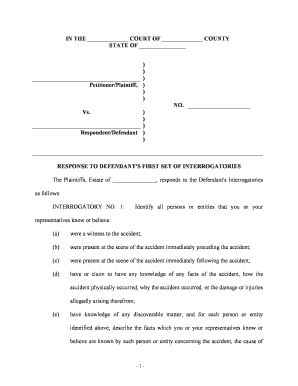
Clear, complete Response Interrogatories reduce disputes, limit later motions, and create an accurate discovery record for depositions and trial.

Parties, document custodians, and witnesses use the served answers to plan depositions, motions, and settlement discussions.
Case caption and court information must match the complaint and docket — use exact party names and the assigned case number.
Define recurring terms and time periods at the start so each answer remains consistent and avoids ambiguity during later briefing.
Respond to each interrogatory in order. Quote the interrogatory or cite its number, then state the response or an objection with legal basis.
When producing documents, list Bates ranges or exhibit IDs and identify custodians to link answers to produced evidence.
State specific objections (e.g., overbroad, burden, privileged) and whether the objection yields a responsive answer or a refusal.
Include a signed verification under oath attesting to the truthfulness and completeness of answers per applicable court rules.
| Case Template Name | Create a case-specific template including caption, signature block, and verification language. |
|---|---|
| Signer Roles | Assign roles for counsel, client signatory, and paralegal reviewer to control access and approval order. |
| Document Attachments | Attach production exhibits and link Bates ranges to answers for traceability. |
| Authentication Level | Choose signer verification (email, SMS, or stronger MFA) consistent with court/local preferences. |
| Audit Logging | Enable full audit trail capture for timestamps, IP addresses, and signer actions. |
Ensure platform logs, tamper-evident PDFs, and secure storage meet discovery and evidentiary needs before serving or filing.
30 days (see Federal Rules of Civil Procedure Rule 33).
Count days from the date of service or from a court order specifying a different schedule.
State and local rules can shorten or lengthen response times; verify court-specific rules.
Parties may stipulate or seek court-ordered extensions for good cause.
Supplement responses promptly upon learning new, responsive information.
Lead counsel or supervising attorney signs verifications and certifies that responses were made after a reasonable inquiry and are true to the best of the client's knowledge.
A corporate representative or officer with knowledge signs for corporate parties, attesting to accuracy and identifying the inquiry and search procedures used.
Include oath or declaration wording that complies with the governing rule.
Have the client confirm factual answers before signing verification.
Signer signs in the presence of required witnesses or a notary if the rule demands.
Obtain notary acknowledgement where verification requires notarized signature.
Use RON only where state and court accept remote notarization methods.
Retain the notarized original in the client file and produce a copy as required.
If witnesses are required, include signed witness statements with contact information.
Keep notary journals and audio-video recordings per state RON rules when used.
| signNow | DocuSign | Adobe Sign | PandaDoc | HelloSign | |
|---|---|---|---|---|---|
| Starting Price | $8/user/mo | $15/user/mo | $14/user/mo | $19/user/mo | $15/user/mo |
| Free Trial | 7-day trial | Varies by vendor | Varies by vendor | Varies by vendor | Varies by vendor |
| Bulk Send | Yes | Yes | Yes | Yes | Varies |
| Audit Trail | Yes | Yes | Yes | Yes | Yes |
| HIPAA Compliant | Yes | Yes | Yes | No | No |