Establishing secure connection…Loading editor…Preparing document…

Revocation of Premarital Agreement

This template is fully customizable. Edit the text, fill out the fields, and send it for signature. Give it a try!
Revocation of Premarital Agreement

What a Revocation of Premarital Agreement Is and When It Applies

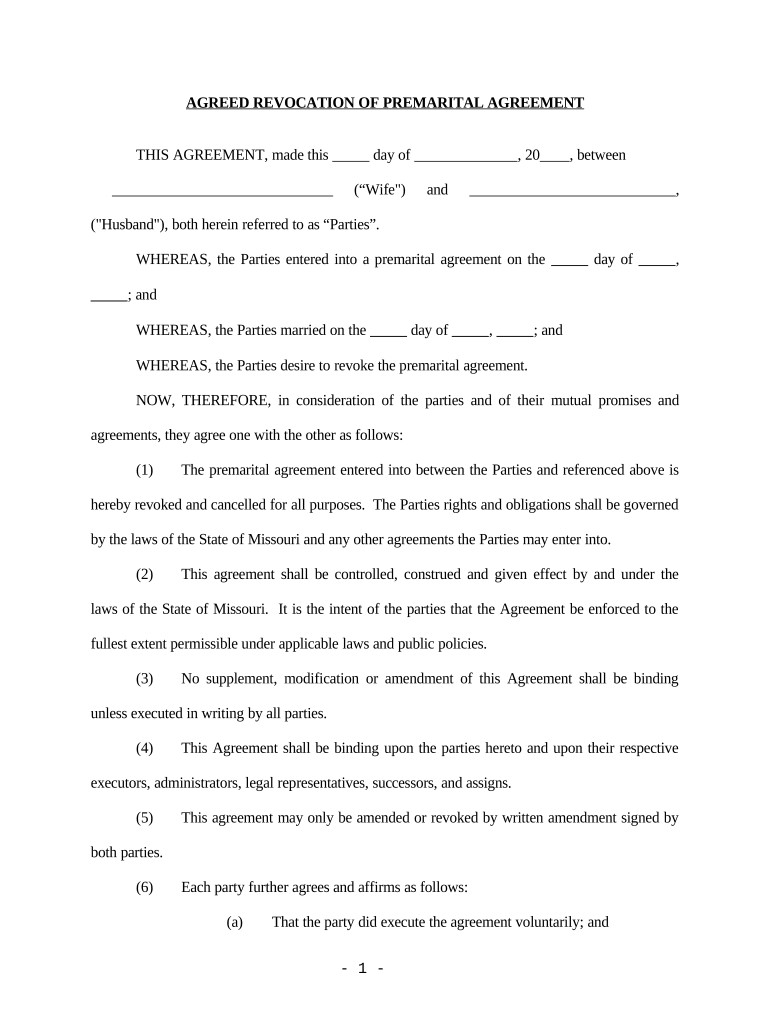
A Revocation of Premarital Agreement is a written instrument by which one or both parties formally cancel, rescind, or terminate an existing premarital (prenuptial) agreement. It identifies the original agreement, states the parties’ mutual intent to revoke specific provisions or the entire instrument, and records the effective date of revocation. Proper form, signatures, and, in some jurisdictions, notarization or witness attestation are required to avoid ambiguity. A clear revocation helps prevent later disputes about the enforceability of previously agreed terms and documents the parties’ present legal positions.

Why You Might Execute a Revocation of Premarital Agreement

Revoking a premarital agreement updates the parties’ legal relationship, clarifies enforceable obligations, and avoids mismatched expectations if circumstances change. A written revocation provides a record that can limit litigation over outdated contractual terms.

Why You Might Execute a Revocation of Premarital Agreement

Who Typically Prepares or Signs a Revocation

Parties and advisors most often involved include the spouses (or prospective spouses), family law attorneys, and settlement officers who assemble the revocation for execution.

  • Individual party — Signs to confirm personal intent and consent to cancel prior terms.
  • Family law attorney — Prepares or reviews language to ensure enforceability and compliance.
  • Court clerk or mediator — May receive or record the revocation when tied to court proceedings.

Having all relevant parties and advisors engaged reduces the risk of defective execution or later dispute over whether the revocation was valid and effective.

Primary Roles Involved

Spouse — Signatory

A party who originally signed the premarital agreement and now signs the revocation to withdraw consent. The signatory must demonstrate present intent and, where required, complete any statutory formalities to make the revocation effective.

Attorney — Advisor

Licensed counsel who drafts or reviews the revocation language, advises on state-specific formalities, and can certify that the revocation reflects clients’ informed and voluntary decisions to avoid later challenges.

Essential Elements to Include in a Professional Revocation

A clear revocation contains discrete elements that identify the original agreement, state which provisions are revoked, and document signatures and execution details for enforceability.

Title and Date

A clear heading and execution date so the document is plainly labeled as a revocation and can be distinguished from amendments or side letters when later reviewed.
Parties Identified

Full legal names and current addresses for each party, matching the names used in the original premarital agreement to avoid ambiguity or mismatched identity citations.

Reference to Original

Explicit citation of the original premarital agreement by date and parties, including any recording or docket numbers if the original was filed with a court or registry.

Scope of Revocation

Specify whether the revocation annuls the entire agreement or particular sections; use precise clause citations or exhibit references when only part of the agreement is rescinded.

Execution Statements

A short attestation of mutual intent and voluntariness, with signature blocks and dates for all signing parties to confirm present consent to revoke.

Authentication

Notary acknowledgement or witness attestations where required by state law; include space for notary/journal entries for remote notarization if used.

Required Information at a Glance

Party Names: Full legal names
Original Date: Date of original agreement
Revocation Scope: Full or partial
Effective Date: MM/DD/YYYY format
Signatures: All signatories
Notary/Witness: If required

Step-by-Step: How to Complete the Revocation

Follow these sequential steps to prepare, sign, and deliver a legally effective revocation of a premarital agreement.

  • 01
    Review original: Locate and read the original premarital agreement.
  • 02
    Draft revocation: Specify full or partial cancellation and reference dates.
  • 03
    Execute: All parties sign; notarize or witness if required.
  • 04
    Distribute copies: Provide signed copies to all parties and counsel.

Configuring a Digital Revocation Workflow

When completing online, set authentication and routing to match legal formality requirements; the following settings are typical.

Authentication Level Email plus SMS code or ID verification
Notary Requirement Enable RON or local notary step if state requires
Signing Order Simultaneous or sequential as parties prefer
Audit Trail Capture IP, timestamps, and actions
Storage Secure, tamper-evident repository

Where to File, Send, or Record the Revocation

Decide the final destinations for executed copies depending on whether the revocation affects court records, property records, or only private contractual relations.

  • Each Party: Retain an original signed copy
  • Attorneys: Provide counsel for client files
  • Court File: File only if the original was filed or ordered
  • Registry: Record with county clerk if linked to recorded property interests

Digital Signing and File Format Considerations

Use e-signature platforms that produce tamper-evident signed PDFs, support audit trails, and comply with applicable authentication rules.

  • Supported Formats: PDF and DOCX
  • Integrations: Salesforce, Google Workspace, NetSuite
  • Security: AES-256 at rest; TLS in transit

Ensure the chosen platform supports the notarization method required by your state (in-person notary, RON) and retains a reliable audit trail for future verification.

Timing, Deadlines, and What To Expect

There is typically no statutory filing deadline for a revocation itself, but timing affects related obligations and potential filing requirements.

Effective Upon Execution:

Revocation generally takes effect on the date signed by the required parties.

Court-Related Filings:

If original agreement was in court record, schedule filing per local court rules.

Notarization Window:

Complete notarization contemporaneously to reduce disputes.

Property Record Timing:

Record promptly when revocation affects recorded interests.

Statute of Limitations Impact:

Effective date may affect time limits for related claims.

Common Risks and Consequences of an Improper Revocation

Invalid Execution: Revocation may be unenforceable
Conflicting Documents: Creates ambiguity about controlling terms
Missing Notary: May be rejected where notarization required
Insufficient Authentication: Electronic signature may lack required proof
Failure to Notify: Third parties may act on old terms
Legal Challenges: Risk of litigation and increased costs

Practical Tips to Reduce Risk and Ensure Clarity

Follow these best practices to make the revocation clear, legally defensible, and easy to administer across systems and parties.

Obtain Legal Review
Have a family law attorney review the revocation language to confirm it accomplishes the intended cancellation and complies with state formalities; legal review reduces the chance of later litigation and ambiguous language.
Use Clear Language
State the scope of revocation precisely (entire agreement or specific clauses), reference the original agreement by date, and avoid vague phrases that invite interpretive disputes.
Match Original Formalities
If the original agreement required notarization or witnesses, replicate those formalities in the revocation to avoid challenges based on procedural mismatch.
Distribute Certified Copies
Provide executed copies to all parties, counsel, and any third parties affected (banks, plan administrators) and maintain a certified original in a secure, tamper-evident system.

Real-World Examples of When Parties Use a Revocation

These short examples show common situations where a revocation clarifies parties’ present intentions and prevents future disputes.

Couple Changing Plans

A couple reconciles after signing a premarital agreement and decide to cancel it before marriage to simplify finances.

  • They jointly sign a revocation stating full cancellation.
  • The revocation is notarized and distributed to both attorneys, preventing future claims that the original agreement controlled asset division.

Partial Revocation for Specific Terms

Parties agree to revoke only the spousal support provisions while leaving property allocations intact.

  • The revocation cites specific clauses by number.
  • Counsel files the signed revocation with client files and notifies account custodians to align beneficiary or title records with the remaining terms.

eSignature Vendor Comparison Relevant to Revocation Workflows

Compare common eSignature providers on starting price, trial availability, bulk send, audit trail, HIPAA options, and envelope limits to decide which platform meets your procedural needs.

signNow DocuSign Adobe Sign PandaDoc HelloSign
Starting Price $8/user/mo $15/user/mo $14/user/mo $19/user/mo $15/user/mo
Free Trial 7-day free trial Yes Yes Yes Yes
Bulk Send Yes Yes Yes Yes No
Audit Trail Yes Yes Yes Yes Yes
HIPAA Compliant Yes Yes Yes No No
Envelope Cap No cap 100 envelopes/user/year Varies by plan Varies by plan Varies by plan

Frequently Asked Questions About Revoking a Premarital Agreement

Answers to common questions about execution, electronic signatures, notarization, and the legal effect of a revocation.


Need help? Contact support

be ready to get more
Join over 28 million airSlate SignNow users