Establishing secure connection…Loading editor…Preparing document…

Guarantor Lease Agreement

This template is fully customizable. Edit the text, fill out the fields, and send it for signature. Give it a try!
Guarantor Lease Agreement

What a Guarantor Lease Agreement Is and When It Applies

A Guarantor Lease Agreement is a legal document in which a third party (the guarantor) agrees to accept financial responsibility for a tenant's obligations under a lease if the tenant defaults. Common in residential and commercial leasing when a tenant lacks sufficient credit, rental history, or local presence, the guaranty supplements the primary lease but is a separate enforceable promise. The guarantor’s obligations may be limited by dollar amount, term, or specific breaches. Properly drafted guarantor agreements clarify parties, effective dates, obligations, termination, and dispute resolution to support enforceability in U.S. courts.

Why a Clear Guarantor Lease Agreement Matters

A precise guarantor agreement reduces ambiguity about payment responsibility, speeds lease approval, and lowers landlord exposure to unpaid rent. It documents scope, triggers, and remedies so parties understand when and how the guarantor must perform.

Why a Clear Guarantor Lease Agreement Matters

Who Typically Prepares or Signs a Guarantor Lease Agreement

Each party should understand obligations, required evidence (IDs, proof of income), and whether notarization or witnesses are recommended in their jurisdiction.

  • Landlords and property managers screening credit and securing performance with a legally binding promise.
  • Prospective tenants who rely on family members or third parties to secure a lease.
  • Guarantors (individuals or entities) who assume contingent liability for rent and damages.

Essential Elements to Include in a Professional Guarantor Lease Agreement

A thorough guarantor agreement clearly allocates responsibility, sets limits, and mirrors or references the underlying lease where appropriate to avoid conflicting terms.

Parties

Full legal names and business entities for landlord, tenant, and guarantor, with mailing addresses and contact information to ensure enforceability and service.
Scope

Specify whether the guaranty is limited (rent only, specific damages) or unlimited, and whether it covers future lease extensions and ancillary charges.

Effective Date

State the date the guaranty begins and whether it is coextensive with the lease term or triggered by specified events.

Obligations

Detail landlord remedies, payment triggers, notice procedure, and whether landlord must pursue tenant first before calling the guarantor.

Duration

Define whether guaranty survives termination, remains for lease renewals, or terminates upon specific conditions such as assignment or replacement guarantor.

Governing Law

Identify the state law governing interpretation and venue for disputes; choice of law affects enforcement and remedies.

How to Complete and Execute a Guarantor Lease Agreement

Follow these steps to prepare, review, and finalize the guarantor agreement with minimal delay.

  • 01
    Gather documents: Collect ID, proof of income, and the primary lease.
  • 02
    Draft terms: Set scope, limits, and effective date aligned with the lease.
  • 03
    Review: Have landlord and guarantor review for clarity and risk.
  • 04
    Sign and authenticate: Sign, date, and notarize if required or recommended.

Setting Up an Online Signing Workflow for a Guarantor Lease Agreement

Configure a clear signer order, required fields, and authentication to streamline remote execution while preserving legal validity.

Field Configuration
Signer Order Tenant then guarantor then landlord for clarity and audit trail.
Required Fields Names, dates, scope selection, and signature blocks set as required.
Authentication Use email link plus optional SMS code or ID check for higher assurance.
Audit Trail Enable IP, timestamp, and document history capture for admissibility.

Technical Requirements for Secure Digital Completion

Retain signed copies and the platform audit log; long-term storage should meet applicable regulatory retention requirements for your industry.

  • Document Formats: PDF or DOCX accepted; ensure flat, non-editable final copy.
  • Authentication Options: Email, SMS, KBA, or ID verification depending on risk profile.
  • Security Controls: TLS in transit and AES-256 at rest recommended.

Standard Routing and Delivery Steps for Execution

A clear delivery path minimizes confusion and documents the sequence of consent and signature for all parties.

  • Upload Document: Landlord uploads the lease and guaranty template to the signing platform.
  • Place Fields: Set required name, date, and signature fields for each signer.
  • Send to Signers: Send in signer order or generate secure signing links.
  • Capture Completion: System records signatures, timestamps, and delivers final PDF.

Timelines, Notice Periods, and Typical Processing Expectations

Understand when obligations start, how quickly a guarantor may be called upon, and common notice windows to preserve remedies.

Effective Date:

Obligations begin on the stated date; use MM/DD/YYYY format.

Rent Default Notice:

Landlord typically issues written notice before demanding guarantor payment; state law may set specific cure periods.

Demand for Payment:

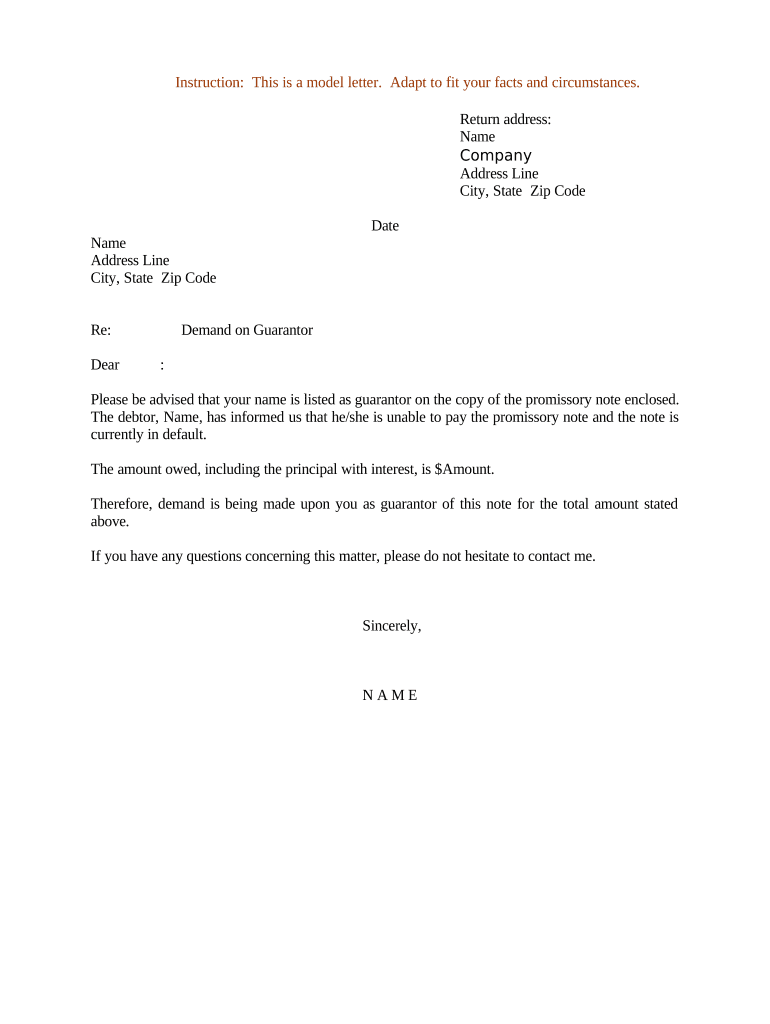
Demand should be in writing and reference the lease and guaranty.

Processing Time:

Digital signing and delivery often complete within 24 hours for remote workflows.

Record Retention:

Keep executed originals and audit logs for the required retention period.

Common Mistakes to Avoid When Preparing a Guarantor Lease Agreement

  • Using vague language about scope which creates disputes over what the guarantor must pay.
  • Failing to match party names and lease references exactly, weakening linkage to the underlying lease.
  • Omitting signature dates or using inconsistent date formats that complicate effective date determination.
  • Skipping authentication and audit trails for remote signatures, which can raise admissibility issues.

Risks and Consequences of an Improper or Incomplete Guarantor Agreement

Enforceability Risk: Ambiguous terms may render guaranty unenforceable.
Financial Exposure: Landlord may face delayed recovery or unpaid rent.
Litigation Costs: Disputes can produce litigation and attorney fees.
Credit Impact: Guarantor credit may be affected by default-based collections.
Invalid Signatures: Poor authentication may lead to challenges in court.
Regulatory Noncompliance: Industry rules (e.g., housing authority conditions) can be violated.

eSignature Vendor Comparison for Executing Guarantor Lease Agreements

Key vendor differences affect cost, bulk sending, audit trails, HIPAA compliance, and envelope limits. signNow is listed first for direct comparison.

signNow DocuSign Adobe Sign PandaDoc HelloSign
Starting Price $8/user/mo $15/user/mo $14/user/mo $19/user/mo $15/user/mo
Free Trial Yes, 7-day free trial Varies by vendor Varies by vendor Varies by vendor Varies by vendor
Bulk Send Yes Yes Yes Yes Varies
Audit Trail Yes Yes Yes Yes Yes
Envelope Cap No cap 100 envelopes/user/year Varies Varies Varies

FAQs and Troubleshooting for Guarantor Lease Agreements

Answers to common questions about validity, signing, notarization, amendments, and digital execution of guarantor agreements.


Need help? Contact support

be ready to get more
Join over 28 million airSlate SignNow users