Establishing secure connection…Loading editor…Preparing document…

Letter Regarding Temporary Restraining Order

This template is fully customizable. Edit the text, fill out the fields, and send it for signature. Give it a try!
Letter Regarding Temporary Restraining Order

What a Letter Regarding Temporary Restraining Order Is and When It’s Used

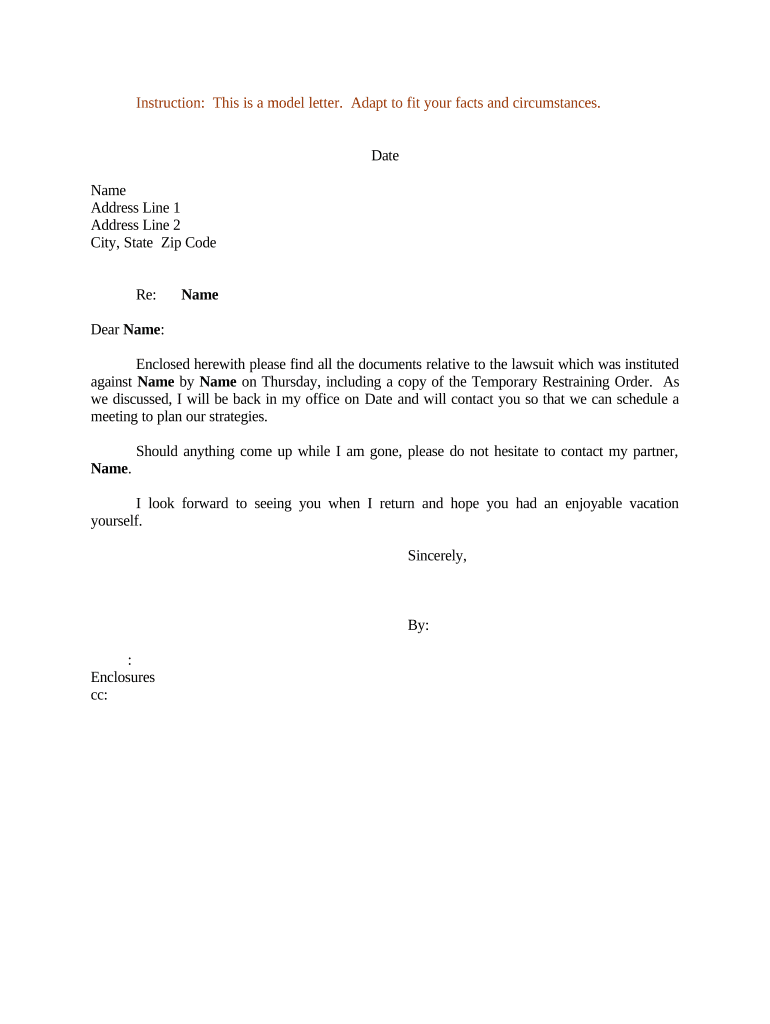
A Letter Regarding Temporary Restraining Order is a formal written notice used to report, confirm, or request temporary injunctive relief from a court and to notify opposing parties, third parties, or service providers about the existence and terms of a court-issued temporary restraining order (TRO). The letter typically summarizes the court caption, the TRO’s effective date and duration, the prohibited and required conduct, any property or contact restrictions, and instructions for compliance or service. It may accompany court filings, be used to notify law enforcement, or be delivered to parties and custodians of records to preserve evidence and prevent prohibited actions.

Why a Clear, Accurate TRO Letter Matters

A concise, correctly formatted TRO letter reduces ambiguity about the court order, supports enforcement, documents notice, and helps limit exposure to contempt or sanctions by creating a record of delivery and the specific obligations communicated.

Why a Clear, Accurate TRO Letter Matters

Who Typically Prepares and Receives a TRO Letter

Organizations and individuals use TRO letters to create a clear, dated record of notice and to trigger compliance or preservation obligations.

  • Plaintiffs and their counsel: Draft and send to effectuate injunctive relief and document notice.
  • Defendants and their counsel: Receive and respond; may preserve evidence and adjust conduct.
  • Third-party custodians: Banks, employers, or service providers who must freeze accounts or preserve records.

Proper distribution and proof of delivery are essential; inaccurate or late notice can complicate enforcement and increase legal risk.

Core Components to Include in a Professional TRO Letter

A professional letter should be structured, court-aware, and concise. Include the court caption, case number, TRO recital, actionable instructions, preservation requests, and signatory details so recipients can identify obligations and respond correctly.

Court Caption

Identify the court, case number, and parties exactly as on the TRO so recipients can correlate the letter with the active court file and avoid misidentification.
Effective Dates

State the TRO issuance date and expiration or return-date. Exact dates determine immediate compliance windows and any emergency relief timelines.

Restricted Conduct

List prohibited acts and specific restrictions in plain language (e.g., no contact, no transfer of assets, no destruction of records) to reduce interpretive disputes.

Required Actions

Describe affirmative duties such as preserving documents, suspending account transfers, or returning property; include deadlines and methods for compliance.

Service and Proof

State how the letter was served or will be served and request confirmation; keep records of delivery (receipt, certified mail, email read receipt).

Signature Block

Include the name, role, firm, address, phone, and signature of the sender. If counsel signs, include bar number and contact for verification.

Step-by-Step: Preparing and Sending a TRO Letter

Follow a consistent sequence to minimize errors: prepare the content, confirm court details, coordinate service, and document delivery for the record.

  • 01
    Draft Letter: Prepare using the TRO language and exact case heading.
  • 02
    Counsel Review: Have an attorney confirm legal accuracy and necessary attachments.
  • 03
    File or Attach: Attach to the court filing if required or reference the docket entry.
  • 04
    Serve and Record: Serve parties and custodians; retain proof of service.

How Distribution and Enforcement Typically Flow

A TRO letter is both a notice and a compliance request; distribution triggers preservation duties and may prompt enforcement steps if ignored.

  • Court Issues TRO: Clerk files order and provides signed copy.
  • Letter Prepared: Sender summarizes key terms and actions required.
  • Recipient Notified: Parties and custodians receive the letter via verified channels.
  • Compliance/Enforcement: Recipient complies or court enforcement steps follow.

Setting Up an eDelivery Workflow for a TRO Letter

Configure a repeatable workflow that captures metadata, service proof, and signatures so each letter is tracked and auditable.

Field Configuration
Document Template Use a standardized TRO letter template with fillable clauses.
Service Method Select certified mail, hand delivery, email with read receipt, or registered courier.
Proof Capture Store delivery receipts, timestamps, and signed acknowledgements.
Retention Tag Apply retention policy and legal hold metadata at creation.

Technical Considerations for eSign and eDelivery

Ensure the chosen platform supports secure formats, audit trails, and integrations that match your evidence and compliance needs.

  • File Formats: PDF and DOCX are standard for court records.
  • Authentication: Use email, SMS codes, or stronger verification when needed.
  • Integrations: Connectors like NetSuite, Google Workspace, and Salesforce aid routing.

Retain signed copies, audit trails, and delivery proofs in a locked archival location accessible to counsel and the court as needed.

Common Preparation Mistakes to Avoid

  • Using an incorrect case caption or number, which can cause the recipient or clerk to misfile the notice and delay enforcement.
  • Vague restriction language that fails to specify prohibited acts, creating room for contested interpretations and enforcement disputes.
  • Failing to document service properly (no certified mail receipt, signed return, or timestamped email), undermining proof of notice.
  • Not coordinating with counsel before sending, which can produce conflicting statements and procedural missteps that harm enforcement options.

Consequences of an Inaccurate or Untimely TRO Letter

Contempt Risk: May expose the non‑complying party to civil contempt fines or other court sanctions.
Spoliation Allegations: Incomplete preservation can lead to evidentiary sanctions or adverse inferences.
Service Defect: Improper service can render enforcement motions ineffective or delayed.
Inconsistent Filings: Conflicting communications may prompt the court to question credibility or impose sanctions.
Criminal Liability: In rare cases, willful violation of clear court orders can trigger criminal contempt.
Costs and Fees: Litigation over notice or enforcement can increase attorneys’ fees and court costs.

Security and Compliance Basics for TRO Letters and Records

Encryption: TLS 1.2/1.3 in transit; AES-256 at rest.
Audit Trail: Timestamps, IP addresses, and action logs capture signer events.
HIPAA Support: Business Associate Agreement required for protected health information.
ESIGN/UETA: Electronic signatures accepted under ESIGN and UETA.
21 CFR Part 11: Available controls for FDA-regulated records where required.
Certifications: SOC 2 Type II, ISO 27001, PCI DSS compliance options.

Examples: When a TRO Letter Is Used in Practice

Realistic scenarios show how the letter clarifies obligations and supports enforcement without creating unnecessary escalation.

Employment Restraint

An employer receives a TRO preventing contact with a former employee

  • employer freezes access immediately
  • the letter documents the notice, preserves company logs, and supports a motion for contempt when breached.

Asset Freeze

A bank is notified via TRO letter to freeze an account

  • bank acknowledges receipt and secures funds
  • the preserved records facilitate a contempt motion and support recovery efforts.

Pricing and Feature Comparison for eSignature Tools Often Used with TRO Letters

Compare baseline pricing and core features relevant to secure delivery, audit trails, HIPAA support, and envelope limits; signNow is listed first for comparison consistency.

signNow DocuSign Adobe Sign PandaDoc HelloSign
Starting Price $8/user/mo $15/user/mo $14/user/mo $19/user/mo $15/user/mo
Free Trial 7-day trial Varies by vendor Varies by vendor Varies by vendor Varies by vendor
Bulk Send Yes Yes Yes Yes Yes
Audit Trail Yes Yes Yes Yes Yes
HIPAA Compliant Yes Yes Yes No No
Envelope Cap No cap 100 envelopes/user/year Varies Varies Varies

Frequently Asked Questions About Letters Regarding Temporary Restraining Orders

Answers to common questions about validity, service, electronic signatures, and what to do if a recipient ignores the letter.


Need help? Contact support

be ready to get more
Join over 28 million airSlate SignNow users