Sender Identity
Name, role (executor/personal representative), probate case number, and contact information to establish authority and traceability.
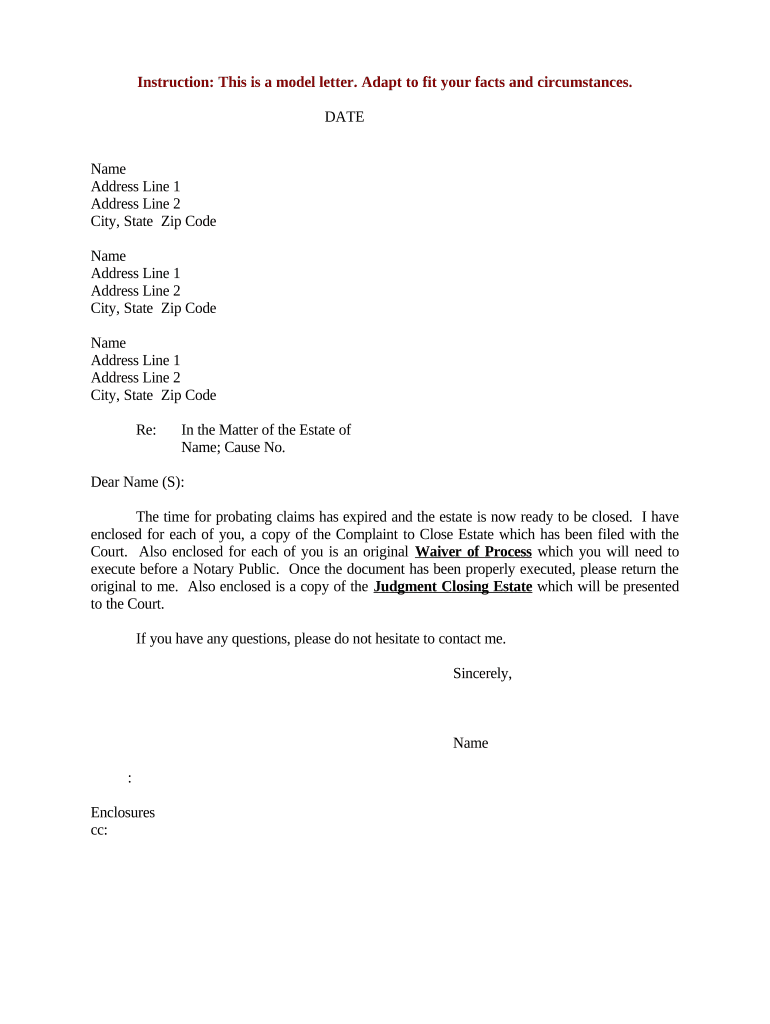
A precise closing letter documents final actions, reduces the risk of disputed claims, and provides recipients with the information they need to update records, release liens, or accept distributions. It supports transparent estate administration and can limit post‑closing liabilities when prepared and distributed correctly.

Common senders include executors, personal representatives, probate attorneys, and estate administrators. Recipients are beneficiaries, creditors, banks, title companies, and the probate court.
Tailor distribution lists and attachments to the recipient group: creditors need accounting and proof of notice, while banks require proof of authority and identification to transfer assets.
Name, role (executor/personal representative), probate case number, and contact information to establish authority and traceability.
Brief summary of total estate receipts, payments for debts and expenses, taxes paid, and net distributable estate with reference to detailed attachments.
Itemized list of asset transfers or payments to each beneficiary, specifying amounts, dates, and method of transfer (check, wire, deed).
Statement confirming whether creditor notices were sent, claims resolved, and federal/state returns filed, including form names where relevant.
Language that asks recipients to acknowledge receipt and release the executor from further claims where permitted by law or court order.
Executor signature, printed name, date, and notary acknowledgment if required by recipient or jurisdiction.
| Field | Online Setting |
|---|---|
| Template | Create reusable template for closing letters |
| Signer Role | Assign Executor as primary signer |
| Authentication | Use email + SMS or advanced auth |
| Date Fields | Auto-fill MM/DD/YYYY with validation |
Ensure the eSignature platform supports required authentication, document formats, and audit trails before sending a closing letter electronically.
Integrations with case management, document storage, and title services streamline recordkeeping; ensure HIPAA or BAA arrangements if letters include health information.
State-specific, often 3–6 months
Varies by court; often months to a year
Form 706 generally due 9 months after death
File final Form 1040 by normal deadline
Begin after creditor resolution and approvals
After final payments were issued, the executor drafted a closing letter summarizing distributions and attached accounting
A personal representative provided a closing letter plus certified court order to a title company
| signNow | DocuSign | Adobe Sign | PandaDoc | HelloSign | |
|---|---|---|---|---|---|
| Starting Price | $8/user/mo | $15/user/mo | $14/user/mo | $19/user/mo | $15/user/mo |
| Free Trial | 7-day free trial (no card) | Varies | Varies | Varies | Varies |
| Bulk Send | Yes | Yes | Yes | Yes | No |
| Audit Trail | Yes | Yes | Yes | Yes | Yes |
| HIPAA Compliant | Yes | Yes | Yes | No | No |