Establishing secure connection…Loading editor…Preparing document…

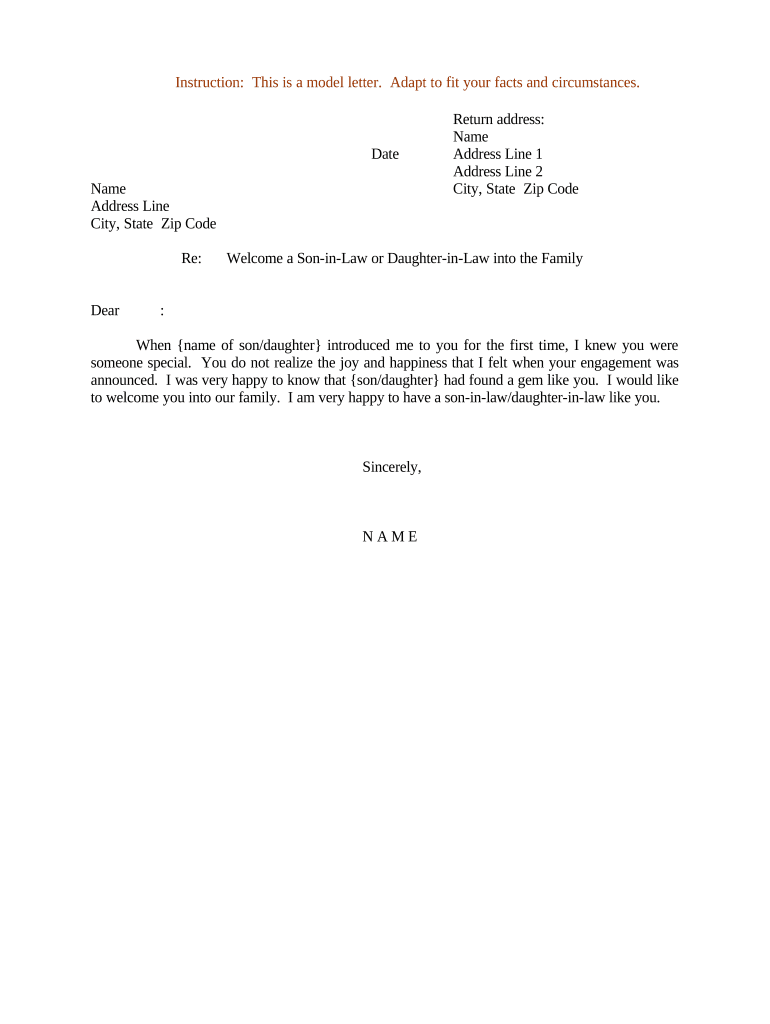
Letter Welcoming Son-in-Law or Daughter-in-Law

This template is fully customizable. Edit the text, fill out the fields, and send it for signature. Give it a try!
Letter Welcoming Son-in-Law or Daughter-in-Law

What the Letter Welcoming Son-in-Law or Daughter-in-Law Is

The Letter Welcoming Son-in-Law or Daughter-in-Law is a concise, personalized statement from family members that formally acknowledges and welcomes a new spouse into the family. It typically identifies the sender, expresses goodwill, may describe family traditions, and can note practical arrangements or contact details. While primarily ceremonial and interpersonal, the letter can accompany legal or administrative filings in adoption, immigration, or name-change contexts. Authors should use clear language, include printed names, and sign and date the document to support future recordkeeping or verification.

Why a Formal Welcome Letter Matters

A clear, written welcome documents family support, reduces misunderstandings about traditions or household expectations, and preserves a record of acceptance. When used alongside legal or administrative filings, the letter can provide corroborating context without creating binding obligations if carefully worded.

Why a Formal Welcome Letter Matters

Who Typically Prepares This Letter

Parents, guardians, and extended family commonly issue this letter to welcome a son-in-law or daughter-in-law into the family circle.

  • Parents seeking a respectful, written welcome and record of family acceptance
  • Couples coordinating introductions, traditions, and household expectations with relatives formally
  • Attorneys or adoption caseworkers when a supportive family letter supplements legal filings

Core Elements to Include in the Letter

A professional Letter Welcoming Son-in-Law or Daughter-in-Law includes clear identification, a warm opening, personal details, statements of support, signature blocks, and optional authenticity or notarization elements.

Opening

Begin with a concise salutation that identifies the sender's relationship and expresses a genuine welcome; avoid language that could be interpreted as conditional or contractual.
Personal Details

Mention family traditions, shared values, or a brief anecdote to create warmth; keep private or sensitive information out of the letter.

Affirmation

State support and acceptance explicitly while avoiding promises about estate, custody, or financial obligations that belong in legal documents.

Logistics

Include practical details when relevant, such as upcoming event dates, household expectations, and preferred points of contact; clarity reduces misunderstandings and eases integration into family activities.

Signature

Provide printed name, relationship, signature, and date. If multiple signers, list each person and their relation for clear attribution in records.

Authentication

Note whether the letter is notarized, witnessed, or electronically signed; add a brief certificate describing how authenticity was verified if applicable.

Step-by-Step: Prepare and Finalize the Letter

Follow these steps to prepare, finalize, and preserve a professional Letter Welcoming Son-in-Law or Daughter-in-Law.

  • 01
    Draft: Write a clear opening and personal welcome.
  • 02
    Personalize: Add specific family traditions or supportive statements.
  • 03
    Review: Confirm names, dates, and tone with other signers.
  • 04
    Sign: Collect handwritten or electronic signatures and dates.

Where to Send and How Recipients Sign

This section outlines where to send the letter and how recipients typically receive, sign, and store the Letter Welcoming Son-in-Law or Daughter-in-Law.

  • Prepare: Finalize content and choose signature method.
  • Deliver: Email, printed hand delivery, or secure e-sign link.
  • Authenticate: Use ID check, SMS code, or notarization as needed.
  • Archive: Store signed copy in secure digital or physical file.

Online Setup: Field Placement and Authentication

Configure an online workflow to place fields, assign signers, set authentication, and define retention before sending the letter.

Field Configuration
Signature Field Add name, date, and signature blocks for each signer
Authentication Email code or SMS OTP; upgrade to KBA for high assurance
Routing Sequential signing to ensure author order and accountability
Retention Store signed PDF with audit trail for access and export

Technical Requirements for Electronic Delivery and Storage

Use platforms that support common document formats and secure e-signing workflows; chosen capabilities affect delivery, verification, and archiving.

  • Formats: PDF, DOCX, and HTML supported
  • Integrations: Google Workspace, Microsoft 365, NetSuite
  • Authentication: Email, SMS, KBA, RON options

Timing and Practical Deadlines

Timing considerations help decide when to send, sign, and record the letter relative to events like engagements, weddings, or formal filings.

Send promptly after engagement or announcement:

Deliver within days of engagement or announcement to demonstrate timely support.

Allow time for reviewer comments:

Give signers 3–7 business days to review and request edits.

Collect signatures before key events:

Collect signatures at family meetings or via secure e-sign link ahead of ceremonies.

Include letter with legal filings as applicable:

Attach letter to adoption or immigration paperwork when requested by agencies.

Issue updates or replacement letters when needed:

If circumstances change, issue a dated amendment or replacement letter.

Required Information and Short Reference

Recipient Name: Full legal name on ID
Sender Name: Full legal name(s) and relation
Date: MM/DD/YYYY format date
Address: Street, city, state, ZIP
Signature Type: Handwritten or electronic signature
Notarization: If used, notary name and seal

Short List: Risks If Prepared Incorrectly

Incorrect Name: Social confusion; administrative delay
Missing Signature: Document may lack attribution
Wrong Date: Misaligned timelines
Unauthorized Signer: Challenges to authenticity
Defamatory Statements: Legal exposure risk
Improper Notarization: State noncompliance

Common Mistakes to Avoid

  • Using overly formal or legalistic language that implies contractual obligations, which can confuse family members and create unintended expectations.
  • Omitting full legal names or dates when the letter will accompany official filings, making verification and record linkage difficult for agencies.
  • Failing to obtain consent or alignment from other signers before finalizing, which can lead to disputes over wording or attribution.
  • Relying on an unsigned scanned copy or informal text message as the sole record, instead of collecting clear signatures and retention copies.

Choosing Between Informal Notes and Formal Letters

Compare common variants so you can choose an informal note, formal letter, or notarized statement depending on purpose and potential legal reliance.

Document Variant Informal Note Formal Letter
Notarization Required optional
Tone casual formal
Typical Signers one signer multiple signers
Legal Weight low low to moderate

eSignature Vendor Pricing Comparison

A neutral pricing comparison for common eSignature plans; signNow is listed first for consistent side-by-side review of typical market options.

signNow DocuSign Adobe Sign PandaDoc HelloSign
Starting Price $8/user/mo $15/user/mo $14/user/mo $19/user/mo $15/user/mo
Free Trial 7-day free trial Varies Varies Varies Varies
Bulk Send Yes Yes Yes Yes No
Audit Trail Yes Yes Yes Yes Yes
HIPAA Compliant Yes Yes Yes No No

Practical Examples of How Families Use the Letter

Two scenarios illustrate common uses: a social welcome and a supportive letter used with official filings.

Engagement Welcome

A mother drafted a formal letter welcoming her daughter's fiancé, expressing family traditions and offering support during wedding planning.

  • Included upcoming celebration dates and family traditions.
  • The letter was signed by both parents, shared with extended family and event planners, and retained in family records; it provided a clear, positive statement without creating legal obligations or requiring notarization.

Immigration Support

Parents prepared a supportive letter to accompany immigration petition materials, confirming family relationship and intent to welcome the new son-in-law.

  • Included with petition evidence and references.
  • Because the letter supplemented official filings, parents notarized the document, obtained clear signature blocks, and retained originals and certified copies as recommended by counsel for immigration case records.

Frequently Asked Questions

Answers to common questions about drafting, signing, notarization, and retention for a Letter Welcoming Son-in-Law or Daughter-in-Law.


Need help? Contact support

be ready to get more
Join over 28 million airSlate SignNow users