Establishing secure connection…Loading editor…Preparing document…

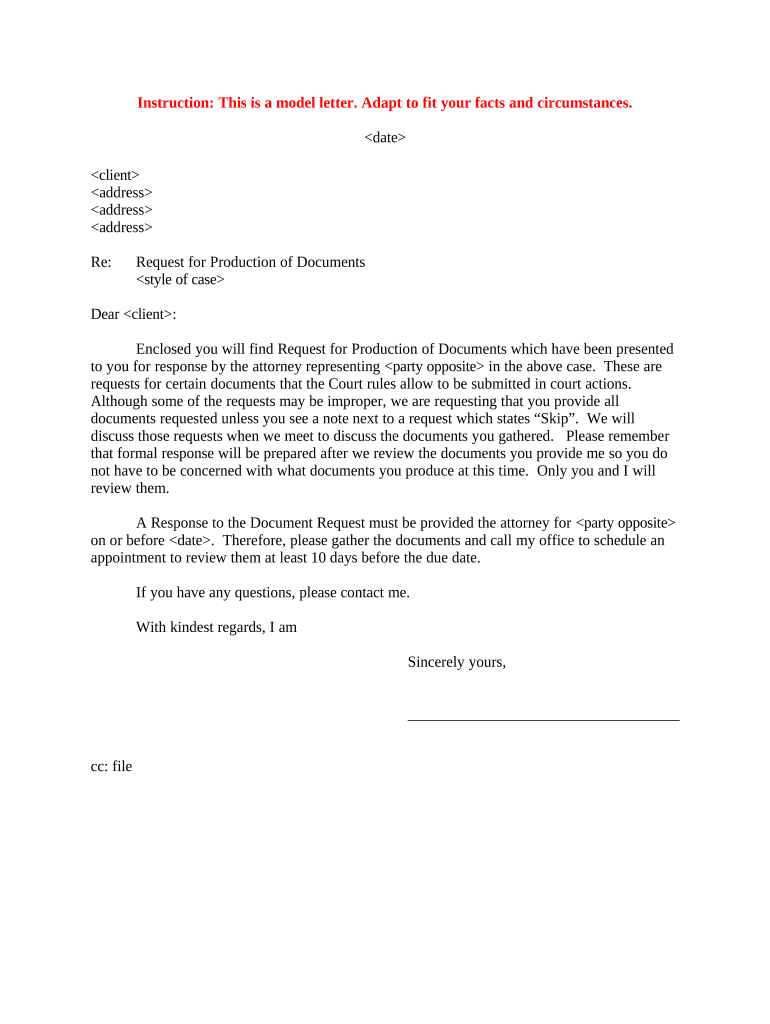
Request for Production of Documents

This template is fully customizable. Edit the text, fill out the fields, and send it for signature. Give it a try!
Request for Production of Documents

What a Request for Production of Documents Is

A Request for Production of Documents is a standardized discovery tool used in U.S. civil litigation to compel an opposing party to produce defined documents, electronically stored information (ESI), and tangible items relevant to claims or defenses. It narrows scope through specific categories and date ranges, often requiring search terms or custodians, and triggers obligations to preserve evidence. Responses typically include objections, a statement of production, and either document delivery or an agreed inspection, with rules governed by federal or state civil procedure.

Why this document matters in litigation and investigations

A well-crafted Request for Production clarifies scope, reduces motion practice, and creates a written foundation for preservation and sanctions if evidence is withheld. It aligns parties on format, custodians, and relevant timeframes and frames disputes for motions to compel.

Why this document matters in litigation and investigations

Who typically prepares and responds to production requests

Both litigants and their counsel use Requests for Production across civil matters to obtain evidence; responding parties must coordinate records custodians and ESI teams to comply.

  • Plaintiff or defense counsel responsible for drafting focused, proportional requests and supporting search protocols.
  • Corporate records custodians and eDiscovery teams tasked with searching, collecting, and producing ESI in agreed formats.
  • Third-party service providers (vendors, custodians) that hold relevant documents subject to subpoena or production must respond or coordinate compliance.

Effective use requires early meet-and-confer communications, clear definitions, and a defensible process for search, review, and production to avoid sanctions.

Essential elements to include in a professional production request

A complete Request for Production should define the requesting party, identify each production category, set temporal limits, specify custodians or sources, state preferred file formats, and provide instructions for objections and privilege logs to avoid later disputes.

Requesting Party

Identify the party making the request and include contact information for counsel and ESI liaisons to facilitate coordination and meet-and-confer.
Definitions

Define key terms (e.g., 'document', 'communication', 'ESI') and any abbreviations to avoid ambiguous scope and reduce discovery disputes.

Production Categories

List discrete document categories with clear time ranges, custodians, and search terms where appropriate to make requests proportional.

Format Instructions

Specify native vs. TIFF/PDF, metadata fields to produce, load file formats, and de-duplication rules for consistent ESI delivery.

Objection Procedures

State deadline for objections, privilege log expectations, and whether redaction is acceptable for privileged material.

Service and Meet-and-Confer

Provide service instructions and request an early meet-and-confer to resolve scope, custodians, and technical production parameters.

Step-by-step: preparing and serving a production request

Follow a clear sequence to draft, narrow, negotiate, and serve Requests for Production; include technical and preservation steps so the response will be defensible and proportional.

  • 01
    Draft request: Define categories, dates, custodians, and formats before serving.
  • 02
    Preserve ESI: Issue preservation notices and litigation holds to custodians immediately.
  • 03
    Serve request: Serve per local rules and confirm receipt to start the response clock.
  • 04
    Meet-and-confer: Discuss scope, format, and objections to avoid motions.

How the production and delivery process typically flows

A predictable workflow helps manage deadlines and reduces disputes: identify custodians, collect ESI, process and review, produce, and document the production with an index or cover letter.

  • Collect: Gather ESI from custodians and centralized systems for processing.
  • Process: De-duplicate, OCR, and extract metadata for review and culling.
  • Review: Conduct privilege and responsiveness review with documented decisions.
  • Produce: Deliver files in agreed format with a production index and load file.

Digital delivery and platform considerations

Digital productions demand secure transfer, metadata fidelity, and platform compatibility to preserve chain of custody and support admissibility.

  • Transfer Methods: Secure FTP, encrypted cloud links, or e-discovery platforms are preferred.
  • Format Support: Ensure PDF, native files, and load-file formats are supported.
  • Integrations: Platforms often integrate with Salesforce, NetSuite, Google Workspace, and Box.

Confirm recipient capabilities before production and retain a verifiable transfer log showing timestamps, hash values, and access records for evidentiary integrity.

Key deadlines and expected turnaround for responses

Timelines depend on the governing rules; under the Federal Rules of Civil Procedure, a party typically has a fixed period to object or produce after service. State courts may set different deadlines.

Initial Response Deadline:

30 days after service to object or respond (see Fed. R. Civ. P. 34(b)).

Productions Schedule:

Propose phased productions for large ESI sets to meet proportionality concerns.

Privilege Log Timing:

Produce privilege logs with the initial production or within an agreed timeframe.

Meet-and-Confer Window:

Engage early—courts expect parties to resolve scope disputes before motions.

Motions to Compel:

File promptly after meet-and-confer if disputes persist; local rules vary on timing.

Common mistakes to avoid when preparing or serving production requests

  • Overbroad or unduly burdensome requests can prompt motions to limit scope and generate costly judicial intervention.
  • Failing to issue a litigation hold before requesting production increases risk of spoliation sanctions and undermines defensibility.
  • Neglecting to specify native formats or required metadata often forces re-production and creates added review expenses.
  • Skipping a meet-and-confer before motion practice increases court sanctions risk and usually leads to wasted attorney time.

Penalties and legal risks for improper handling or withholding

Sanctions: Court sanctions for failure to produce or preserve evidence.
Adverse Inference: Judge may instruct jury that missing evidence hurts the producing party.
Contempt: Willful disobedience of production orders can result in contempt findings.
Cost Shifting: Court may require paying opposing party's production costs.
Attorney Fees: Successful motions to compel can award fees against noncompliant parties.
Criminal Exposure: In narrow circumstances, obstruction or document destruction may have criminal consequences.

eSignature vendor comparison for document delivery and execution

The table below compares starting prices and key features for common eSignature providers to consider when planning secure delivery or authenticated document signing alongside production workflows.

signNow DocuSign Adobe Sign PandaDoc HelloSign
Starting Price $8/user/mo $15/user/mo $14/user/mo $19/user/mo $15/user/mo
Free Trial 7-day free trial Varies by vendor Varies by vendor Free trial available Free trial available
Bulk Send Yes Yes Yes Yes Varies
Audit Trail Yes Yes Yes Yes Yes
HIPAA Compliant Yes Yes Yes No No

Real-world examples of digital document workflows in practice

Organizations across industries use secure eSignature and document platforms to streamline legal and operational document exchanges while preserving compliance and auditability.

Optica Ventures

The interface is simple and easy-to-use for our team; more importantly, it is just as easy for our customers.

  • Efficiency gains in execution reduced turnaround.
  • Optica implemented secure online signing to minimize in-person exchanges and to maintain a clear audit trail during investor due diligence.

BIS

We felt most comfortable with airSlate SignNow given their SOC 2 certification and strict focus on ESIGN and UETA act compliance.

  • Security and compliance were decisive factors.
  • BIS standardized on a secure platform to meet regulatory requirements and reduce legal risk during contract and discovery exchanges.

Practical tips for accurate and efficient production

Adopt defensible, documented procedures for collection and review; clear communication with opposing counsel reduces motion practice and improves proportionality outcomes.

Start Preservation Early
Issue litigation holds and notify custodians at the outset. Document preservation steps to avoid spoliation allegations and support good-faith compliance.
Be Specific and Proportional
Tailor categories by custodian, date range, and subject matter. Proportional requests reduce review burden and the likelihood of contentious disputes.
Agree on Formats
Negotiate native vs. PDF production, required metadata, and load-file specifications to avoid repeated productions and technical rework.
Document Decisioning
Keep a written record of searches, filters, and privilege decisions to demonstrate a defensible discovery process if challenged.

Frequently asked questions about Requests for Production

Answers below address typical procedural, timing, and technical questions encountered when drafting, serving, and responding to production requests.


Need help? Contact support

be ready to get more
Join over 28 million airSlate SignNow users