Letter Regarding Refund in Different Tender Type
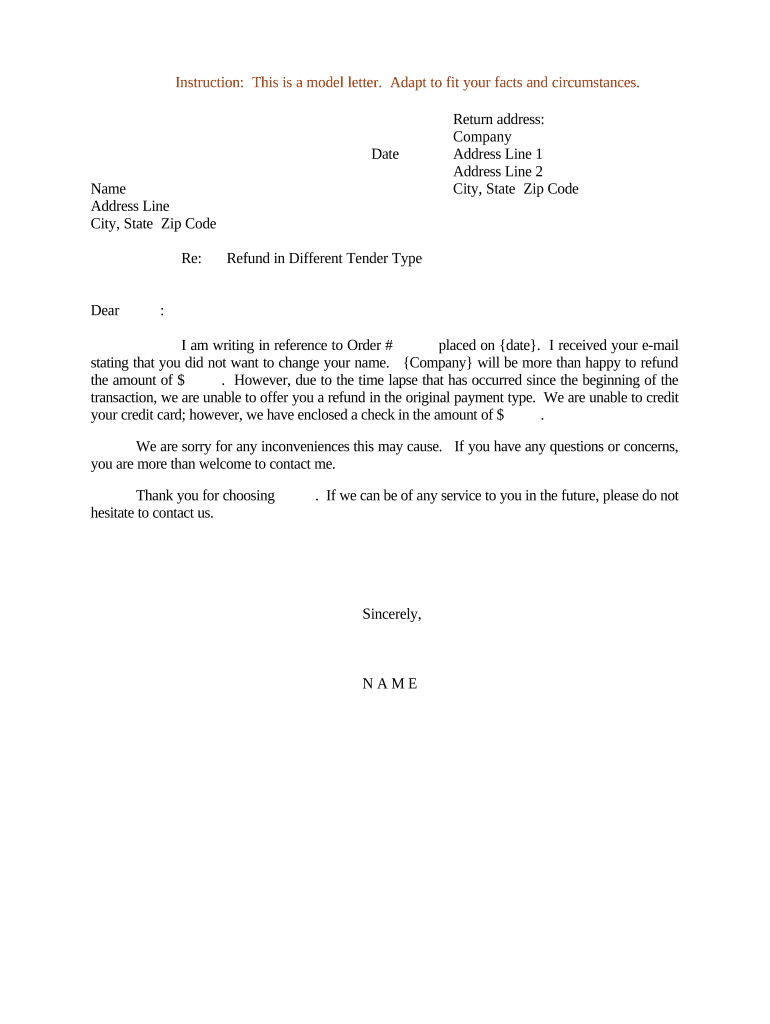
What the Letter Regarding Refund in Different Tender Type Is
Why a Clear Refund Letter Helps Your Process
A well‑crafted Letter Regarding Refund in Different Tender Type clarifies the refund method, reduces processing delays, and creates an auditable record for finance and customer-service teams. It helps avoid duplicate refunds, supports tax reporting, and provides evidence if disputes or compliance reviews arise.

Who Prepares and Receives This Letter
Commonly completed by businesses, refunds teams, or consumers when payment and refund tender types do not match.
- Merchants and finance departments managing mixed-tender refunds and final reconciliations.
- Customer-service agents responding to refund requests, payment disputes, and escalations.
- Accountants and auditors verifying correct tender handling and tax reporting.
Step-by-Step: Prepare and Send the Refund Letter
-
01Prepare Document: Gather transaction ID, tender details, and supporting receipts.
-
02Fill Fields: Complete all required fields using MM/DD/YYYY format for dates.
-
03Authorize: Authorized signer signs and dates; include title.
-
04Send and Retain: Deliver to payer and keep a signed copy for records.
How to Configure an Online Template for This Letter
| Template Field and Configuration Settings | Defines purpose, validation rules, and routing actions for each field. |
|---|---|
| Field Auto-population and Mapping Rules | Map to order ID, payment tender, and customer record. |
| Signer Authentication and Verification Methods | Choose email OTP, SMS code, or KBA for signer identity. |
| Approval Routing, Escalation, and Conditions | Set approvers, conditional steps, and escalation timelines. |
| Record Retention and Export Configuration Options | Define PDF export, audit trail retention, and archive location. |
Where to File, Send, or Submit the Completed Letter
-
Send to Payer: Email finance or use secure portal with signed PDF.
-
Keep Copy: Retain signed copy in accounts payable and customer file.
-
Notify Customer: Confirm refund method and expected timeline to customer.
-
Escalation: If delayed, route to refunds supervisor or compliance.
Distribution Methods and Technical Requirements
For digital distribution, select secure delivery channels and ensure formats are compatible with payer accounting systems and audit needs.
- Accepted Formats: PDF, PDF/A, and CSV exports.
- Authentication Options: Email OTP, SMS code, or SSO.
- Integrations: Connectors for ERP, CRM, cloud storage.
Timelines, Deadlines, and Processing Expectations
Immediate Acknowledgment:
Acknowledge receipt within 24–48 business hours.
Internal Processing Window:
Finance typically processes refunds within 5–10 business days.
Card Reversals Timing:
Card issuer reversals may take 5–10 business days.
ACH or Check Timing:
ACH completes in 3–5 business days; mailed checks take longer.
Dispute Response Period:
Keep documentation for at least 90 days pending dispute.
Key Milestones and Processing Stages
Request Received
Log receipt, assign case ID, and notify stakeholders.
Verification
Confirm tender, transaction, and supporting evidence before approval.
Approval & Authorization
Authorized personnel approve refund and specify refund tender and amount.
Completion & Archive
Execute refund, confirm settlement, and store signed letter.
Common Mistakes to Avoid When Preparing the Letter
- Incomplete tender details leading to misrouted refunds, duplicated reimbursements, and longer reconciliation cycles; always provide original payment identifiers and last four digits of account numbers.
- Vague refund requests such as 'credit due' without specifying refund method cause delays and require additional correspondence to authorize payout.
- Failing to include signed authorization or dated signature prevents finance from processing refunds, increases fraud risk, and may violate internal controls.
- Not retaining a copy of the signed letter with an audit trail (timestamps, IP addresses) undermines dispute defense and may conflict with recordkeeping rules.
Penalties and Risks for Incorrect or Incomplete Letters
Pricing and Capability Comparison: signNow vs. Common Alternatives
| signNow | DocuSign | Adobe Sign | PandaDoc | HelloSign | |
|---|---|---|---|---|---|
| Starting Price | $8/user/mo | $15/user/mo | $14/user/mo | $19/user/mo | $15/user/mo |
| Free Trial | Yes, 7-day free trial, no credit card | Varies by plan and billing cycle | Varies by plan and billing cycle | Varies by plan and billing cycle | Varies by plan and billing cycle |
| Bulk Send | Yes (premium tier) | Yes (available on business tiers) | Yes (enterprise tiers) | Yes (templates & bulk) | No bulk feature on basic plans |
| Audit Trail | Yes (full audit trail) | Yes (full audit trail) | Yes (full audit trail) | Yes (full audit trail) | Yes (audit trail available) |
| HIPAA Compliant | Yes | Yes | Yes | No | No |
| Envelope Cap | No envelope cap | 100 envelopes/user/year limit | Varies by plan | Varies by plan | Varies by plan |
Two Example Scenarios Showing How the Letter Works
Retail Refund
A customer returned electronics purchased with a credit card and requested store credit instead of a card reversal; the merchant prepared a formal letter documenting the request.
- Linked refund to order and receipt.
- The letter included transaction ID, original card last four digits, requested store credit amount, manager authorization, and proof of return; accounting used it to reconcile ledgers and avoid duplicate chargebacks.
Healthcare Refund
A clinic issued a refund where patient paid by credit card but requested check; staff used a formal letter to record patient authorization and payment details.
- Patient signed a written authorization.
- The letter referenced visit date, procedure code, original transaction ID, and included patient contact for verification; a HIPAA-compliant consent was attached and the clinic retained the signed record for its six‑year retention requirement.
Frequently Asked Questions About the Refund Letter
-
Can this Letter be electronically signed?
Yes. Electronic signatures meet legal standards under the federal ESIGN Act (15 U.S.C. ch. 96) and state UETA where adopted, provided intent, consent, attribution, and durable record retention are satisfied; exceptions (e.g., certain court filings) may still require wet signatures.
-
Is notarization required for the refund letter?
Generally no; notarization is not required for typical refund letters, but some payers or banks may require an acknowledgment for disbursement or when refund alters settlement related to real property; verify payer requirements or state notary rules.
-
Which supporting documents should be attached?
Attach proof of purchase, receipt, transaction ID, original tender evidence (e.g., credit card slip), and documentation supporting the reason for refund. For tax or healthcare refunds, include W-9 or signed patient authorization when requested.
-
How long must I retain refund letters?
Retain refund letters at least three years for tax records (IRC §6501(a)); retain healthcare-related records six years from creation or last effective date per HIPAA (45 CFR §164.530(j)). Industry or state rules may require longer retention.
-
Who is authorized to sign the refund letter?
An authorized representative with authority to request refunds signs the letter; for businesses this is typically a finance manager or officer. Include title and contact information; organizations may require board or corporate officer signatures per internal policy.
-
What if the payer refuses the requested tender?
If the payer declines the requested refund tender, document the refusal, include alternative remedy offered (store credit, original-card reversal), and preserve correspondence. Consider escalating to supervisor or compliance and retain records for dispute resolution or regulatory review.