Charge Identifier
Include the EEOC charge number, complainant name, and employer name so staff can locate the correct investigative file without delay.
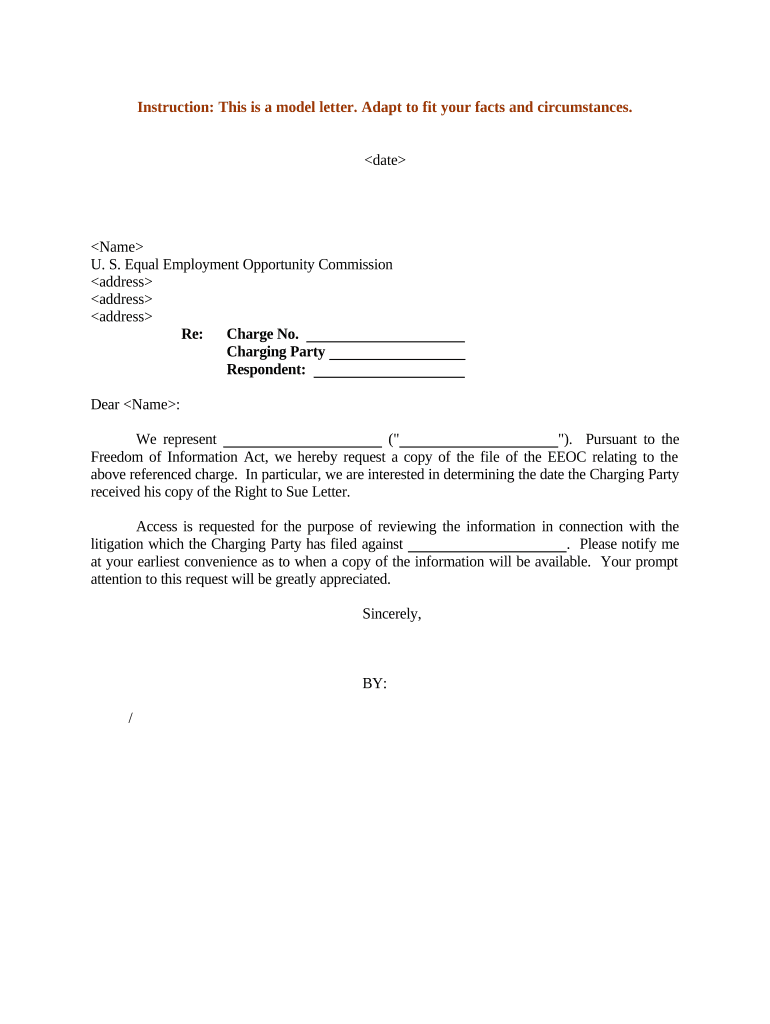
A clear, properly formatted request helps ensure the EEOC locates the correct investigative file, evaluates any privacy exceptions, and responds promptly. Precise identification and scope reduce processing delays and support any subsequent legal or administrative steps.

Common requesters include charged parties, complainants, human resources representatives, attorneys, and authorized third-party investigators who need the EEOC investigative file for defense, settlement, or litigation purposes.
When an attorney prepares the letter, include a signed authorization or power of attorney and clearly state the requester’s relationship to the charge to speed verification by the EEOC.
A human resources director or designated company counsel may submit the letter on behalf of the employer; include a title, contact information, and a statement of authority to request the file.
The charging party or their attorney can request the file; include a signed release or power of attorney where required and provide direct contact details for identity verification and follow-up.
Include the EEOC charge number, complainant name, and employer name so staff can locate the correct investigative file without delay.
Provide full legal name, job title or relationship to the charge, mailing address, phone number, and email for verification and correspondence.
Attach a signed authorization, power of attorney, or written consent when the requester is an attorney or third party acting on behalf of a principal.
Specify the documents or date range requested (for example, interview transcripts, investigative reports, exhibits), and note any exclusions to narrow the search.
Briefly state why access is needed (defense, settlement, litigation planning) to assist EEOC in assessing disclosure under privacy rules.
All requests should be signed and dated; include printed name and title. Electronic signatures may be acceptable where the EEOC permits them.
| Field | Configuration |
|---|---|
| Authentication | Email link or SMS code; consider stronger ID proofing for attorneys |
| Document Format | PDF/A for archival and redaction-friendly processing |
| Signature Type | Electronic signature with audit trail meeting ESIGN/UETA |
| Retention | Store signed request and authorization for at least six years |
When submitting or storing a request letter electronically, prioritize secure transmission, tamper-evident storage, and an auditable trail of consent and signature.
Maintain encrypted storage and an access log for the request file; these practices support compliance with ESIGN, UETA, and applicable privacy rules when records are shared or archived.
Agency typically acknowledges receipt within a few business days
Agencies aim to respond within 20 business days under FOIA (5 U.S.C. §552)
Redaction and privacy checks can add several weeks
Expedited processing considered in limited circumstances
Follow agency-specific procedures for appeal of denial
Prepare letter with charge ID, requester authority, and documents sought.
Transmit by the EEOC’s accepted method and retain proof of delivery.
EEOC verifies identity and conducts privacy/redaction review.
Agency provides records or denial with appeal instructions.
A COO requested the investigative file to evaluate settlement options and preserve evidence
Company counsel sought the EEOC file to prepare litigation materials
| signNow | DocuSign | Adobe Sign | PandaDoc | HelloSign | |
|---|---|---|---|---|---|
| Starting Price | $8/user/mo | $15/user/mo | $14/user/mo | $19/user/mo | $15/user/mo |
| Free Trial | 7-day trial | No | No | No | No |
| Bulk Send | Yes | Yes | Yes | Yes | No |
| Audit Trail | Yes | Yes | Yes | Yes | Yes |
| HIPAA Compliant | Yes | Yes | Yes | No | No |