Establishing secure connection…Loading editor…Preparing document…

Letter Announcing Actions During a Strike

This template is fully customizable. Edit the text, fill out the fields, and send it for signature. Give it a try!
Letter Announcing Actions During a Strike

What this Letter Is and When it’s Used

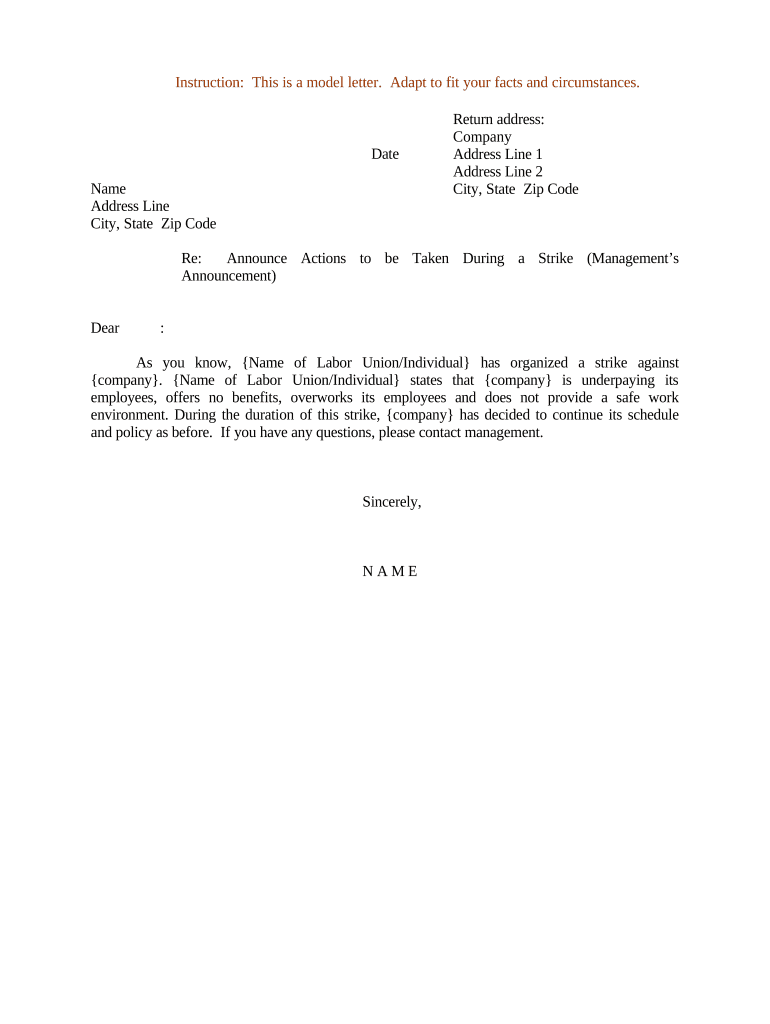
A Letter Announcing Actions During a Strike is a formal employer communication that explains operational changes, staffing adjustments, service interruptions, and employee expectations when a labor strike occurs. The letter documents which actions the employer will take (temporary closures, reduced services, use of replacement labor, safety protocols, and payroll handling), the effective dates, and contact points. It records employer intent and notification to employees, customers, and vendors, and is often used alongside collective bargaining correspondence, legal notices, and contingency plans to create a clear written record of decisions taken during labor disruptions.

Why a Clear Announcement Letter Matters

Issuing a concise, documented letter reduces uncertainty, helps manage legal risk, and preserves evidence of employer actions and communications during a strike. A properly drafted notice supports operational continuity and demonstrates good-faith communication with employees, unions, customers, and regulators.

Why a Clear Announcement Letter Matters

Who Typically Prepares and Receives This Letter

Targeted distribution and retained copies form part of the organization’s strike response documentation and may be needed for future bargaining, litigation, or regulatory review.

  • Employees and management: to communicate changes to schedules, pay, and workplace access
  • Union representatives and shop stewards: to confirm employer actions and timelines
  • Vendors and customers: to explain service impacts and alternate arrangements

Step-by-step: Preparing the Strike Actions Letter

Follow a consistent sequence to draft, review, and distribute the announcement so it is accurate, legally defensible, and practically useful for recipients.

  • 01
    Draft core facts: Summarize actions, affected locations, and effective dates.
  • 02
    Confirm legal review: Have labor counsel review to ensure compliance with labor law.
  • 03
    Approve distribution list: Identify employees, union reps, vendors, customers, and agencies.
  • 04
    Deliver and archive: Send by chosen channels and keep signed, timestamped records.

How to Configure an Electronic Workflow for This Letter

Set up an e-distribution workflow that preserves signatures, timestamps, and an audit trail for each recipient.

Field Configuration
Signer Order Single-stage or role-based depending on approvals required
Authentication Email link plus optional SMS code for higher assurance
Retention Automated archival with tamper-evident audit trail
Notifications Automated reminders at set intervals

Typical Digital Delivery Flow

A standard electronic distribution captures actions in sequence so each step is auditable and reproducible for compliance or dispute resolution.

  • Upload Letter: Add final approved document to the eSignature platform.
  • Place Fields: Insert signature, date, and acknowledgement fields where needed.
  • Add Recipients: Enter recipient roles and delivery order or send simultaneously.
  • Send and Track: Dispatch via email/SMS, track opens, signatures, and downloads.

Technical Considerations for eSubmission

Ensure the chosen setup records signer identity, timestamps, IP addresses, and provides exportable audit reports for internal and legal review.

  • File Formats: PDF, DOCX supported for consistent rendering
  • Integrations: Connect to HRIS, payroll, and document storage systems
  • Security: TLS in transit and AES-256 at rest

Essential Elements to Include in the Letter

Include clear, factual points so recipients understand the scope, timing, and contacts without ambiguity. Keep language neutral and focused on actions and logistics.

Statement of Purpose

Explain why the letter is issued and reference any prior communications or bargaining context as appropriate.
Scope and Locations

Identify affected sites, departments, or business units to avoid misinterpretation about coverage.

Specific Actions

Describe each action (e.g., temporary closure, service reductions, use of replacement labor) with operational detail.

Effective Dates

Specify start and end dates or a review cadence to provide clarity on duration.

Pay and Benefits

Summarize payroll treatment, benefits continuation, or instructions for leave and reporting.

Contacts and Safety

List a contact for questions and safety reporting, including phone and email for urgent issues.

Data and Security Details to Log

Encryption: TLS 1.2/1.3 in transit
At Rest: AES-256 encryption
Audit Trail: IP, timestamp, and action log
Authentication: Email, SMS, or multi-factor
Compliance: ESIGN and UETA adherence
HIPAA BAA: Require BAA if health data included

Common Pitfalls to Avoid

  • Vague timelines that create disputes about when actions begin or end
  • Omitting recipient specifics, causing unclear coverage or missed notices
  • Failing to obtain legal review for bargaining or statutory notice requirements
  • Inadequate recordkeeping that undermines defensibility in later challenges

Legal and Operational Risks of an Incorrect Letter

Unfair Labor Practice: Risk of charges if actions violate NLRA or bargaining obligations
Contract Breach: Potential breach of collective bargaining agreements
Regulatory Fines: Penalties for failing statutory notice requirements
Reputational Harm: Customer and employee trust erosion affecting operations
Payroll Liability: Incorrect pay treatment can create wage claims
Evidence Gaps: Poor documentation weakens legal defense in disputes

Time-sensitive Items and Typical Deadlines

Identify mandatory deadlines and internal milestones so notifications align with legal and operational timing requirements.

Notice to Union:

Follow any contractually required notice period as specified in the CBA

Effective Date Set:

Specify MM/DD/YYYY for start of announced actions

Payroll Cutoff:

Coordinate with payroll deadlines to determine pay impact

Regulatory Filings:

File any required agency notices promptly per jurisdiction

Record Retention:

Archive signed copies immediately and maintain per retention policy

Key Milestones in the Strike Notification Process

A sequential milestone view helps coordinate drafting, review, delivery, and archival steps with responsible parties and dates.

01

Draft Approval

Legal and HR sign-off before distribution

02

Recipient Review

Confirm list and delivery channels for all targeted groups

03

Distribution

Send via chosen channels and log delivery receipts

04

Post-Distribution Review

Address incoming questions and update records as needed

eSignature Pricing and Feature Snapshot for Distribution and Signing

Compare starting price and key feature availability for common eSignature vendors; signNow is listed first per vendor-ordering guidelines.

signNow DocuSign Adobe Sign PandaDoc HelloSign
Starting Price $8/user/mo $15/user/mo $14/user/mo $19/user/mo $15/user/mo
Free Trial 7-day free trial Varies by vendor Varies by vendor Varies by vendor Varies by vendor
Bulk Send Yes (Business Premium) Yes Yes Yes Varies
Audit Trail Yes Yes Yes Yes Yes
HIPAA Compliant Yes (BAA available) Yes Yes No No

Frequently Asked Questions

Answers to typical questions about drafting, delivering, and preserving a Letter Announcing Actions During a Strike.


Need help? Contact support

be ready to get more
Join over 28 million airSlate SignNow users