Establishing secure connection…Loading editor…Preparing document…

Letter Regarding Miscommunication with Clerk's Office

This template is fully customizable. Edit the text, fill out the fields, and send it for signature. Give it a try!
Letter Regarding Miscommunication with Clerk's Office

What the Letter Regarding Miscommunication with Clerk's Office Is

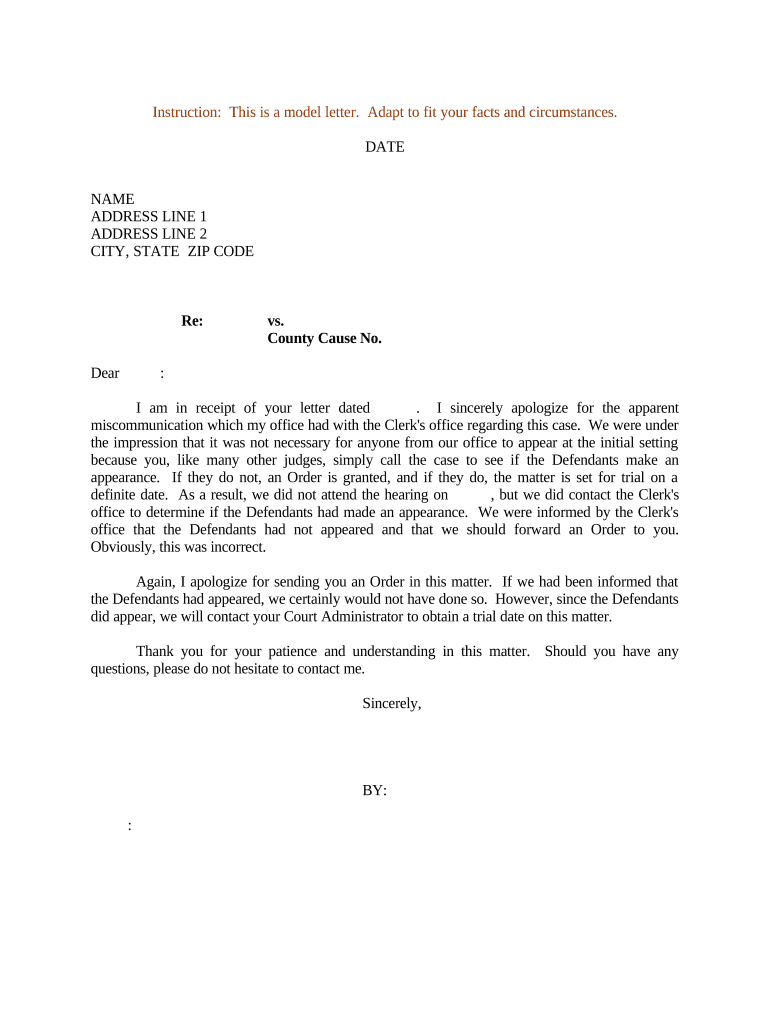
A Letter Regarding Miscommunication with Clerk's Office is a formal written notice sent to a county, municipal, or court clerk to identify and correct an administrative or filing error, clarify conflicting information, or request confirmation of received documents. The letter documents the sender's understanding of events, cites relevant file numbers or case identifiers, and requests a specific corrective action or acknowledgement. It is typically concise, factual, and dated; it may be filed in electronic or paper form depending on local rules and may be used as evidence of timely notice if disputes arise.

Why a Clear, Documented Letter Matters

Documenting miscommunication preserves a clear record, supports timely correction, and helps avoid escalation into formal motions or appeals. A concise letter can speed resolution, reduce fees, and show good-faith effort to resolve administrative issues before pursuing costlier remedies.

Why a Clear, Documented Letter Matters

Who Typically Prepares and Sends This Letter

Tailor tone and attachments to the recipient: internal clerk staff expect concise facts; opposing counsel or courts may expect notarized or certified attachments.

  • Court litigants seeking confirmation of filing receipt or docket accuracy.
  • Attorneys clarifying clerk office actions or requesting corrections to case records.
  • Company compliance teams confirming document acceptance or filing fee application.

Step-by-step: Preparing the Letter for Submission

Follow these sequential steps to create a clear, actionable letter that the clerk's office can process quickly.

  • 01
    Collect details: Gather case numbers, filing receipts, and clerk correspondence.
  • 02
    Draft concise facts: Write a short chronological summary of the miscommunication.
  • 03
    State corrective request: Specify exactly what you want the clerk to do.
  • 04
    Attach proof: Include copies of receipts, stamped filings, or screenshots.

How to Configure an Electronic Workflow for This Letter

Set up an e-submission flow so the letter and attachments reach the clerk and retain an audit trail.

Field Configuration
Document upload PDF or DOCX; combine attachments into one file
Recipient address Clerk email or intake portal ID
Authentication Email verification or SMS code
Confirmation Enable delivery receipt and audit trail

Typical eSubmission Sequence

Electronic submission follows a predictable chain; confirm each step to ensure acceptance and a retrievable record.

  • Upload: Sender uploads completed letter and attachments.
  • Address: Sender enters clerk office contact or portal identifier.
  • Authenticate: Recipient or signer verifies identity if required.
  • Confirm: System captures timestamp and returns delivery proof.

Essential Elements to Include in the Letter

A professional letter includes specific elements that make it actionable and easily processed by clerk staff. Include each item below.

Header

Include sender and recipient names, complete addresses, phone number, and email for follow-up so the clerk can contact you without searching other records.
Reference

Place the exact case or file number and filing date near the top; clerks rely on numbers to locate records faster than descriptive titles.

Summary

Provide a short, factual chronology describing the miscommunication, including dates and document names, avoiding emotive language.

Attachments

List and attach proof items (stamped receipts, screenshots, copies of filings) and label them clearly to match references in the summary.

Requested Remedy

State the precise correction or confirmation you request and, if appropriate, suggest a reasonable deadline for acknowledgement.

Signature

Sign and date the letter; include printed name and title. For some filings, notarization or counsel signature may be required.

Required Identifying Information and Supporting Data

Sender ID: Full legal name
Recipient ID: Clerk office name
Case Number: Exact docket ID
Dates: Filing and notice dates
Attachments: Receipts or stamped copies
Signature: Signed and dated text

Risks of an Incomplete or Incorrect Letter

Delay in Processing: Missed deadlines
Rejection of Filing: No clerk action
Fees or Fines: Additional filing fees
Evidence Gaps: Weaker dispute record
Tax Penalties: IRC §6721 exposure
I-9 Violations: 8 CFR §274a.2 risk

Common Mistakes That Prolong Resolution

  • Missing or incorrect case numbers that force clerks to request clarifying information and resubmit the request.
  • Attaching non-legible scans or screenshots instead of readable stamped copies, which prevents clerks from confirming receipt.
  • Using informal language or including extraneous arguments rather than a concise corrective request, inviting pushback or delay.
  • Failing to include a clear contact name and preferred method for acknowledgement, which increases back-and-forth and processing time.

Typical Timelines and When to Expect a Response

Clerk response times vary by jurisdiction and workload; set realistic expectations and include a requested acknowledgement timeline within the letter.

Request Acknowledgement:

Ask for a response within 7–14 days.

If No Response:

Follow up in writing after 14 days.

Escalation:

Escalate to supervisor after 30 days if unresolved.

Formal Motion Window:

Consider formal motion options per local rules after 30–60 days.

Record Retention:

Keep confirmation receipts indefinitely for dispute support.

Key Processing Milestones

Track these milestones to monitor progress and decide when to escalate or seek alternative remedies.

01

Draft Sent

Document prepared and sent to clerk with attachments.

02

Acknowledgement Received

Clerk confirms receipt and assigns an internal tracking number.

03

Correction Implemented

Clerk updates docket entry or files and notifies sender.

04

No Resolution

Escalate to supervisor or file formal motion if unresolved.

How This Letter Differs from a Formal Court Motion

A quick comparison helps determine whether to attempt administrative resolution or proceed with a motion to the court.

Criteria Letter Formal Motion
Filing Required
Court Review typically no
Processing Time faster slower
Formality informal formal

eSignature Vendor Comparison for Submitting the Letter

Common eSignature options and their core pricing and compliance profiles; signNow is listed first per comparison convention.

signNow DocuSign Adobe Sign PandaDoc HelloSign
Starting Price $8/user/mo $15/user/mo $14/user/mo $19/user/mo $15/user/mo
Free Trial 7-day trial Varies Varies Varies Varies
Bulk Send Yes Yes Yes Yes Varies
Audit Trail Yes Yes Yes Yes Yes
HIPAA Compliant Yes Yes Yes No No

Real-World Examples: How Organizations Resolved Clerk Miscommunications

Two brief examples show practical approaches used by organizations when administrative errors threatened processing.

Optica Ventures LLC

When a filing was misindexed, Optica documented timestamps and receipt numbers to support their correction request.

  • The team provided scanned stamped copies.
  • Brian Fitzgibbons, COO, noted the interface and record clarity helped speed resolution and customer follow-up.

Martin Properties

A property filing was assigned to the wrong parcel and Martin Properties sent a concise letter with deed references.

  • They attached recorded instrument numbers.
  • Tim Martin, Founder, reported being able to resolve the error online while maintaining compliance with recording office requirements.

Practical Tips for an Accurate, Efficient Letter

Small formatting and content choices can reduce back-and-forth and improve acceptance by the clerk's office.

Be concise
Limit the letter to the necessary facts and attachments; clerks process many requests and appreciate a single-page summary.
Use clear labels
Reference attachments with exhibit letters or numbers that match in-text references to speed review.
Include proof
Attach stamped receipts, screenshots, or portal confirmation timestamps to substantiate your claims.
Keep records
Retain delivery receipts and signed copies for the retention period appropriate to the matter.

Frequently Asked Questions About the Letter Regarding Miscommunication with Clerk's Office

Answers to common questions about format, legality, notarization, and next steps when a clerk does not respond.


Need help? Contact support

be ready to get more
Join over 28 million airSlate SignNow users