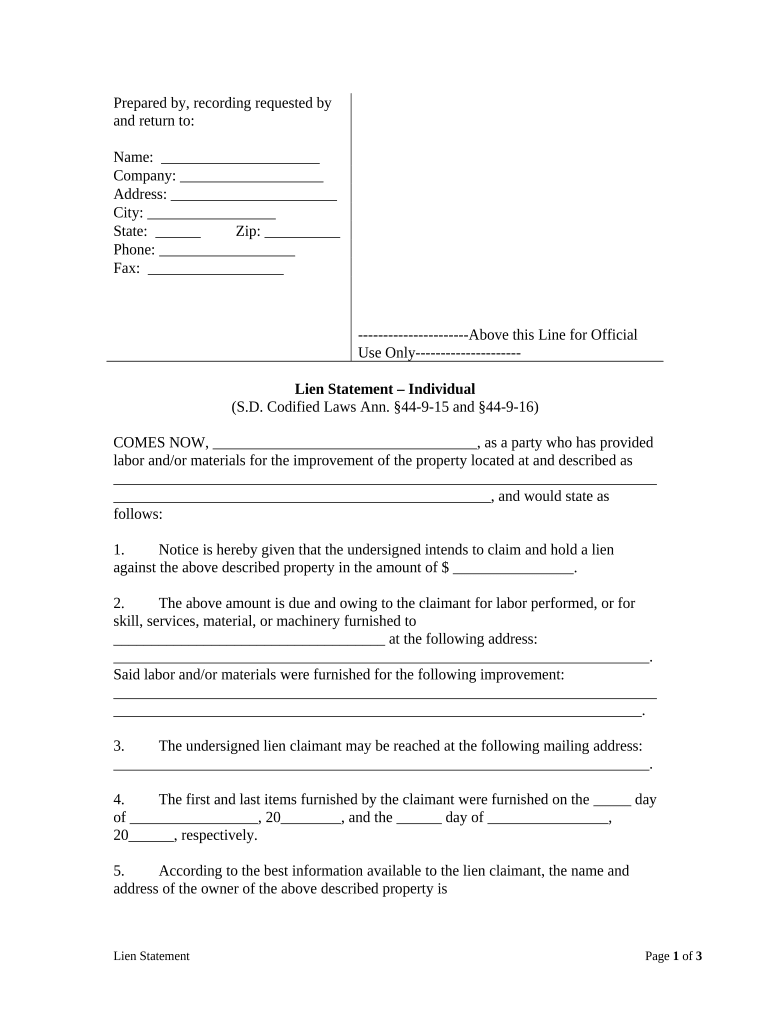
South Dakota Lien
What the South Dakota Lien Is and when it applies
Why filing a proper South Dakota lien matters
A correctly prepared lien preserves the claimant's right to payment, establishes priority among creditors, and creates leverage for collection. Proper filing reduces risk of rejection and enforcement barriers by ensuring accuracy in claimant identity, legal description, and service requirements under state recording procedures.
Who commonly completes or relies on a South Dakota lien
Parties should confirm claimant authority, service obligations, and county recording practices before filing to reduce rejection risk.
- General contractors and subcontractors who supplied labor or materials on construction projects and need to secure payment.
- Suppliers and material vendors who delivered goods used in property improvements but have unpaid invoices.
- Lenders and judgment creditors who record liens to secure repayment or preserve priority ahead of other claims.
Stepwise process to prepare and file a South Dakota lien
-
01Prepare claim: Complete all required fields with legal names and exact amounts.
-
02Verify identity: Confirm owner, parcel number, and deed information at the county clerk's office.
-
03Notarize if required: Have the signer appear before a notary or use RON where allowed by law.
-
04Record and serve: File with the county recorder and serve statutory notices to affected parties.
How the lien filing and enforcement flow typically works
-
Claim Created: Claimant documents unpaid obligation and compiles supporting invoices and contracts.
-
Document Signed: Authorized signer signs and notarizes if the form or county requires it.
-
Record with County: Submit the original document to the county recorder or register of deeds for indexing.
-
Serve Notice: Deliver required statutory notices to the property owner and other interested parties.
Typical digital workflow settings for preparing and distributing the lien
| Field | Configuration |
|---|---|
| Authentication | Email link plus optional SMS code for signer verification |
| Notifications | Email notifications at signature, filing, and any rejections |
| Storage | Store completed PDF/A copy in secure cloud repository |
| Retention | Apply a 7+ year retention policy for recorded documents |
Digital signing and file format considerations
When using e-signatures, retain an audit trail and export a tamper-evident final PDF for recording and long-term storage.
- Supported formats: PDF and DOCX are widely accepted for preparation and archiving.
- Signer authentication: Email and SMS codes are common; stronger methods available where required.
- Integrations: ERP and document management integrations reduce manual entry and duplication.
Common pitfalls when preparing a South Dakota lien
- Incomplete property descriptions or incorrect parcel numbers lead to recording office rejection or mis-indexing, delaying enforceability.
- Using an informal business name instead of the claimant's legal name can create disputes over authority and invalidate the claim.
- Failing to notarize when required or using an improper notarial method can make the lien unacceptable to the county recorder.
- Neglecting to serve statutory notices prevents enforcement actions and may forfeit priority rights under state procedures.
Consequences of incorrect or late lien filings
Timing considerations and filing expectations
Filing window:
Varies by lien type — check state statute for exact deadline
Priority date:
Often the completion date or the date materials were supplied
Notice deadlines:
Some liens require pre-filing or post-filing notices within set days
Enforcement period:
Limited timeframe to perfect or foreclose lien under state law
Recording response:
County recorders may take days to weeks to index and return documents
Key milestones from claim to enforcement
Claim Documentation
Compile contracts, invoices, and proof of delivery or performance.
Notice and Service
Deliver required statutory notices to owner and relevant parties.
Recording
File with the county recorder to create public record and priority.
Enforcement
If unpaid, pursue foreclosure or judgment collection under state law.
How a South Dakota lien compares to other common lien types
| Criteria | South Dakota Lien | Mechanics Lien |
|---|---|---|
| Notary Required | usually yes | often yes |
| Filing Office | county recorder | county recorder |
| Common Use | broad creditor claims | construction-related unpaid work |
| Typical Deadline | statutory; varies | statutory; varies |
eSignature vendor comparison for preparing and submitting liens
| signNow | DocuSign | Adobe Sign | PandaDoc | HelloSign | |
|---|---|---|---|---|---|
| Starting Price | $8/user/mo | $15/user/mo | $14/user/mo | $19/user/mo | $15/user/mo |
| Free Trial | 7-day free trial | Yes — trial available | Yes — trial available | Yes — trial available | Yes — trial available |
| Bulk Send | Available (Business Premium+) | Available (select plans) | Available (enterprise) | Available (enterprise) | Available (enterprise) |
| Audit Trail | Yes | Yes | Yes | Yes | Yes |
| HIPAA Compliant | Yes | Yes | Yes | Varies by plan | Varies by plan |
| Envelope Cap | No envelope cap | 100 envelopes/user/year | Varies by plan | Varies by plan | Varies by plan |
Real-world examples of South Dakota lien use
Contractor claim
A subcontractor documents unpaid labor and compiles invoices prior to filing.
- The claim lists exact parcel and owner.
- After recording and timely notice service, the subcontractor negotiated payment to avoid foreclosure, preserving business cash flow and claim priority.
Judgment lien
An attorney records a court judgment as a lien on debtor property.
- The judgment lien attaches to real property.
- Proper recording allowed the creditor to secure payment through negotiation or future sale proceeds when the property was transferred.
Practical tips for accurate and efficient lien preparation
Frequently asked questions about South Dakota liens
-
What if the county rejects my filing?
If the county recorder rejects a filing for defects, promptly correct the specified errors and refile. Keep the rejection notice and any replacement document receipts to preserve priority arguments and to demonstrate diligence.
-
Can I e-sign a lien document?
Electronic signatures are generally valid under ESIGN and UETA for most transactional documents. Confirm the county recorder accepts electronically signed or certified electronic copies and ensure any required notarization or RON is completed per state rules.
-
How do I release a filed lien?
Record a lien release or satisfaction document with the same county recorder office, signed by the claimant (and notarized if required). Provide recipients with recorded release copies to clear title concerns.
-
Who may sign for a business claimant?
An authorized officer, registered agent, or other person with delegated authority should sign for an entity. Maintain written authorization or corporate resolution to prove signing authority.
-
What if the claimant name is wrong?
A mismatched claimant name can invalidate recording results. Prepare a corrected or amended claim and refile promptly; consider recording an affidavit of correction where permitted.
-
When should I consult an attorney?
Consult counsel for disputed amounts, complex priority questions, potential foreclosure, or to confirm strict compliance with filing and service statutes to avoid forfeiture.