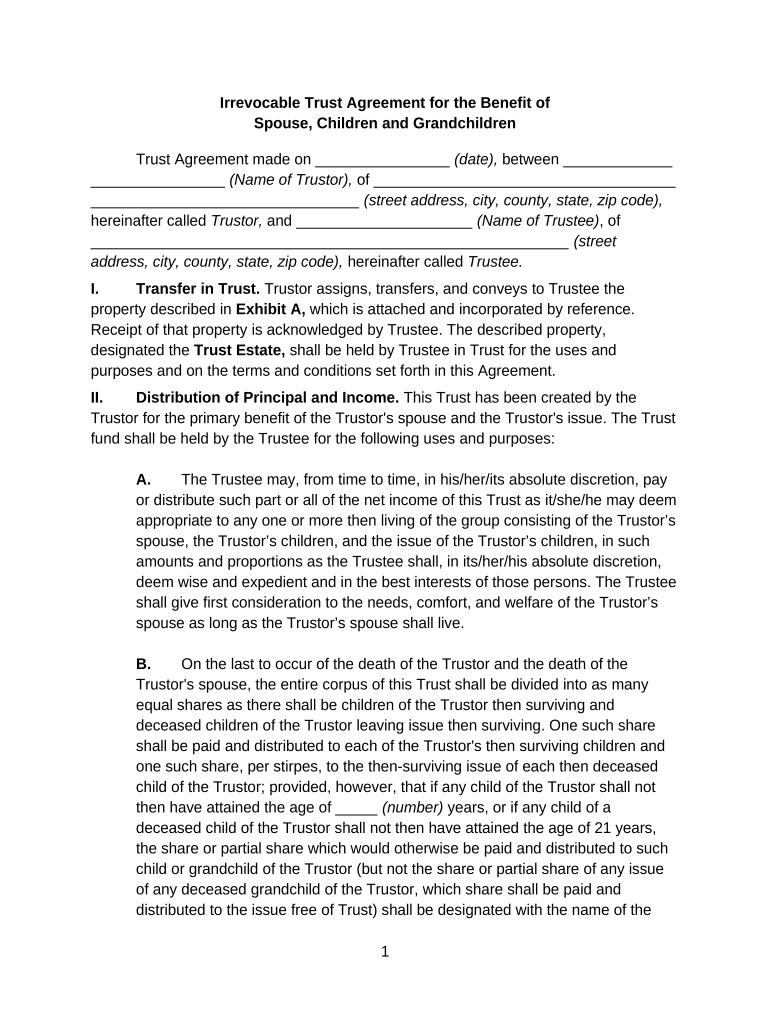
Irrevocable Trust Agreement for the Benefit of
Spouse, Children and Grandchildren
Trust Agreement made on ________________ (date) , between _____________
________________ (Name of Trustor), of ____________________________________
________________________________ (street address, city, county, state, zip code),
hereinafter called Trustor, and _____________________ (Name of Trustee) , of
_________________________________________________________ (street
address, city, county, state, zip code), hereinafter called Trustee.
I. Transfer in Trust. Trustor assigns, transfers, and conveys to Trustee the
property described in Exhibit A, which is attached and incorporated by reference.
Receipt of that property is acknowledged by Trustee. The described property,
designated the Trust Estate, shall be held by Trustee in Trust for the uses and
purposes and on the terms and conditions set forth in this Agreement.
II. Distribution of Principal and Income. This Trust has been created by the
Trustor for the primary benefit of the Trustor's spouse and the Trustor's issue. The Trust
fund shall be held by the Trustee for the following uses and purposes:
A. The Trustee may, from time to time, in his/her/its absolute discretion, pay
or distribute such part or all of the net income of this Trust as it/she/he may deem
appropriate to any one or more then living of the group consisting of the Trustor’s
spouse, the Trustor’s children, and the issue of the Trustor’s children, in such
amounts and proportions as the Trustee shall, in its/her/his absolute discretion,
deem wise and expedient and in the best interests of those persons. The Trustee
shall give first consideration to the needs, comfort, and welfare of the Trustor’s
spouse as long as the Trustor’s spouse shall live.
B. On the last to occur of the death of the Trustor and the death of the
Trustor's spouse, the entire corpus of this Trust shall be divided into as many
equal shares as there shall be children of the Trustor then surviving and
deceased children of the Trustor leaving issue then surviving. One such share
shall be paid and distributed to each of the Trustor's then surviving children and
one such share, per stirpes, to the then-surviving issue of each then deceased
child of the Trustor; provided, however, that if any child of the Trustor shall not
then have attained the age of _____ (number) years, or if any child of a
deceased child of the Trustor shall not then have attained the age of 21 years,
the share or partial share which would otherwise be paid and distributed to such
child or grandchild of the Trustor (but not the share or partial share of any issue
of any deceased grandchild of the Trustor, which share shall be paid and
distributed to the issue free of Trust) shall be designated with the name of the
1
child or grandchild and shall continue to be held as a separate and distinct Trust
and Trust fund for the following uses and purposes:
1. With respect to each such Trust, the Trustee may, from time to
time, in his/her/its absolute discretion, pay or distribute to the child or
grandchild with whose name the Trust is designated all or such part of the
net income of the Trust as it/he/she may deem appropriate.
2. When any child of the Trustor with whose name such a Trust is
designated shall have attained the age of _____ (number) years, ____%
of the corpus of the Trust designated with the name of the child shall be
paid and distributed to the child; provided, however, that the Trustee, may,
in its/her/its absolute discretion, postpone the date on which the right to
the distribution vests.
3. When any child of the Trustor with whose name such a Trust is
designated shall have attained the age of ____ (number) years, or when
any grandchild of the Trustor with whose name such a Trust is designated
shall have attained the age of 21 years, the entire remaining corpus of the
Trust designated with the name of the child or grandchild shall be paid and
distributed to the child or grandchild, as the case may be; provided,
however, that the Trustee may, in its/her/his absolute discretion, postpone
the date on which the right to the distribution of any Trust designated with
the name of a child of the Trustor vests for a period not to
exceed ____ (number) years.
4. If any child of the Trustor with whose name such a Trust is
designated shall die prior to the termination of the Trust leaving issue then
surviving, the entire corpus of the Trust shall be divided into as many
equal shares as there shall be children of the child of the Trustor then
surviving and deceased children of the child of the Trustor leaving issue
then surviving. One such share shall be paid and distributed to each of the
then-surviving children of the child of the Trustor (being grandchildren of
the Trustor) and one such share, per stirpes, to the then-surviving issue of
each then deceased child of the child of the Trustor; provided, however,
that if any child of the child of the Trustor shall not then have attained the
age of 21 years, the share which would otherwise be paid and distributed
to the grandchild shall be designated with the name of the grandchild and
shall continue to be held as a separate and distinct Trust and Trust Fund
for the same uses and purposes as provided herein for a Trust for a
2
grandchild of the Trustor whose parent predeceased the survivor of the
Trustor and the Trustor's spouse.
5. If any grandchild of the Trustor with whose name such a Trust is
designated shall die prior to the termination of the Trust, the entire corpus
of the Trust designated with the name of the grandchild shall be paid and
distributed to the estate of the grandchild.
6. If any child of the Trustor with whose name such a Trust is
designated shall die prior to the termination of the Trust leaving no issue
then surviving, the entire corpus of the Trust shall be divided into equal
shares. One such share shall be paid and distributed to each then
surviving brother or sister of the child, and one such share, per stirpes, to
the then-surviving issue of each then deceased brother or sister of the
child or grandchild; provided, however, that if a Trust created by this
Section designated with the name of any such person should then be in
existence, the share or partial share which otherwise would be paid and
distributed to that person shall instead be added to and become a part of
the corpus of the Trust.
C. Net income not paid or distributed from any Trust created by this Section
may be added to any subsequent income payment from the Trust. Until
distributed, accumulated income shall be regarded for all purposes under this
instrument as corpus of the respective Trusts created by this Section.
D. The Trustee may, from time to time, in his/her/its absolute discretion, pay
or distribute to the Trustor's spouse or to any beneficiary then eligible to receive
income from any Trust created by this Section such part of the corpus of the
Trust from which the Trustor's spouse or the beneficiary is eligible to receive
income as the Trustee may deem appropriate. No such payment or distribution
shall constitute an advance against any amount receivable by any person from
any Trust created by this Section unless the independent Trustee shall otherwise
provide in writing at the time of making the payment, and then only to the extent
so provided.
E. At any time after the death of the Trustor's spouse, the Trustee may, in
its/her/his absolute discretion, pay and distribute to the person then eligible to
receive income from any Trust created by this Section the entire remaining
corpus of the Trust from which the person is eligible to receive income if it deems
the termination appropriate because the corpus of the Trust is so small in amount
as to make efficient management of it impracticable.
3
F. If, prior to the time that any Trust fund shall be set up for and designated
with the name of any person under the foregoing provisions, or any addition shall
be made to any such fund, or any other fund or share of any other fund shall
become payable to him or her or to a Trust for his or her benefit under the
provisions of this instrument, the person shall have arrived at the age when a
mandatory partial or total distribution to him or her is required under the terms of
this instrument, then that person's fund or the person's share of any other fund
promptly shall be partially or totally paid and distributed to the person in the same
proportions as required by the mandatory provisions.
G. If at any time after the death of the Trustor there shall be no beneficiary
eligible to receive the income or corpus of any Trust created by this instrument,
then the entire corpus of any such Trust shall be paid and distributed to the
persons then living who would have been the Trustor's next of kin if the Trustor
had died at the time or times of such payment and distribution, under the laws of
_________________ (name of state) existing on the date of the execution of this
Trust relating to the distribution of intestate personal property in the proportions
prescribed by such laws.
H. All interest, both in income and in corpus, in all Trusts created by this
Section are intended for the personal protection and welfare of the beneficiaries.
No such interest shall be transferable, voluntarily or involuntarily, by the
beneficiary nor subject to the claims of creditors or of a spouse or former spouse
of the beneficiary.
I. Any person may irrevocably disclaim and renounce any part or all of any
gift made to that person by this Section. Any such disclaimer and renunciation
shall be effected in the manner required by applicable law, if any, and by serving
a written, signed declaration of the disclaimer and renunciation with the Trustee
at any time prior to the expiration of _____ (number) days following the date on
which the gift would otherwise have vested. If any person disclaims and
renounces all interest in all or any part of any gift made to the person by this
Section, all of the gift or all of the part shall be disposed of as if the person had
died prior to the time when the gift vested.
J. Notwithstanding any other provision of this instrument with respect to the
time of the termination of any Trust created by this instrument, if, on the
expiration of _____ (number) years and _____ (number) months immediately
following the death of the last survivor of the Trustor, the Trustor's spouse at the
date of the execution of this instrument and the Trustor's issue living on the day
4
preceding the date of the execution of this instrument, any Trust created by this
instrument, or any part of any such Trust, shall then remain in existence, then
such Trust or part shall promptly be paid and distributed to the person with
whose name the Trust is designated, or, if the Trust under Paragraph A of this
Section is still in existence, then to the Trustor's spouse.
III. Additions to Trust Estate. Trustor and any other person shall have the right at
any time to add property acceptable to Trustee to this Trust. Such property, when
received and accepted by Trustee, shall become part of the Trust Estate.
IV. Irrevocability of Trust. This Trust shall be irrevocable and shall not be revoked
or terminated by Trustor or any other person, nor shall it be amended or altered by
Trustor or any other person.
V. Powers of Trustee. In addition to any powers given to it by law or otherwise,
Trustee is authorized and empowered with respect to any property at any time held
under any provision of this Agreement, including accumulated income, if any, and any
property held pursuant to any power in Trust, and until the actual distribution of the
property:
A. The powers to loan money or other property, with or without formal
evidence of indebtedness, with or without collateral security, for such periods of
time and on such terms and conditions as may be deemed appropriate to any
beneficiary of any Trust created by this instrument, to any business controlled by
any such beneficiary, or to any estate or Trust of which any such beneficiary is a
beneficiary, out of any Trust created by this instrument from which such
beneficiary is eligible to receive income; to make any such loan a lien on any
property payable or distributable to the beneficiary; and to guarantee any loans of
any such beneficiary, business, estate, or Trust.
B. The powers to receive, acquire, and retain any of the property of several
Trusts created by this instrument undivided until division shall become necessary
in order to make any payment or distribution, to hold, manage, invest, reinvest,
and account for the several shares or parts of shares by appropriate entries in
books of account, and to allocate to each such share or partial share its
proportionate part of all receipts and expenses.
C. The power to retain for any period of time cash or other unproductive
property.
5
D. The power to receive, acquire, and retain policies and proceeds of policies
of life insurance and of immediate and deferred annuities, either in stock or in
mutual companies, in any amount, on the life of any beneficiary of any Trust
created by this instrument, or on the life of any person in whom the beneficiary or
any such Trust has an insurable interest; to pay the premiums of the same out of
either the income or surplus or both of any such Trust which is the beneficiary of
the policy or out of which the beneficiary of the policy is eligible to receive
income; and to exercise all rights, privileges, and options available under the
policy.
E. Not to file an inventory of the property which is part of the Trust nor annual
accounts of administration with and not to have any of such property examined
by any court where the filing or examination is not required by applicable law.
F. To retain for any period of time any property which may be received or
acquired, even though its retention by reason of its character or otherwise would
not be appropriate apart from this provision.
G. To collect, receive, and receipt for rents, profits, or other income from any
property which may be held.
H. To expend money or other property in order to collect, sell, manage,
conserve, or administer any property which may be held, or in order to improve,
repair, equip, develop, furnish, maintain, alter, extend, or add to any such
property.
I. To sell at public or private sale (including, specifically, the power to initiate
or participate in any public offering or underwriting), partition, exchange for like or
unlike property, lease for any period of time even though it may be longer than
the duration of the Trust, modify, renew, or extend any lease, grant options on,
release, demolish, abandon, dedicate, and otherwise dispose of any property
which may be held, on such terms and conditions, including credit, and for such
consideration, even though it may be less than the value at which the property
was received or acquired, or for such other benefit, even though it may be
intangible, as may be deemed appropriate.
J. To transfer title to, grant rights in, and convey in fee simple or otherwise
any property which may be held, free of all Trusts.
K. To invest and reinvest in any and all kinds of securities, domestic or
foreign, including common and preferred stocks, bonds, debentures, notes,
6
commodity contracts, mortgages and options on property; in money market
funds, commercial paper, repurchase agreements, United States Treasury
obligations, certificates of deposit, savings accounts, checking accounts, and any
other cash investment medium; in investment trusts and in common-trust funds;
in any real property; in any personal or mixed property; in any business, mining
or farming operation or other venture; or in any other interest or investment
medium, even though the investment would not be of a character authorized by
applicable law but for this provision.
L. To retain cash for reasonable periods of time in amounts sufficient to meet
anticipated needs, including payments of expenses and to beneficiaries.
M. With respect to property subject to depreciation or depletion, to withhold
an amount from Trust income in the discretion of the independent Trustee to
provide for a reasonable allowance for depreciation or depletion on such property
under generally accepted accounting principles.
N. To do all things necessary, customary, or desirable to conduct the affairs
of an unincorporated business, mining or farming operation, real-estate
operation, or other venture.
O. To do all things necessary, customary, or desirable to conduct the affairs
of any corporation; to act as officer, director, attorney or employee of any
corporation; and to place stock in the name of a Trustee or any beneficiary of the
Trust in order to qualify him or her as a director of the corporation.
P. Alone or with others, to organize, reorganize, merge, consolidate,
recapitalize, dissolve, liquidate, or otherwise create or change the form of any
corporation, partnership, joint venture, or other entity.
Q. To exercise all voting, sale, purchase, exchange, or other rights or options
with respect to any security or other property which may be held.
R. To refuse, reject, or not to exercise any offer to purchase, option to
purchase, voting or other right or option with respect to any security or other
property which may be held.
S. To participate in any plan or proceeding for protecting or enforcing any
right, obligation, or interest arising from any property which may be held; to serve
as a member of a security-holder protective committee; and to deposit securities
in accordance with any plan agreed on.
7
T. To expend money or other property, whether by bidding in at foreclosure,
by making a contribution to capital, by paying an assessment, or otherwise, in
order to protect any property which may be held.
U. To pay, contest, compromise, abandon, release, adjust, submit to
arbitration, sue on, defend, and otherwise deal with and settle any claim in favor
of or against the Trust or the Trustee.
V. To receive, acquire, and retain policies of fire, motor vehicle, business
interruption, title, liability, fidelity, indemnity, or other casualty insurance, either in
stock or in mutual companies, in any amount, against any risk in which the Trust
has an insurable interest.
W. To borrow money or other property for such periods of time, on such terms
and conditions, and for such purposes as may be deemed appropriate; to
mortgage, pledge, or otherwise encumber any property which may be held as
security for any such loan; and to renew, extend, or refund any existing loan
either as maker or endorser.
X. With respect to any obligation held, whether secured or unsecured, to
reduce the interest rate on the obligation, to continue it on and after maturity, with
or without renewal or extension, and without regard to the then-value of any
security, to foreclose on the security or to acquire the security without
foreclosure.
Y. To keep books of account and to make reports on such reasonable basis
and with such detail as may be deemed appropriate.
Z. To execute any instrument, under seal or otherwise.
AA. To bind absolutely, by any action taken or not taken, all beneficiaries, born
or unborn, ascertained or unascertained, of the Trust as against any other party;
no party dealing with the Trustee shall have any duty to follow any property
transferred by the party to the Trustee.
BB. To sell any property to, to exchange any property with, to purchase any
property from or otherwise to deal with any beneficiary of the Trust or with any
trust or estate of which either the Trustor, the Trustor's spouse, or any issue of
the Trustor is or was a Trustor or beneficiary, whether created by this instrument
or not, even though some or all of the Trustee are also fiduciaries of such other
8
Trust or estate; and when dealing with any fiduciaries, the Trustee shall have no
duty to follow any property transferred by them.
CC. To obtain the advice of accountants, attorneys-at-law, brokers, investment
counsel, realtors, appraisers, and other experts, and to compensate the experts
by salary, commission, fee, or otherwise, and to act pursuant to the advice of
such experts without independent investigation.
DD. To delegate to one the Trustee or to agents: the authority to execute
contracts, checks, documents of title, and other instruments, to keep books of
account, to prepare reports and tax returns, to hold possession and record
ownership of securities, bank accounts, and other property, or to perform any
other ministerial functions; the authority to perform the following-discretionary
functions: the management of any investment, unincorporated business, farming
or mining operation, and real-estate operation or other venture (whether by
employing agents, giving proxies, entering into voting trusts, or otherwise) and
the selection of the time to acquire or to dispose of any property which may be
held, any power, including this power, possessed by the Trustee which is
necessary, customary, or desirable so that the delegate may perform any
function delegated pursuant to this paragraph; and to compensate the agents by
salary, commission, fee, or otherwise.
EE. To enter into binding agreements not to exercise any power which they
possess on such terms and conditions and for such reasons as may be deemed
appropriate.
FF. To enter into any pooling or unitization agreement.
GG. To purchase options on any property.
HH. To advance money on behalf of the Trust for which advances, with any
interest, the Trustee shall have a lien on the assets of the Trust as against any
beneficiary.
II. To permit any beneficiary to have the use, possession, and enjoyment of
any property then distributable pending actual distribution of the property.
VI. Compensation of Trustee. Trustee shall be entitled to reasonable
compensation from time to time for Trustee's ordinary services rendered under this
Agreement, for any extraordinary services performed by Trustee, and for all services in
connection with the termination of the Trust, either in whole or in part.
9
VII. Successor Trustee. If ________________________ (Name of Original Trustee)
resigns or is unable to continue to act as Trustee, ______________________________
( Name of Successor Trustee) of ____________________________________________
______________________ (street address, city, county, state, zip code), is appointed
as successor Trustee, and shall succeed as Trustee with like effect as though originally
named as such in this Agreement. All authority and powers conferred on Trustee under
this Agreement shall pass to __________________________ ( Name of Successor
Trustee) as successor Trustee.
VIII. Invasion of Principal. In the event that the net income of this Trust is at any
time insufficient to provide for the care, comfort, maintenance, and support of
Beneficiaries , Trustee, in its uncontrolled discretion, may pay or apply for those
purposes such sums from the principal of the Trust Estate as Trustee may deem proper,
considering any other sources of income of Beneficiaries .
IX. Allocation of Principal and Income. Except as otherwise specifically provided
in this Agreement, Trustee shall have full power and authority to determine, in its
absolute discretion, what shall constitute principal of the Trust Estate, gross income
from the Trust Estate, and net income of the Trust Estate distributable under the terms
of this Agreement.
X. The following provisions shall apply with respect to any and all life insurance
policies, any proceeds of which may be payable to the Trustee hereunder:
A. The Trustee shall have the right to accept, take out, apply for, purchase
and/or pay the premiums on life insurance policies on the life of _____________.
Further, the Trustee shall have the right to pay premiums on any insurance
policies comprising a part of the Trust estate, and to take out, apply for, and buy
any type of insurance for the beneficiaries, including life, accident, health and
major medical insurance, and to pay the premiums thereon, out of principal of the
Trust. However, in no event shall the Trustee be obligated to pay any premiums
unless funds for such payments are available in the Trust or conveyed to the
Trustee by the Trustor or others. Notwithstanding the foregoing, the Trustee shall
not use the income of the Trust to pay premiums on life insurance on the life of
the Trustor, which premiums may only be paid from principal. The Trustee shall
not be under any obligation to notify the Trustor, beneficiaries, or any other
person of the nonpayment of premiums. In addition to the foregoing powers
respecting insurance, the Trustee shall have the right to do any and all things
incident to the purchase and ownership of such insurance.
B. The Trustee may, in their discretion, cancel any of the insurance policies
held by them, no matter how acquired. The policies may be canceled and turned
10
in for their cash surrender value, if any, and the Trustee shall not be liable to any
party for canceling the said policies. Furthermore, the Trustee may borrow on,
surrender, hypothecate or pledge the said policies, convert them to different
kinds of insurance or select any method of settlement of the proceeds provided
by the terms of the policies.
C. The Trustee may pay premiums by the "minimum deposit" method (that is,
borrow cash value) on all insurance that the Trust owns on the life of the Trustor
or anyone else. The Trustee shall use principal of the Trust to pay the said
premiums. The Trustee may apply the dividends on such policies to pay
premiums. When making policy loans, the Trustee may apply the dividends on
such policies to pay premiums. When making policy loans, the Trustee may
elect the dividend type option (that is, use dividends to purchase one year term
insurance) to keep the death benefit at the face amount of the policy. The
Trustee shall not be required to pay premiums from their own funds.
D. The Trustee, in their discretion, may borrow funds from any party to pay
the premiums on any policies of insurance owned by the Trust. As security for
the repayment of the amounts borrowed, the Trustee may collaterally assign the
policy or policies to the Lender and may, in their discretion, enter into any
agreement in regard to the collateral assignment of the policy.
E. Upon the death of any insured, if insurance should be payable to the
Trust, the Trustee shall receive such sums of money as shall be payable to the
Trust under the terms of said policies of life insurance, including accidental death
benefits, and they shall hold the same in Trust for the uses and purposes herein
set forth. To facilitate the receipt of such sums of money, the Trustee shall have
the power to execute and deliver receipts and such other instruments as they
shall deem advisable, to compromise or adjust disputed claims in such manner
as they in their sole and absolute discretion shall deem advisable and proper for
the collection of any such proceeds; provided, however, that if payment on any
such policy is contested, the Trustee shall not be obligated to take any action for
collection unless and until they shall have been indemnified to their satisfaction
against any loss, liability or expense, including attorneys' fees. Notwithstanding
anything to the contrary herein contained, the Trustee are authorized to
reimburse themselves, with respect to any liability, fees and any other expenses
incurred in connection with obtaining any proceeds of any said policies, from the
principal or income of this Trust, and the Trustee may charge the same as an
expense of that Trust.
11
F. Upon payment to the Trustee of the amounts due under said policies of
insurance, the insurance company issuing such policies shall be relieved from all
liability hereunder and no such company shall be under any responsibility to see
to the performance of the Trust created hereby.
G. With respect to any proceeds of any insurance payable to the Trust
hereunder, the Trustee may, in their absolute discretion, leave such proceeds, or
any part thereof, with the insurance company issuing the policy or policies from
which such proceeds are payable. Further, the Trustee may exercise any option
permitted by the terms of such policy or policies or permitted by the issuing
insurance company, thereby causing such proceeds, or the interest thereon, to
be payable by the insurance company pursuant to the terms of such option or
any supplementary agreement with such company, to the Trustee, as Trustee of
this Trust, or to any beneficiary hereof, in such manner and amounts as the
Trustee shall elect.
XI. Accounting. Trustee at any time shall be entitled to render to the current income
beneficiary or beneficiaries of the Trust Estate an account of the acts of Trustee and
transactions with respect to the income and principal of the Trust Estate from the date of
the creation of the Trust or from the date of the last previous account of Trustee. The
beneficiary or beneficiaries shall have full power and authority on behalf of all persons
now or later interested in the Trust to finally settle and adjust such account. Approval of
the account by the beneficiary or beneficiaries shall constitute a full and complete
discharge and release of Trustee from all further liability, responsibility, and
accountability for or with respect to the acts and transactions of Trustee as set forth in
the account, both as to income and principal.
XII. Governing Law. The validity, construction, and effect of this agreement and of
the Trust created under it and its enforcement shall be determined by the laws of
____________________ (name of state) .
XIII. Spendthrift Trust
A. Neither the principal nor the income of this Trust, nor any part of same,
shall be liable for the debts of any of the beneficiaries hereof, nor shall the same
be subject to seizure by any creditors of said beneficiaries. The said beneficiaries
shall not have any power to sell, assign, transfer, encumber or in any manner to
anticipate or dispose of their interest in the Trust funds, or any part of same, or
the income produced from said funds, or any part of same.
B. In making payments for beneficiaries as required herein, and especially
where such beneficiaries may be minors, or by reason of illness or otherwise be
incapable of transacting business, the Trustee, in their sole discretion, can make
such payments either (i) directly to such beneficiary, (ii) to the legal or natural
12
guardian of such beneficiary, (iii) to any relative or guardian of such beneficiary,
or (iv) by applying such payments for the benefit of such beneficiary by paying
his or her expenses directly. In any event the Trustee shall require such reports
or take such steps which they deem requisite to insure and enforce the due
application of such payments for the exclusive benefit of the said beneficiary.
XIV. Binding Effect. This Agreement shall be binding on Trustor, Trustor's executor,
administrator, successors and assigns, and Trustee and Trustee's successors and
assigns.
Trustor and Trustee have executed this Agreement as of the day and year first above
written.
__________________________ __________________________
Name & Signature of Trustor Name & Signature of Trustee
( Acknowledgments before Notary Public)
(Attach Exhibit)
13