Establishing secure connection…Loading editor…Preparing document…

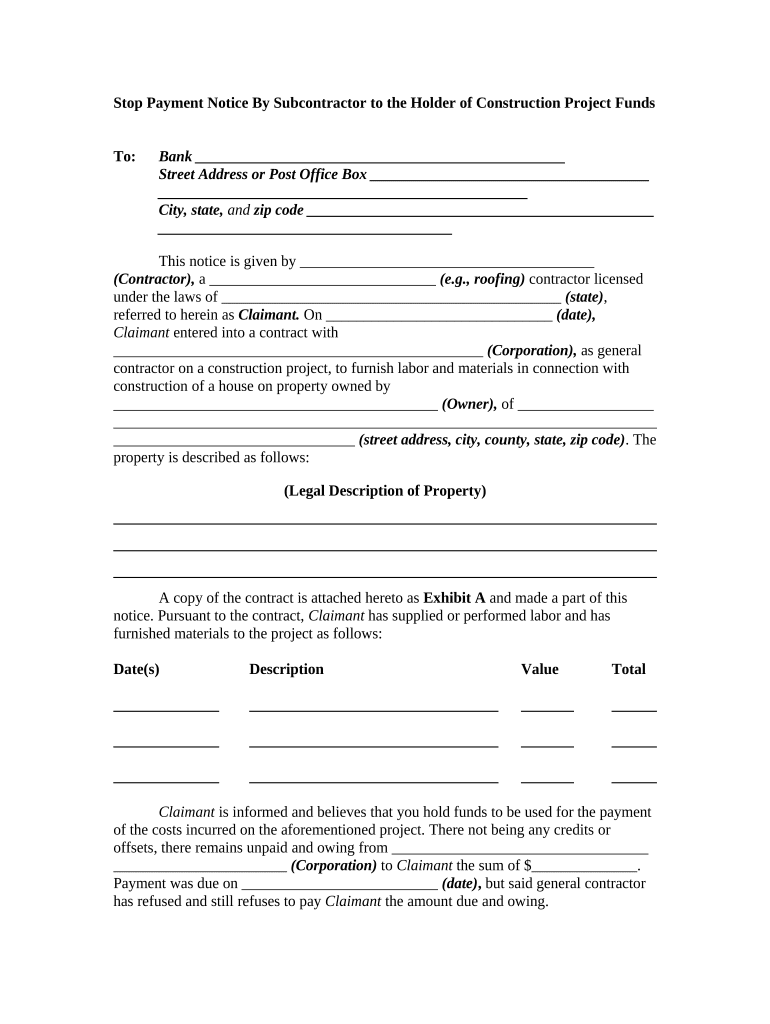
Stop Payment Notice By Subcontractor

This template is fully customizable. Edit the text, fill out the fields, and send it for signature. Give it a try!
Stop Payment Notice By Subcontractor

What a Stop Payment Notice By Subcontractor Is

A Stop Payment Notice By Subcontractor is a formal written demand used by a subcontractor to notify an owner, lender, or general contractor that payments for labor, materials, or services are unpaid and that funds should be withheld or redirected to satisfy the subcontractor’s claim. It operates alongside mechanics lien and payment bond remedies in many states and may trigger the payor or lender to hold sufficient funds while the dispute is resolved. Requirements and legal effects vary by jurisdiction; state statutes and contract terms determine timing, content, and whether filing with a public agency is necessary.

Why this Notice Matters for Payment Protection

A Stop Payment Notice By Subcontractor preserves payment rights, notifies responsible parties, and can prompt a payor or lender to set aside funds. It documents the claim, may preserve mechanics lien rights, and strengthens leverage during dispute resolution.

Why this Notice Matters for Payment Protection

Who Typically Prepares and Receives This Notice

Subcontractors, material suppliers, and sub‑tiers commonly use this notice to assert unpaid balances or to protect lien rights.

  • Subcontractors with outstanding invoices after progress or final payment is due.
  • Material suppliers who supplied goods without timely payment from upstream parties.
  • Sub-subcontractors and specialty trades seeking to preserve rights under state lien statutes.

Step-by-Step: Preparing and Serving the Notice

Follow these steps to prepare and serve a Stop Payment Notice By Subcontractor in a compliant, timely manner.

  • 01
    Confirm Eligibility: Verify unpaid balance and contractual standing.
  • 02
    Gather Documents: Collect contracts, invoices, and delivery receipts.
  • 03
    Draft Notice: Complete statutory form with accurate figures.
  • 04
    Serve Parties: Deliver per statute: owner, lender, and GC.

How the Stop Payment Notice Process Flows

This high-level flow shows compilation, verification, service, and administrative follow-up steps after issuing a stop payment notice.

  • Compile: Assemble invoices, contracts, lien waivers, and evidence.
  • Verify: Check contract terms, payment history, and statutory deadlines.
  • Serve: Serve required parties by permitted delivery methods.
  • Follow-up: Monitor payor response and prepare filings if unpaid.

Core Elements of a Professional Stop Payment Notice

A professional Stop Payment Notice By Subcontractor is precise, statutory-compliant, and supported by documentation; these features reduce procedural rejection risk and clarify the claimed amounts.

Statutory Language

Use the exact language or headings required by state statute. Missing statutory phrases or incorrect form names can invalidate the notice or delay payment withholding.
Clear Amounts

Provide a precise numerical and written amount with an itemized breakdown. Vague totals increase dispute risk and may lead payors to refuse withholding.

Recipient Details

Name the owner, lender, general contractor, and billing contact; include full addresses and contact details. Incorrect or incomplete addressees frequently prevent proper service and jeopardize lien remedies.

Supporting Proof

Attach invoices, change orders, lien waivers, delivery tickets, and correspondence; retain originals when possible. Well-documented claims are harder to challenge and speed administrative responses from payors.

Proper Service

Serve the notice following state statute: registered mail, certified mail, personal delivery, or statute-specified methods, and document proof of service. Incorrect service methods create procedural defenses for payors.

Deadline Compliance

Observe state deadlines for serving and filing supplemental notices; late service can forfeit withholding rights and bar later lien or bond claims, so consult counsel immediately.

Essential Data Elements to Include

Claimant ID: Legal entity and tax ID
Project Identifier: Jobsite address and contract number
Amount Claimed: Numeric and written totals
Relevant Dates: Service, invoice, and cutoff dates
Recipients: Owner, lender, general contractor contacts
Supporting Documents: Invoices, orders, delivery receipts

Penalties and Risks of Incorrect Notices

Rejected Notice: Procedural defects can void claim
Forfeited Lien Rights: Late or incorrect service may bar lien
Withholding Failure: Payor may release funds despite claim
Bond Claim Delay: Loss of priority on bond claims
Statutory Penalties: State statutes may impose fines
Attorney Fees: Successful defense may seek fees

Common Preparation Mistakes to Avoid

  • Incorrect recipient or address leading to failure of statutory service and loss of withholding or lien preservation rights; double-check owner and lender contact details before service.
  • Missing statutory language or improper form; some states require specific phrases or form templates — using generic letters can cause outright rejection.
  • Incomplete evidence: sending notice without supporting invoices, delivery tickets, or change orders weakens the claim and invites dispute about amounts owed.
  • Late service relative to statutory deadlines or contract notice provisions may waive stop payment rights and foreclose lien or bond remedies.

Setting Up an Online Workflow for Notices

Configure your online workflow to capture required fields, automate service methods, and record proof of delivery for audit purposes.

Field Configuration
Notification Method Email, certified mail, or personal delivery
Service Method Follow state statute; document proof of service
Authentication Signer email, SMS code, or ID verification
Retention Store signed copy and proof for retention period

Platform Requirements for Digital Preparation and Service

Use eSignature platforms that support document templates, proof of service tracking, and secure storage to streamline stop payment notices.

  • File Formats: PDF and DOCX supported
  • Integrations: Procore, Google Drive, NetSuite
  • Security: TLS 1.2/1.3, AES-256

Key Deadlines and Time-Sensitive Actions

Key deadlines include statutory service windows, claim filing periods, and interim response times for payors and lenders.

Service Window:

Varies by state; commonly 20–90 days after last work

Filing Deadline:

Some states require filing before pursuing lien

Owner Response:

Owner or payor may dispute within statutory term

Lender Holds:

Lender may withhold funds pending resolution

Contract Provisions:

Contract may shorten or extend statutory timelines

eSignature Vendor Pricing and Feature Comparison

Comparing typical eSignature vendor pricing and core features relevant when preparing and executing Stop Payment Notice By Subcontractor documents.

signNow DocuSign Adobe Sign PandaDoc HelloSign
Starting Price $8/user/mo $15/user/mo $14/user/mo $19/user/mo $15/user/mo
Free Trial Yes, 7-day free trial Varies by plan Varies by plan Varies by plan Varies by plan
Bulk Send Yes Yes Yes Yes No
Audit Trail Yes Yes Yes Yes Yes
HIPAA Compliant Yes Yes Yes No No

Frequently Asked Questions About Stop Payment Notices

Answers to common questions about preparing, serving, and enforcing a Stop Payment Notice By Subcontractor, including timing and electronic signature considerations.


Need help? Contact support

be ready to get more
Join over 28 million airSlate SignNow users