Establishing secure connection…Loading editor…Preparing document…

Oklahoma Petition for Summary Administration

This template is fully customizable. Edit the text, fill out the fields, and send it for signature. Give it a try!
Oklahoma Petition for Summary Administration

What the Oklahoma Petition for Summary Administration Is

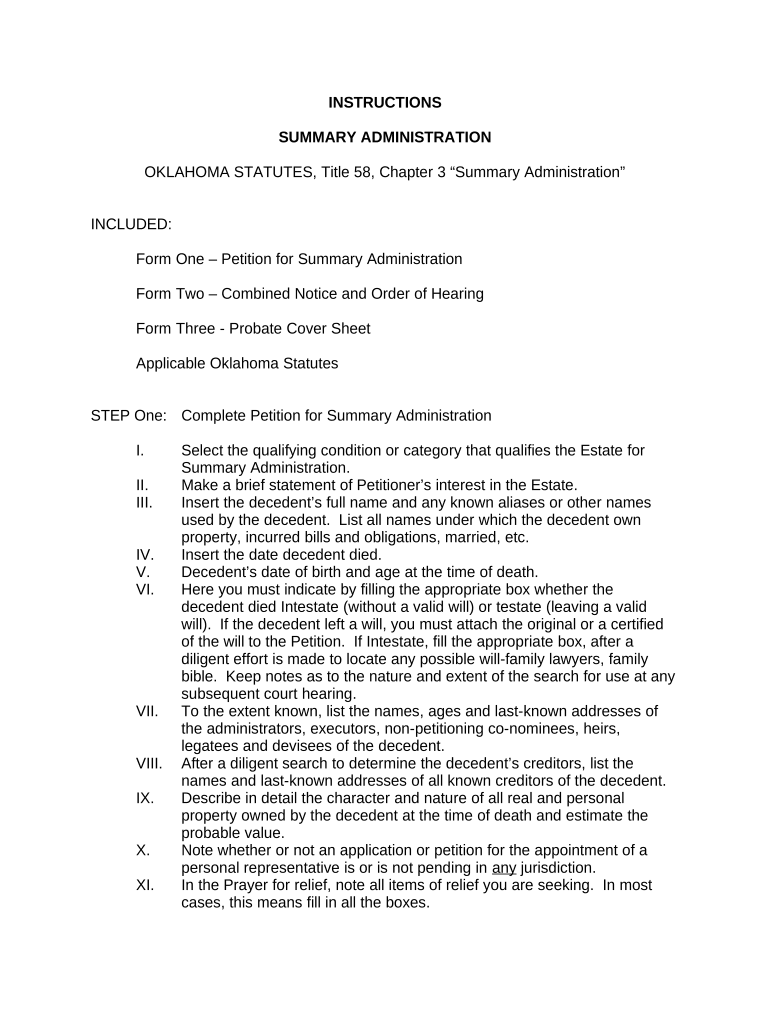
The Oklahoma Petition for Summary Administration is a probate filing used to simplify distribution of a decedent's estate when circumstances allow an expedited process. It is intended for small or uncontested estates where formal administration would be time-consuming or unnecessary. The petition asks the probate court to approve a streamlined appointment or direct distribution to heirs, often without full creditor administration or lengthy probate hearings. Courts evaluate eligibility, notice to known creditors or interested parties, and clear title transfer language before issuing an order. Preparers should confirm local county procedures and required attachments.

Why Summary Administration Can Matter in Oklahoma

A summary petition can reduce delay, cut filing complexity, and lower administrative costs versus full probate when eligibility criteria are met.

Why Summary Administration Can Matter in Oklahoma

Who Typically Prepares or Uses This Petition

Common filers include close relatives acting as petitioners, personal representatives seeking a faster process, and attorneys handling small estates.

  • Family members or heirs filing to transfer modest assets without full probate proceedings.
  • Designated personal representatives seeking court approval for direct distribution.
  • Estate or probate attorneys preparing a concise petition and required affidavits for the court.

Stepwise Process to Prepare and File the Petition

Follow these four core steps to prepare, file, and obtain a court order for summary administration in Oklahoma.

  • 01
    Prepare Petition: Complete petition, attach death certificate and asset affidavit.
  • 02
    Gather Evidence: Collect beneficiary IDs, titles, account statements.
  • 03
    File with Court: Submit petition to county probate clerk with fee.
  • 04
    Obtain Order: Judge reviews, issues decree enabling asset transfer.

Setting Up an Online Workflow for the Petition

Configure your digital workflow to match filing steps, signer authentication, notarization needs, and storage format for court records.

Document Template Use a jurisdiction-specific Oklahoma probate petition template for consistent filing.
Authentication Require email verification plus SMS code for petition signers when possible.
Notary Enable remote online notarization where the county permits RON technology.
Routing Set sequential routing: petitioner -> notary -> local counsel -> file clerk.
Storage Save executed files as PDF/A and include an audit trail record.

Where to File and How the Court Reviews the Petition

Understand the filing destination and the court's typical review actions so you can include all required exhibits and notices.

  • Filing Location: File at the county probate clerk's office where the decedent resided.
  • Clerk Review: Clerk ensures paperwork, signatures, and filing fee are present.
  • Judicial Consideration: Judge examines eligibility, notice, and any creditor claims before ruling.
  • Entry of Order: Court issues a decree authorizing distribution or limited appointment.

Security and Compliance Considerations for Electronic Copies

Encryption: TLS 1.2/1.3 in transit
Data at Rest: AES-256 encryption
Audit Trail: Detailed timestamp and IP logs
HIPAA Support: BAA available where required
Federal eSign Laws: ESIGN and UETA compliant
Regulatory Standards: SOC 2 Type II and ISO 27001

Key Risks and Consequences of Errors

Invalid Transfers: Court may void distributions
Probate Delays: Additional hearings and costs
Creditor Claims: Unknown creditors can interrupt distribution
Clerk Rejections: Incomplete forms returned to filer
Title Defects: Real estate transfer complications
Statute Issues: Missing statutory language prompts denial

Common Preparation Pitfalls to Avoid

  • Listing incorrect heirs or misspelling names creates identity disputes and may require amendment filings.
  • Omitting required attachments such as the death certificate or asset appraisal often causes immediate rejection at the clerk's office.
  • Providing inconsistent asset valuations risks creditor challenges and possible court-ordered accountings.
  • Failing to confirm local county filing procedures or fee schedules leads to processing delays and extra trips to the clerk.

Essential Elements of a Complete Petition

A professional petition includes clear case captioning, factual affidavits, a concise asset inventory, legal basis for summary relief, signature blocks, and a proposed order for the judge.

Caption

Court name, county, case number, and full party names formatted per local rules.
Affidavit of Decedent

Signed statement verifying death, domicile, and absence of contested wills or claims.

Asset Inventory

Itemized list with values, account numbers, and documentation for real property or vehicles.

Notice to Creditors

State how creditors were notified, or explain lack of known creditors for summary relief.

Signature Block

Petitioner's signature, printed name, address, and date; notary acknowledgment if required.

Proposed Order

Draft decree for judge to sign specifying distribution and authorization to transfer titles.

Digital Signing and eSubmission Requirements

If you use electronic tools, verify authentication, notarization acceptance, document format, and audit trail retention.

  • Integrations: Salesforce, NetSuite, Microsoft 365 supported
  • File Formats: PDF, DOCX, and PDF/A for court-ready copies
  • Authentication Options: Email, SMS code, or advanced signer verification

Practical Examples of Summary Administration Use

These scenarios illustrate when summary administration can simplify transfers for uncontested or low-value estates.

Sibling Transfer Scenario

A small estate with no creditors and clear beneficiary succession

  • Siblings agree on distribution quickly
  • The county court granted a summary order after petition, allowing title transfer without full probate, saving months of administration and attorney time.

Sole Surviving Spouse

Spouse-only estate with limited assets and no will contest

  • Spouse petitions for direct distribution
  • The court approved a summary decree based on affidavit and asset list, enabling immediate access to bank accounts and vehicle title transfer.

Practical Tips for Accurate and Efficient Filings

Use a checklist and verify each attachment to minimize returns and court questions.

Confirm Heir Details
Verify legal names, current addresses, and relationships before filing to prevent identity disputes and amendment filings.
Attach Proofs
Include certified death certificate, account statements, and vehicle titles to substantiate asset values quickly.
Check Local Rules
County clerks may require specific form language, caption formatting, or additional attachments—confirm prior to filing.
Preserve Originals
Keep original signed affidavits and court-ordered decrees in secure storage and retain electronic copies with audit trails.

eSignature Vendor Comparison for Completing and Signing the Petition

Comparing commonly used eSignature providers can help you select a platform that meets authentication, notarization, and storage needs for probate filings.

signNow DocuSign Adobe Sign PandaDoc HelloSign
Starting Price $8/user/mo $15/user/mo $14/user/mo $19/user/mo $15/user/mo
Free Trial 7-day free trial Varies by plan Varies by plan Varies by plan Varies by plan
Bulk Send Yes Yes Yes Yes Varies
Audit Trail Yes Yes Yes Yes Yes
HIPAA Compliant Yes Yes Yes No No

Frequently Asked Questions and Practical Answers

Answers to common questions about eligibility, signing, filing, and post-filing issues related to Oklahoma summary administration.


Need help? Contact support

be ready to get more
Join over 28 million airSlate SignNow users