Establishing secure connection…Loading editor…Preparing document…

Supplemental Interrogatories

This template is fully customizable. Edit the text, fill out the fields, and send it for signature. Give it a try!
Supplemental Interrogatories

What Supplemental Interrogatories Are and when they apply

Supplemental Interrogatories are written discovery requests used in civil litigation to obtain additional factual information after initial interrogatories or when new facts arise. They ask a party to supplement or amend prior responses, to add details, or to identify documents and witnesses relevant to ongoing claims or defenses. Courts treat timely, accurate supplemental responses as part of the formal record; failure to supplement can lead to motion practice, sanctions, or exclusion of evidence. Procedures and allowable scope vary by rule and jurisdiction.

Why accurate supplemental responses matter

Timely, precise supplemental interrogatories preserve your client’s right to a complete factual record, reduce later disputes, and avoid sanctions. Clear supplements narrow issues, streamline depositions, and support admissibility of evidence at trial.

Why accurate supplemental responses matter

Who prepares and relies on supplemental interrogatories

Supplemental interrogatories are prepared by litigators and discovery teams to clarify facts or update prior answers.

  • Plaintiff and defense counsel — craft targeted follow-up questions to address gaps found during discovery or after new evidence emerges.
  • Corporate counsel and paralegals — collect verified, internal responses and supporting documents for supplementation and privilege review.
  • E-discovery vendors and contract attorneys — assist with collection, redaction, and production under document protocols and protective orders.

Proper use reduces contested discovery motions and helps courts manage the case schedule efficiently.

Typical roles that sign or approve supplements

Plaintiff Counsel

Lead trial attorneys who draft supplemental interrogatories and manage responses; they coordinate client statements, witness lists, and production of supporting documents for supplementation.

Corporate Paralegal

Operational staff who gather custodian records, verify answers with the client, assemble exhibits, and ensure responses meet formatting, signature, and certificate of service requirements before filing or production.

Core parts of a professional supplemental interrogatory

A compliant supplemental interrogatory includes clear references to the original interrogatory, precise questions or requests, and formal verification language. Each element supports authenticity and ease of use during motion practice or trial.

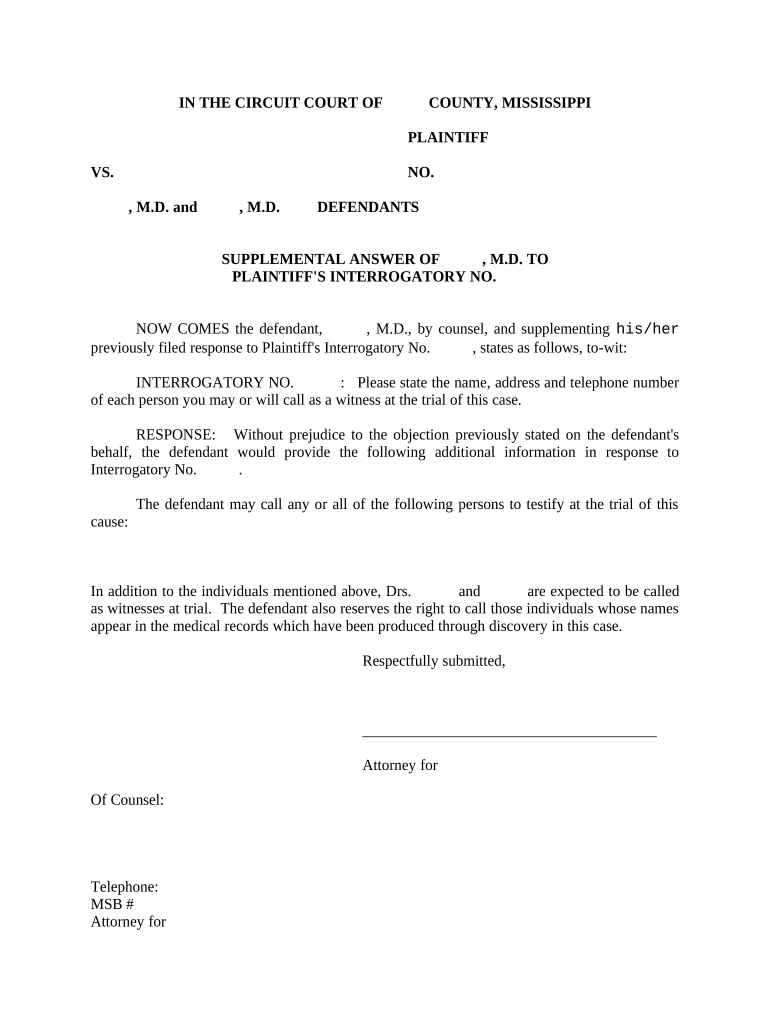
Caption

Court name, case number, and party identification placed at the top to match the original pleadings and ensure responses are docketed correctly.
Reference to Original

Explicit citation to the prior interrogatory or response (by number and date) that the supplement amends or supplements to avoid ambiguity.

Specific Questions

Focused follow-up questions that request facts, document identification, or witness information tied to the new evidence or clarification needed.

Document Requests

When appropriate, request specific documents by Bates range, custodian, or topic to accompany the written supplement and support the answer.

Verification

A sworn verification clause where the responding party affirms the truth of supplemental responses under penalty of perjury, with signer identified and dated.

Certificate of Service

A short statement confirming how and when the supplement was served on opposing counsel and any third parties, using the method allowed by local rule.

Step-by-step: preparing and serving a supplemental interrogatory

Follow an ordered process to confirm accuracy, obtain verification, and serve the supplement according to court and local rules to avoid disputes.

  • 01
    Identify Need: Review new facts, documents, or deposition testimony that require supplementation.
  • 02
    Draft Amendments: Reference original interrogatory, add precise questions or clarified answers, and attach supporting document citations.
  • 03
    Verify Internally: Have counsel and client review answers; collect verification and privilege determinations before finalizing.
  • 04
    Serve and File: Serve per local rules, retain proof of service, and file any court-required notices or exhibits.

Setting up an online supplemental-interrogatory workflow

Configure the digital flow to preserve audit logs, require appropriate signer authentication, and attach exhibits in searchable format.

Upload Document Start with a searchable PDF or DOCX version of the supplement.
Place Fields Add signature, date, and verification fields where required by the court.
Signer Authentication Choose email, SMS, or advanced authentication depending on verification needs.
Routing Order Set sequential or parallel signing for client review and counsel approval.
Notifications Enable automatic reminders and a completion certificate on final signing.

Typical e-submission flow for supplemental interrogatories

An online workflow captures evidence of intent, identity, and completion while keeping the document format court-ready and searchable.

  • Prepare: Create the supplement and attach exhibits in PDF or DOCX.
  • Place Fields: Add signature, verification, and date fields for required signers.
  • Authenticate: Signers verify identity via email link, SMS code, or stronger methods.
  • Complete: System records timestamps, IP, and creates a certificate of completion.

Digital platform essentials for secure e-submission

Choose a platform that provides provable signer identity, tamper-evident signed files, and an auditable event log.

  • Authentication: Email, SMS, or multi-factor options
  • Document Formats: PDF and DOCX supported
  • Integrations: Connects to case management systems

Retain the signed PDF and audit trail; confirm the e-submission method satisfies local court rules and any opposing-party agreements.

Common deadlines and timing expectations

Deadlines for supplements depend on the governing rules and case schedule; federal rules set baseline timing and many courts require prompt supplementation.

Federal Response Deadline:

30 days after interrogatories served (FRCP 33(b)(2)).

Ongoing Supplementation:

Supplement 'in a timely manner' when new info arises (FRCP 26(e)).

Local Rule Variations:

State and court local rules may shorten or extend timing.

Discovery Cutoff:

Supplement before the court's discovery cutoff to preserve evidence.

Motion Timing:

Allow reasonable time to supplement before filing a motion to compel.

Common mistakes to avoid when preparing supplements

  • Overbroad answers that create new objections and invite motions to compel if not responsive and specific.
  • Failing to verify responses under oath or using improper verification wording that courts may reject.
  • Omitting proper citation to original interrogatory numbers, causing confusion about what is being supplemented.
  • Producing documents without a privilege log or clear withholding explanation, which can lead to waiver disputes.

Consequences of late, incomplete, or false supplements

Sanctions: Court-ordered fines or cost awards
Evidence Exclusion: Undisclosed facts may be barred at trial
Adverse Inference: Court may infer unfavorable evidence
Default: Severe failures may risk default judgment
Privilege Waiver: Improper production can waive privilege
Ethics Exposure: Counsel faces professional responsibility review

How practitioners use e-signed supplemental interrogatories

Real organizations have adopted e-sign workflows to reduce turnaround and preserve audit trails for discovery documents.

Optica Ventures LLC

The interface is simple and easy-to-use for our team.

  • Team adoption was quick.
  • Optica noted faster internal review cycles and fewer clerical errors when proving supplementation chains and attaching exhibits to responses for opposing counsel.

BIS (Dan Rotelli, CEO)

We felt most comfortable with SOC 2 compliance and legal standards.

  • Security aligned with counsel needs.
  • BIS used the platform to maintain auditable evidence of verification and to centralize document production for discovery responses across multiple matters.

Pricing and basic feature comparison for e-sign tools

Compare starting prices and common features across vendors; confirm plan details and enterprise add-ons with each provider before procurement.

signNow DocuSign Adobe Sign PandaDoc HelloSign
Starting Price $8/user/mo $15/user/mo $14/user/mo $19/user/mo $15/user/mo
Free Trial 7-day free trial Varies by plan Varies by plan Varies by plan Varies by plan
Bulk Send Yes (Premium) Yes Varies by plan Yes Varies by plan
Audit Trail Yes Yes Yes Yes Yes
HIPAA Compliant Yes (BAA available) Yes (BAA available) Yes (BAA available) Varies Varies
Envelope Cap No cap 100 envelopes/user/year Varies Varies Varies

Security and compliance facts for e-submission platforms

In-transit Encryption: TLS 1.2/1.3
At-rest Encryption: AES-256
Certifications: SOC 2 Type II
Regulatory Standards: ESIGN and UETA compliant
Healthcare Support: HIPAA with BAA
FDA Compliance: 21 CFR Part 11 supported

Frequently asked questions about Supplemental Interrogatories

Practical answers to common procedural, evidentiary, and e-sign questions that arise when supplementing discovery responses.


Need help? Contact support

be ready to get more
Join over 28 million airSlate SignNow users