Establishing secure connection…Loading editor…Preparing document…

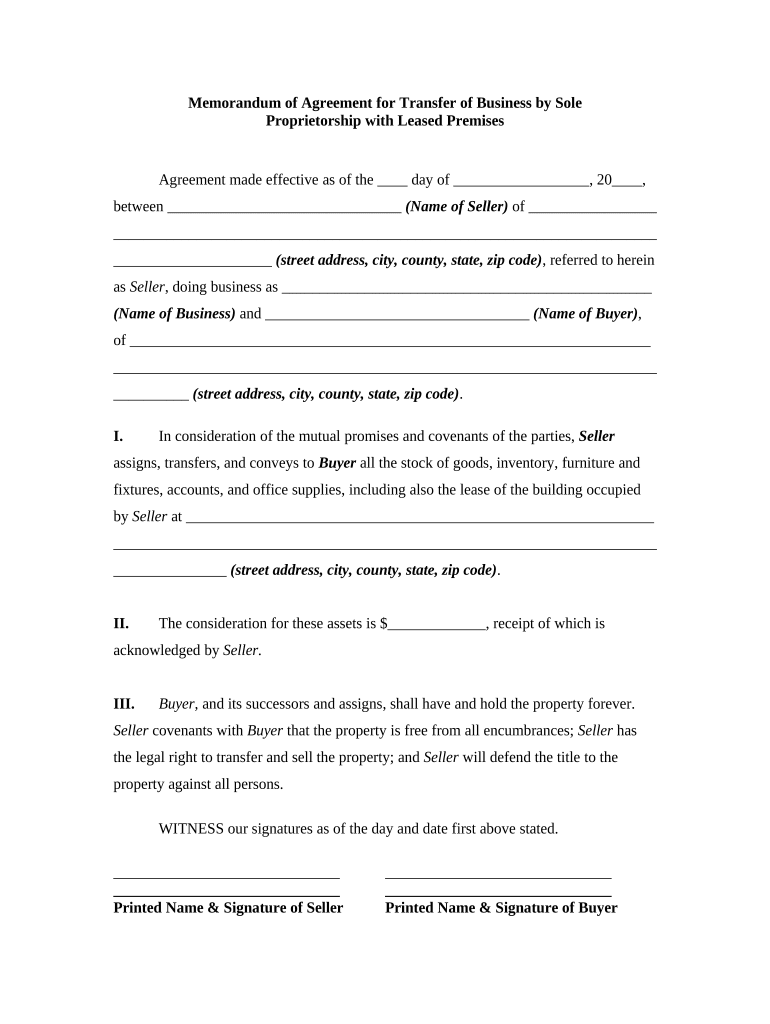
Memorandum of Agreement for Transfer of Business

This template is fully customizable. Edit the text, fill out the fields, and send it for signature. Give it a try!
Memorandum of Agreement for Transfer of Business

What the Memorandum of Agreement for Transfer of Business Is

A Memorandum of Agreement for Transfer of Business is a written contract documenting the terms under which ownership, assets, liabilities, and operational control of a business move from one party to another. It clarifies what is transferred, the effective date, purchase price or consideration, representations and warranties, employee and vendor transition plans, and any conditions precedent. The memorandum serves as an interim or final instrument to guide closing, regulatory filings, and integration steps, and it often supplements a more detailed purchase agreement or assignment documents prepared by counsel.

Why a Clear Memorandum Matters for Transfers

Use a Memorandum of Agreement for Transfer of Business to create clear, enforceable terms for asset and liability transfer, reduce closing uncertainty, document transitional responsibilities, and provide a record for regulatory, tax, and employee-related compliance. It streamlines integration planning.

Why a Clear Memorandum Matters for Transfers

Who Typically Prepares and Signs This Memorandum

Professionals who prepare or approve transfers—buyers, sellers, corporate counsel, and advisors—use this memorandum to outline obligations and preserve evidence of agreed terms.

  • Selling owner: documents assets, liabilities, employee transition terms, and representations.
  • Purchaser or investor: verifies consideration, closing conditions, and post-transfer liabilities retained.
  • Legal and tax advisors: review compliance, tax consequences, and required filings.

Representative Roles Involved

Selling Owner

An owner or majority shareholder preparing to transfer a business needs to document which assets and contracts convey, allocate tax liabilities, establish employee handling, and set escrow or holdback terms; this protects against post-closing disputes and supports tax and regulatory reporting obligations.

Purchasing Entity

A purchaser or investor requires clear warranties, representations, indemnities, and a list of excluded liabilities; the memorandum helps conduct due diligence, confirms agreed consideration, and defines closing conditions and transition responsibilities to reduce integration risk.

Simplified Step-by-Step Completion Checklist

Follow this stepwise guide to prepare and execute a clear Memorandum of Agreement for Transfer of Business before closing.

  • 01
    Identify assets: List tangible and intangible assets to be transferred.
  • 02
    Define liabilities: Specify which debts or obligations remain or are assigned.
  • 03
    Set consideration: State payment amount, timing, and any escrows.
  • 04
    Finalize signing: Obtain signatures, dates, and required notarizations or witnesses.

Coordinated Tasks Grid for Transaction Teams

Use this grid to coordinate parallel tasks: legal review, tax checks, consents, and operational transition steps before and after closing.

01

Due diligence:

Complete asset schedules and verify contract assignability.
02

Third-party consents:

Secure landlord, vendor, and lender approvals where required.
03

Tax clearance:

Assess sales, transfer, and payroll tax implications.
04

Employee transition:

Notify employees and determine benefits and severance arrangements.
05

Closing checklist:

Confirm funds, assign contracts, and exchange closing deliverables.
06

Post-closing:

Record transfers, update registrations, and monitor indemnity periods.

How an Electronic Signing Workflow Preserves the Record

An efficient electronic workflow simplifies execution and preserves an audit trail for the Memorandum of Agreement for Transfer of Business.

  • Upload document: Add final draft PDF or DOCX for tagging.
  • Place fields: Insert signature, initial, and date fields as needed.
  • Authenticate: Choose signer authentication level (email, SMS, KBA).
  • Complete & archive: Capture certificate of completion and store securely.

Recommended Digital Workflow Settings

Configure fields and workflow settings to automate signature order, reminders, and required authentications for each signer.

Field Configuration
Signature Order Set signer sequence or parallel signing.
Authentication Level Choose email, SMS code, or KBA.
Reminder Schedule Set automatic reminders and escalation.
File Retention Define storage, export format, and retention.

Distribution Channels and Technical Constraints

Consider how documents will be delivered, signed, and archived when choosing platforms and integrations.

  • Email and Signing Links: Email delivery and one-click signing links for remote signers.
  • API and Integrations: Connectors for CRM, ERP, cloud storage, and accounting platforms.
  • File Formats: Support for PDF, DOCX, and archival exports.

Essential Content Elements to Include

The memorandum should include clear transfer mechanics, warranties, schedules, and remedies; each feature below highlights content commonly required in professionally drafted transfer agreements.

Transferred Assets

Provide a comprehensive schedule identifying physical property, intellectual property, contracts, permits, inventory, and accounts receivable, with unique identifiers and any exclusions to avoid post-closing ambiguity, and state any liens or encumbrances, transfer mechanics, and valuation methods for inventory and receivables.

Assigned Contracts

List each contract proposed for assignment, state required consents, note termination clauses, and indicate whether novation or assignment will occur to ensure enforceability; attach copies and note cure obligations or indemnities required by counterparties.

Consideration

Describe cash payments, stock, assumption of liabilities, or staged payments; include escrow provisions, holdbacks, formulae for adjustments such as working capital true-ups, and include currency, payment account, and set-off rights plus tax gross-up responsibilities where applicable.

Warranties

State seller representations on title, compliance, financial statements, and pending litigation; define survival periods and remedies for breach, including indemnity caps and baskets, and clarify knowledge qualifiers, materiality thresholds, and remedies timetable for breach notifications and cure periods.

Employee Matters

Address transfer of employment, benefit continuation, accrued payroll obligations, and required notices; specify which party bears severance or benefit liabilities and state obligations for COBRA, benefit plan assignments, and accrued PTO payouts with timing.

Closing Conditions

List conditions precedent such as regulatory approvals, consents, financing, and absence of material adverse change; include timelines for satisfaction and termination rights, specify deliverables at closing, escrow release triggers, and post-closing covenant timelines.

Supporting Documents and Closing Exhibits to Attach

Include these supporting components to make the Memorandum of Agreement comprehensive, enforceable, and simple to execute and store across parties and regulators.

Schedules

Attach asset schedules, excluded assets, assigned contracts list, and detailed inventory; each schedule should reference numbered items and, where applicable, exhibit numbers for cross-reference in closing.

Exhibits

Include copies of material contracts, permits, IP assignments, and financial statements as exhibits; ensure redactions are noted and originals are available at closing for auditor review.

Signing Blocks

Provide individual signature blocks for each party with printed name, title, capacity (e.g., authorized signatory), and date lines; include corporate attestation language if applicable and notary acknowledgment where required.

Closing Deliverables

List required closing items such as bills of sale, assignments, releases, tax clearance certificates, and proof of payment; specify delivery method and escrow instructions, and contact for wire instructions.

Practical Tips to Reduce Risk and Delay

Apply these practical tips to reduce ambiguity, expedite approvals, and limit post-closing disputes in a Memorandum of Agreement for Transfer of Business.

Use precise asset and liability descriptions
Avoid blanket phrases. Itemize every asset and liability with identifiers, dates, serial numbers, and contract references. Clear exclusions and schedules reduce litigation risk and make post-closing reconciliation measurable and auditable by accountants and legal counsel.
Obtain required third-party consents early
Identify contracts requiring consent and request waivers or novations during due diligence. Track responses, cure requirements, and timelines. Failure to secure consents before closing can cause invalid assignments and operational disruption for the buyer.
Document post-closing covenants and obligations
Spell out who handles tax filings, outstanding claims, indemnity procedures, and ongoing support. Include notice periods, claim windows, and escalation processes. Clear post-closing obligations limit disputes and provide measurable triggers for indemnity releases or escrow distributions.
Specify remedies, caps, and timelines for breaches
State indemnity scopes, liability caps, survival durations, and deductible or basket thresholds explicitly. Provide mechanisms for cure, dispute resolution (mediation/arbitration), and final remedies. Well-drafted remedy clauses reduce litigation costs and align party expectations.

Common Preparation Pitfalls to Avoid

  • Failing to list all transferred assets, including intangible property such as trademarks, customer lists, or software licenses, which delays closing and can result in post-transfer disputes.
  • Neglecting to allocate specific liabilities or to obtain creditor consents where required, exposing either party to unexpected claims or obligations after closing.
  • Using vague consideration language like 'fair value' without formula or escrow terms; this creates ambiguity about payment timing and remedies for breach.
  • Overlooking required third-party approvals, regulatory filings, or licenses that must transfer or be reissued, which can prevent lawful operation post-transfer.

Key Risks and Potential Penalties

Tax Penalties: Incorrect reporting can trigger IRC §6721 fines
I-9 Violations: Errors may lead to $281–$2,789 penalties
Liability Transfer Risk: Unclear assignment can expose buyer to debts
Employee Claims: Failure to notify may cause wrongful termination suits
Regulatory Noncompliance: Licenses not transferred may halt operations
Contractual Disputes: Vague terms increase litigation likelihood

Milestone Roadmap for a Transfer Transaction

Key milestones map negotiation, due diligence, signing, closing, and short post-closing review to confirm all transfer obligations were satisfied.

01

Negotiation

Agree on scope, price, and general terms.

02

Due Diligence

Complete audits, consents, and title verifications.

03

Signing

Execute memorandum, obtain signatures, and notarizations.

04

Closing

Exchange funds, assignments, and delivery of closing deliverables.

Time-Sensitive Filings and Notices to Track

Observe filing and notice timelines that affect taxes, employment forms, and any regulatory filings tied to the transfer.

Tax reporting and asset sale reporting:

File required forms and report asset sales per IRS rules.

I-9 and payroll tax notifications:

Retain I-9s per 8 CFR and update payroll records promptly.

State licensing and regulatory notices:

Submit transfers for professional licenses and permits when required by state agencies.

Vendor and supplier assignment notices:

Provide timely assignment or novation notices per contract notice periods.

UCC filings and real property recordings:

File UCC-1s and record deeds where required to perfect security interests.

How This Memorandum Differs from Related Documents

Compare the Memorandum of Agreement for Transfer of Business with related documents to choose the correct form and scope for your transaction.

Criteria Memorandum Asset Purchase Agreement
Formality less formal comprehensive, negotiable
Structure summary of key terms full contractual obligations
Use case interim roadmap definitive transfer and assignments
Signing parties key parties only multiple executing parties, escrows

eSignature Vendor Pricing Snapshot for Transfer Workflows

Basic pricing and feature distinctions among common eSignature vendors for signing Memorandum of Agreement for Transfer of Business workflows.

signNow DocuSign Adobe Sign PandaDoc HelloSign
Starting Price $8/user/mo $15/user/mo $14/user/mo $19/user/mo $15/user/mo
Free Trial 7-day free trial Varies Varies Varies Varies
Bulk Send Yes Yes Yes Yes No
Audit Trail Yes Yes Yes Yes Yes
HIPAA Compliant Yes Yes Yes No No
Envelope Cap No envelope cap 100 envelopes/user/year Varies Varies Varies

Security and Compliance Considerations for Digital Execution

Encryption: TLS 1.2/1.3 in transit; AES-256 at rest
Certifications: SOC 2 Type II, ISO 27001, PCI DSS
HIPAA: Compliant with BAA available
ESIGN/UETA: Meets federal and state e-signature law
21 CFR Part 11: Controls, timestamps, audit trail support
Accessibility: WCAG 2.0 Level AA

Frequently Asked Questions About the Memorandum

Answers to frequent questions about completing, signing, and enforcing a Memorandum of Agreement for Transfer of Business in the United States.


Need help? Contact support

be ready to get more
Join over 28 million airSlate SignNow users