Establishing secure connection…Loading editor…Preparing document…

Trustee Resignation

This template is fully customizable. Edit the text, fill out the fields, and send it for signature. Give it a try!
Trustee Resignation

What a Trustee Resignation Is and when it’s used

A Trustee Resignation is a written declaration by which an appointed trustee formally gives up their duties and powers under a trust. The form typically identifies the trust by name and date, names the resigning trustee, states the effective date of resignation, and names a successor trustee or explains the vacancy. It often includes language confirming transfer of records and duties, any limitations on retained authority, and signatures. Local law or the trust instrument may require notarization, witnesses, delivery to beneficiaries, or recording with a county office.

Why a clear Trustee Resignation matters

A formal resignation creates a clear record of trustee succession, reduces disputes, and allows beneficiaries and successor trustees to rely on the effective date. A complete resignation helps with administrative handoffs, bank and title records, and avoids ambiguity that can delay trust administration or trigger litigation.

Why a clear Trustee Resignation matters

Who prepares and receives a Trustee Resignation

Typical parties involved include the resigning trustee, successor trustee, trust attorney, and trust beneficiaries; institutions holding trust assets also receive notice.

  • Individual trustees and co-trustees who are stepping down and must document the transition.
  • Corporate or institutional trustees when assigning duties to another entity or person.
  • Trust administrators, estate attorneys, and title companies responsible for recording or updating custody records.

Delivering the resignation to beneficiaries, successor trustees, and any institutions named in the trust instrument is standard practice to effectuate the change.

Step-by-step: completing a Trustee Resignation

Follow these steps to prepare a clear, enforceable resignation document.

  • 01
    Identify the trust: Enter trust name and date exactly as on trust instrument.
  • 02
    State resignation: Declare your intention and specify the effective date.
  • 03
    Name successor: Provide successor trustee name and contact details, if available.
  • 04
    Sign and notarize: Sign in the presence of required witnesses or notary per jurisdiction.

Typical workflow for issuing and accepting a resignation

A standard administrative flow ensures the resignation is effective and recognized by relevant parties.

  • Draft: Prepare resignation using trust language and legal counsel input.
  • Execute: Resigning trustee signs before required witnesses or notary.
  • Distribute: Send to successor, beneficiaries, and custodial institutions.
  • Record: Record or file with county or institution if required by trust or local law.

Digital workflow options for Trustee Resignation

Configure a signing workflow that captures signatures, identity verification, and distribution automatically.

Field Configuration
Signature Require signer signature field and date stamp
Notary Enable remote notary or in-person notarization step
Authentication Use email link, SMS code, or stronger ID verification
Distribution Automatically send signed copy to beneficiaries and institutions

Technical considerations for eSigning and eDelivery

Ensure the chosen eSignature platform meets identity, audit, and retention needs for trust administration.

  • Formats: Accepts PDF and DOCX for record compatibility
  • Authentication: Supports email, SMS, or KBA signer verification
  • Audit Trail: Captures timestamps, IP, and signer actions

Prefer platforms with strong audit trails and optional notarization integrations to satisfy banks, title companies, and courts.

eSignature vendor comparison for Trustee Resignation workflows

Basic vendor features and starting prices. signNow is shown first to reflect plan and capability comparisons relevant to trust form workflows.

signNow DocuSign Adobe Sign PandaDoc HelloSign
Starting Price $8/user/mo $15/user/mo $14/user/mo $19/user/mo $15/user/mo
Free Trial 7-day free trial, no credit card required Varies by vendor Varies by vendor Varies by vendor Varies by vendor
Bulk Send Yes (Premium) Varies by plan Varies by plan Varies by plan Varies by plan
Audit Trail Yes Yes Yes Yes Yes
HIPAA Compliant Yes Yes Yes No No
Envelope Cap No cap 100 envelopes/user/year Varies by plan Varies by plan Varies by plan

Timing considerations and typical deadlines

Key timing items to track when resigning as trustee and when successor duties begin.

Effective Date:

Choose and enter the precise resignation effective date in MM/DD/YYYY format

Notice to Beneficiaries:

Provide notice promptly; some trust terms require notice within a set period

Institution Acceptance:

Banks and brokers may require signed, notarized documents and institution-specific forms

Recording Requirements:

If property title changes, record documents with county recorder within local deadlines

Retention Start:

Retain originals and signed copies according to applicable record retention rules

Security and compliance items to include

Encryption: TLS 1.2/1.3 transit; AES-256 at rest
Audit Trail: Record timestamps, IP, and signer actions
Authentication: Email, SMS, or stronger verification available
BAA Available: HIPAA requires a BAA for PHI handling
Compliance: ESIGN and UETA support for legal enforceability
Retention: Support for secure long-term storage and exports

Legal risks and common consequences of improper resignations

Invalid Resignation: May cause fiduciary liability
Delayed Transfer: Assets may be inaccessible pending clarification
Record Rejection: Banks may refuse unnotarized or incomplete documents
Beneficiary Disputes: Ambiguity can trigger litigation costs
Tax Issues: Incorrect dates affect reporting deadlines
Notary Violations: Improper notarization can void acceptance

Common mistakes to avoid when preparing a resignation

  • Using an informal email or unsigned letter as the sole resignation; lacks required legal formalities and may be rejected by institutions.
  • Mismatching the trust name or date with the original instrument; banks and recorders reject inconsistent identifiers and require corrections.
  • Failing to name a successor or to state how a vacancy will be handled; this can leave trusteeship unresolved and delay asset administration.
  • Skipping notarization or required witnesses where the trust instrument or state law demands them, resulting in non-acceptance by third parties.

Essential elements of a professional Trustee Resignation

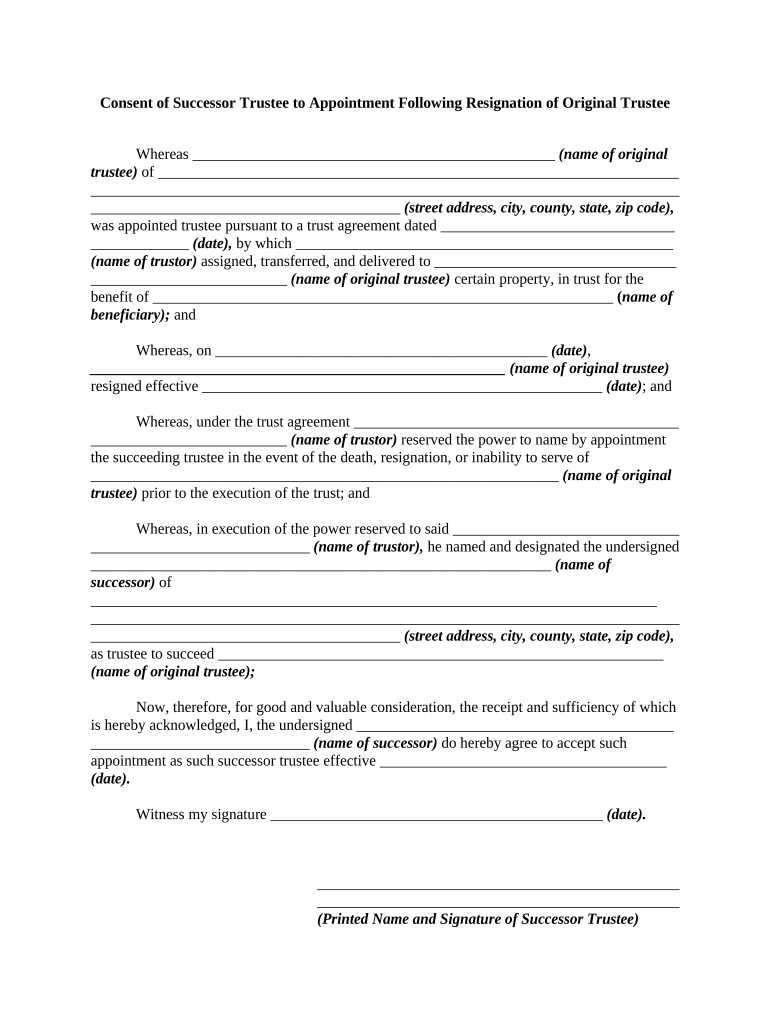
A robust resignation includes clear identification, effective dates, successor designation, signature blocks, delivery instructions, and notarization when required.

Trust Identification

Complete legal name and original trust date so the resignation can be matched to trust records and title documents.
Resignation Statement

Concise language stating the trustee resigns and the exact effective date to prevent ambiguity about when duties cease.

Successor Naming

Full successor trustee details or a provision describing how a successor will be selected under the trust instrument.

Acknowledgment

Notary or witness block if required by the trust instrument, including space for official stamps or seals.

Delivery Instructions

Specify required notice recipients and whether the document should be recorded or delivered to account custodians.

Records Transfer

Statement addressing transfer of trust records, keys, account access, and any pending trustee obligations.

Practical examples of Trustee Resignation scenarios

Two illustrative scenarios show common resignation reasons and required follow-up steps.

Corporate Trustee Resignation

A corporate trustee resigns after merger

  • Successor trustee named per trust terms
  • The firm delivered a notarized resignation to the successor, beneficiaries, and account custodians and provided records transition documentation to avoid service interruptions.

Individual Trustee Health Resignation

An individual trustee resigns due to incapacity

  • Resignation names successor trustee and effective date
  • Notice was provided to beneficiaries and the trust attorney; the successor obtained institution acceptance with notarized resignation and updated account authorizations.

Frequently asked questions about Trustee Resignation

Answers to frequent practical and legal questions when preparing or accepting a trustee resignation.


Need help? Contact support

be ready to get more
Join over 28 million airSlate SignNow users