Establishing secure connection…Loading editor…Preparing document…

Virginia Homestead Deed

This template is fully customizable. Edit the text, fill out the fields, and send it for signature. Give it a try!
Virginia Homestead Deed

What the Virginia Homestead Deed Is and when it applies

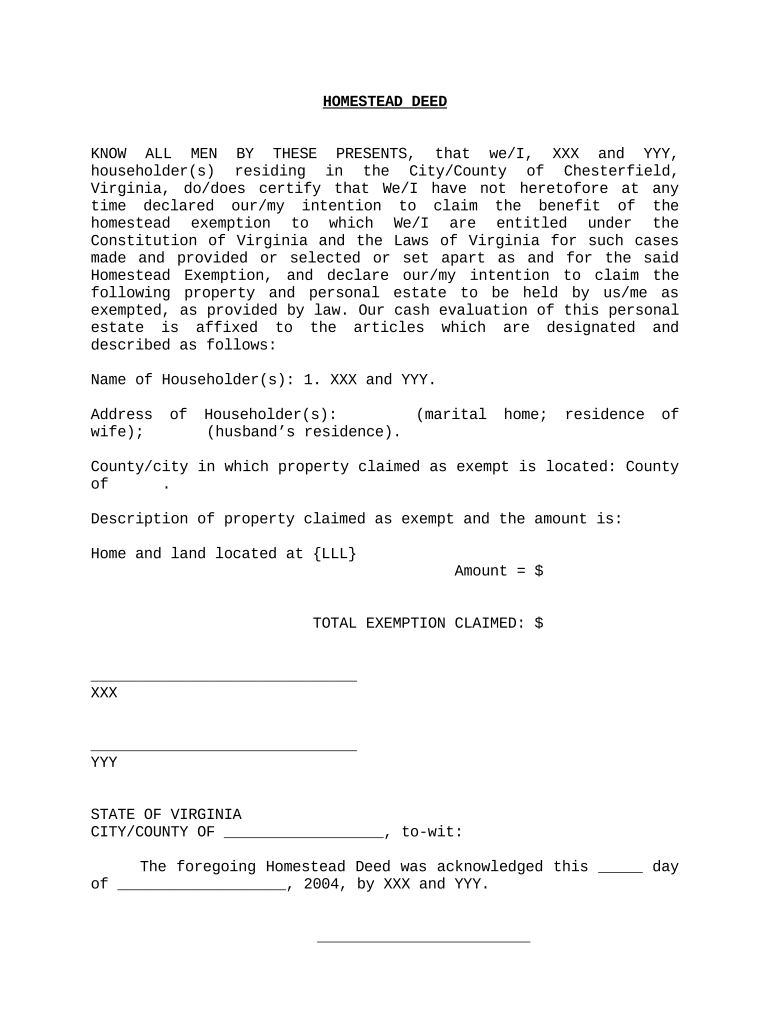
A Virginia Homestead Deed is a recorded instrument used to declare or confirm a homeowner's homestead interest in real property within Virginia. It identifies the primary residence, the owner(s), and any statutory language needed to claim homestead protection under state law. Recording the deed in the local circuit court land records provides public notice and may support exemption rights against certain creditors; the specific protections and procedural steps are governed by state recording practice and relevant statutes.

Why a Homestead Deed matters for Virginia homeowners

Filing a Virginia Homestead Deed creates a public record of residence that can help protect a homeowner’s equity from certain creditor claims, clarify ownership interests, and simplify estate administration. It documents the primary residence and can be especially useful where multiple properties or partial interests exist.

Why a Homestead Deed matters for Virginia homeowners

Who typically prepares and records a Virginia Homestead Deed

Use professional review when ownership is complex, when liens exist, or when homestead protections may affect creditor or tax outcomes.

  • Homeowners filing to record homestead protection and preserve equity rights.
  • Real estate attorneys preparing deeds for clarity, title insurance, or estate planning.
  • Title companies and closing agents attaching the homestead deed to closing packages.

Essential components of a professional Virginia Homestead Deed

A complete deed uses precise, recordable language and includes property identifiers, parties, and signatures. Omitting required elements may delay recording or reduce legal effect.

Grantor and Grantee

Full legal names of the person(s) claiming the homestead and any transferee, exactly as on government ID or title records.
Legal Description

The complete metes-and-bounds or lot-and-block description used in county land records; tax parcel numbers are an adjunct, not a substitute.

Property Address

Street address of the residence for identification, even when the legal description is primary.

Consideration Statement

If required, a concise statement of consideration or recitals (nominal consideration is acceptable when declaring homestead).

Homestead Language

Clear statutory or customary wording describing the homestead claim and the intent to assert protection for the primary residence.

Signature and Notary

Grantor signature(s) with notary acknowledgment (or remote online notarization where allowed) and signature dates for recording.

Key data fields required on the Virginia Homestead Deed

Property Address: Street, city, VA
Grantor Name: Full legal name
Grantee Name: If applicable
Consideration: Dollar amount or recital
Legal Description: Metes-and-bounds or plat
Recording County: Circuit Court name

Step-by-step: Completing a Virginia Homestead Deed

Follow this sequence to prepare, sign, notarize, and record the deed so it is accepted by the clerk of circuit court.

  • 01
    Prepare: Enter legal names, property description, and homestead language.
  • 02
    Review: Confirm ownership, current liens, and consistent name spellings.
  • 03
    Sign & Notarize: Grantor signs before a notary; use RON only where permitted.
  • 04
    Record: File with the clerk of circuit court in the county where property is located.

How to set up a digital workflow for the Homestead Deed

Configure fields, signer order, and notarization options before sending to avoid delays and ensure a recordable instrument.

Field Configuration
Authentication Email + SMS code or stronger for identity assurance
Signature Type Hand-drawn or typed signature; consider PKI for high-assurance needs
Notary Mode In-person or RON where state law permits
Delivery Send final copy to all parties and record a PDF/A copy with the county clerk

Where to file and how the recording process works

Record the deed in the county where the property is located; clerks process recorded instruments per local practice and fees.

  • Circuit Court Clerk: Primary filing office for deeds and land records in Virginia counties.
  • eRecording: Many Virginia counties accept e-recording via authorized vendors for faster processing.
  • Mail Filing: Clerks may accept mailed originals with payment and return envelope for recorded copy.
  • Title Company: Title agents can record on behalf of parties and confirm acceptance and indexing.

Sharing, eSubmission, and file formats to use

Use tamper-evident PDFs and retain the audit trail; when using an eSign vendor, confirm the clerk accepts electronically signed and notarized PDFs.

  • Supported Formats: PDF, PDF/A, Word DOCX
  • Integrations: Connectors for Google Workspace, Microsoft 365, and title systems
  • Authentication: Email, SMS, KBA, or platform SSO options

Timelines and processing expectations for recording

Recording timing and retention rules vary by county; plan for clerk processing, courier time, and any required local steps.

File Promptly:

Record as soon as the deed is executed to establish priority in land records.

Clerk Processing:

Typical acceptance ranges from same day to 7–14 business days depending on county workload.

RON Recordings:

If used, require retention of audio-video session per state RON rules.

Notary Journal:

State rules often require notary journals be retained for several years after the act.

Title Follow-up:

Obtain recorded copy and indexing confirmation from the clerk for title insurance and records.

Key milestones from execution to recorded copy

Track these four milestones to confirm the deed was accepted and indexed by the clerk.

01

Prepare Deed

Complete names, legal description, and homestead language before signing.

02

Execute & Notarize

Sign before a notary or complete RON session where allowed.

03

Submit for Recording

Deliver original or authorized electronic copy to the circuit court clerk.

04

Confirm Recording

Obtain stamped recorded copy and verify indexing in land records.

Common mistakes to avoid when preparing the deed

  • Using an abbreviated or inconsistent legal name that does not match title or ID can trigger rejection or require re-execution.
  • Copying an incomplete legal description or relying only on parcel numbers can result in an unrecordable instrument.
  • Failing to notarize correctly or using RON in a county that does not accept it will delay recording.
  • Omitting consideration language or statutory homestead wording can create ambiguity about the deed's purpose.

Consequences of an incorrect or improperly recorded Homestead Deed

Loss of Protection: Claim may be unenforceable
Recording Rejection: Clerk may return or refuse acceptance
Title Issues: Insurance or sale complications
Re-execution Cost: Additional notary and filing fees
Creditor Exposure: Equity may remain vulnerable
Delay in Closing: Settlement timelines affected

Practical tips for accurate and efficient deed completion

Follow consistent naming, confirm the legal description, and verify clerk requirements to minimize rejections and expedite recording.

Verify Ownership and Names
Confirm grantor names exactly match recorded title and government ID; mismatches are a common cause of recording delays and title issues.
Use Exact Legal Description
Copy the legal description from the most recent recorded deed or plat; abbreviated descriptions or parcel-only entries may be rejected.
Confirm Notary and RON Rules
Check county acceptance of remote online notarization and required notarial wording before attempting an electronic notarization session.
Obtain Recorded Copy
Request a certified or stamped recorded copy and update title, mortgage, or tax records promptly after recording.

eSignature vendor comparison for executing and notarizing deeds

When choosing an eSignature provider for deed execution and remote notarization, consider price, enterprise features, HIPAA availability, and envelope or session caps.

signNow DocuSign Adobe Sign PandaDoc HelloSign
Starting Price $8/user/mo $15/user/mo $14/user/mo $19/user/mo $15/user/mo
Free Trial 7-day free trial Varies Varies Varies Varies
Bulk Send Yes Yes Yes Yes No
Audit Trail Yes Yes Yes Yes Yes
HIPAA Compliant Yes Yes Yes No No

Frequently asked questions about the Virginia Homestead Deed

Answers to common execution, recording, and e-signature concerns for Virginia homestead deeds.


Need help? Contact support

be ready to get more
Join over 28 million airSlate SignNow users