Establishing secure connection…Loading editor…Preparing document…

Virginia Lien

This template is fully customizable. Edit the text, fill out the fields, and send it for signature. Give it a try!
Virginia Lien

What a Virginia Lien Is and when it applies

A Virginia lien is a legal claim a creditor or claimant records against real property or personal property in Virginia to secure payment for labor, services, materials, or an unpaid debt. Common forms include mechanic's (construction) liens, judgment liens, and tax liens; each has its own statutory basis, filing location, deadlines, and priority rules. Properly drafted and timely filed liens preserve enforcement options — including foreclosure or sale — while failing to meet procedural requirements can render the lien unenforceable.

Why a properly prepared Virginia Lien matters

A correctly prepared lien preserves your right to payment, establishes priority among creditors, and creates leverage for collection or foreclosure.

Why a properly prepared Virginia Lien matters

Who files or responds to Virginia Liens

Typical users include contractors, subcontractors, material suppliers, judgment creditors, and attorneys who enforce monetary claims against property.

  • Contractors and subcontractors who supplied labor or materials and need to secure payment and preserve priority for claims.
  • Material suppliers and equipment lessors seeking to protect receivables tied to a specific construction project or property.
  • Judgment creditors, collection attorneys, and lienholders enforcing court judgments or statutory lien rights.

Each party should confirm the correct statutory form, filing office, and statutory notice requirements before filing.

Step-by-step: preparing and filing a Virginia lien

Follow these sequential steps to prepare, file, and serve a statutory lien in Virginia.

  • 01
    Gather documents: Collect contracts, invoices, and proof of performance.
  • 02
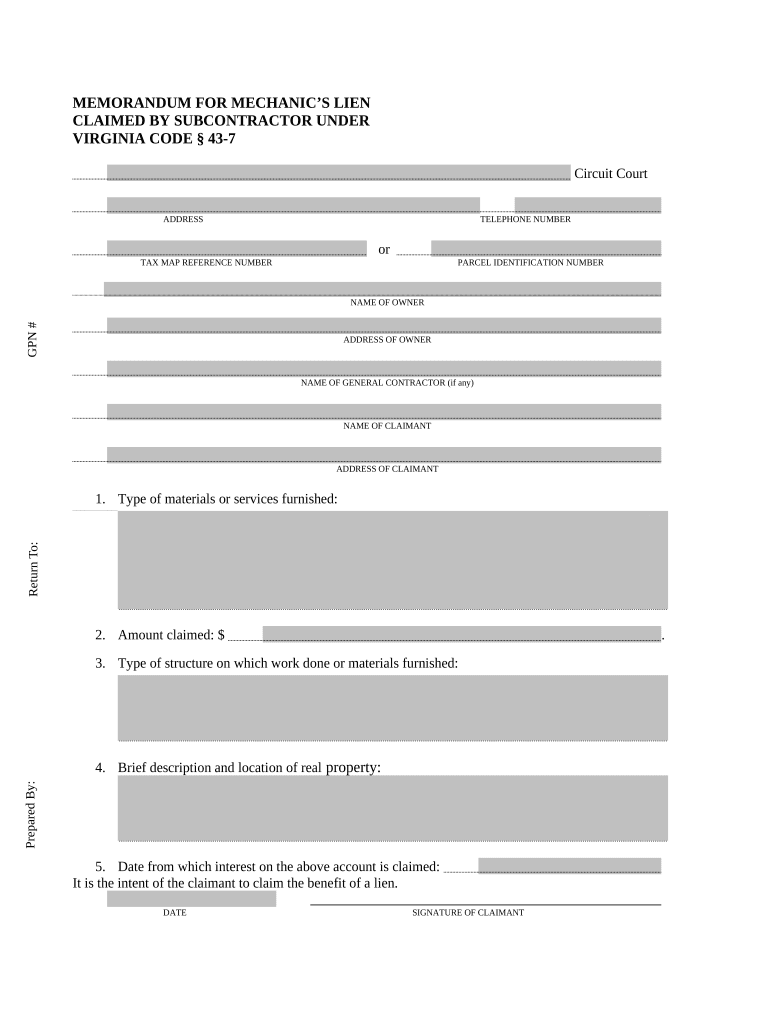
    Complete lien form: Fill claimant, property, dates, and amount fields.
  • 03
    Notarize if required: Execute before a notary where statute or local practice requires.
  • 04
    File and serve: Record at the correct clerk's office and serve statutorily required notices.

Digital workflow settings for e-filing and e-signature

Configure your electronic workflow to ensure completeness, authentication, and record retention.

Field Configuration
Claimant field validation Require exact legal-entity input
Date format enforcement Enforce MM/DD/YYYY
Signature authentication Enable SMS or email code
Retention settings Set immutable audit-trail retention

How electronic completion and submission typically flow

A clear electronic workflow helps reduce errors and preserves admissible records for enforcement.

  • Upload: Import completed lien form into the system.
  • Place fields: Add signature, date, and confirmation fields.
  • Authenticate signer: Use email link, SMS code, or stronger methods.
  • Record audit trail: Capture IP, timestamps, and actions.

Essential elements to include in a professional Virginia lien

Include these core elements so the lien meets statutory content requirements and supports enforcement.

Claimant identity

Full legal name, business form, and contact information that match court or clerk records to avoid service defects during enforcement.
Property description

A precise legal description or address as recorded in county land records; vague descriptions often lead to clerical rejection or weakened priority.

Amount claimed

An exact numeric and written total; itemize labor, materials, and retainage where applicable to prevent factual disputes about the claim.

Performance dates

Clear start and end dates for the labor or supply period; these dates affect lien priority and interplay with notice requirements.

Signature and authorization

Dated signature of an authorized representative; include title and capacity for entities to show authority to file the lien.

Notices attached

Attach statutorily required pre-lien or notice-to-owner documents; missing notices can invalidate mechanisic's liens.

Common deadlines and timing expectations for liens in Virginia

Observe statutory deadlines for filing and serving lien-related notices to preserve your claim.

Pre-lien notice timing:

Provide required pre-lien notices per contract or statute before filing.

Filing deadline:

File within the statutory period for the lien type to preserve priority.

Service requirements:

Serve owner and interested parties per statute after filing.

Enforcement period:

Begin foreclosure or enforcement actions within statutory limitation periods.

Record retention:

Retain records of filing, service, and proof for enforcement and audits.

Common mistakes to avoid when preparing a Virginia lien

  • Using an incorrect owner name or property description that does not match county records, causing rejection or diminished priority.
  • Failing to include exact performance dates or itemized amounts, which invites disputes and can lead to dismissal.
  • Missing statutory pre-lien notices or improper service methods that render the lien unenforceable in court.
  • Not verifying the correct filing office or clerk procedures for the county where the property is located, delaying enforcement.

Consequences of filing an incorrect or untimely lien

Enforceability loss: Incorrect filing details can void the lien.
Liability exposure: Wrongful or fraudulent liens may trigger damages.
Statute-barred claim: Missing deadlines can forfeit your remedy.
Cost increases: Re-filing and litigation add attorney and court fees.
Credit impact: Recorded liens affect owner and asset marketability.
Sanctions risk: Courts may impose sanctions for baseless liens.

Data security and compliance points for electronic lien workflows

Encryption in transit: TLS 1.2/1.3
Encryption at rest: AES-256
Privacy frameworks: GDPR, CCPA compliance
Audit and controls: SOC 2 Type II
Regulated workflows: HIPAA (BAA available)
Electronic law support: ESIGN, UETA, 21 CFR Part 11

Real-world examples: lien workflows in practice

These short examples show how organizations document and enforce lien rights while using electronic workflows where permitted.

Martin Properties (Real Estate)

Tim Martin used electronic filing and authenticated signatures for project claims to speed collection.

  • The platform captured timestamps and proof of service.
  • He reported faster resolution of outstanding payment issues while preserving required record retention and compliance with local recording procedures.

Optica Ventures (Construction)

Optica Ventures standardized lien templates and notice timelines across projects to reduce errors.

  • Templates ensured consistent descriptions and amounts.
  • Standardization cut preparatory time, reduced filing defects, and improved coordination with county clerk requirements for recording.

eSignature vendor comparison for lien document workflows

Basic pricing and capability differences among common eSignature providers. signNow is shown first for direct comparison of core plan features.

signNow DocuSign Adobe Sign PandaDoc HelloSign
Starting Price $8/user/mo $15/user/mo $14/user/mo $19/user/mo $15/user/mo
Free Trial 7-day free trial, no credit card Varies by plan Varies by plan Varies by plan Varies by plan
Bulk Send Yes Yes Yes Yes No
Audit Trail Yes Yes Yes Yes Yes
HIPAA Compliant Yes Yes Yes No No

Technical and platform considerations for e-signing lien documents

Verify integrations, file formats, and signer authentication options before e-submitting recorded documents.

  • File formats: PDF, DOCX support
  • Integrations: Salesforce, NetSuite, Google Workspace
  • Authentication: Email, SMS, or KBA options

Frequently asked questions about Virginia liens and e-submission

Answers to common procedural and technical questions about preparing, filing, and enforcing liens in Virginia.


Need help? Contact support

be ready to get more
Join over 28 million airSlate SignNow users