Establishing secure connection…Loading editor…Preparing document…

Bill of Sale for Aircraft Engine

This template is fully customizable. Edit the text, fill out the fields, and send it for signature. Give it a try!
Bill of Sale for Aircraft Engine

What a Bill of Sale for Aircraft Engine Is and Why It Matters

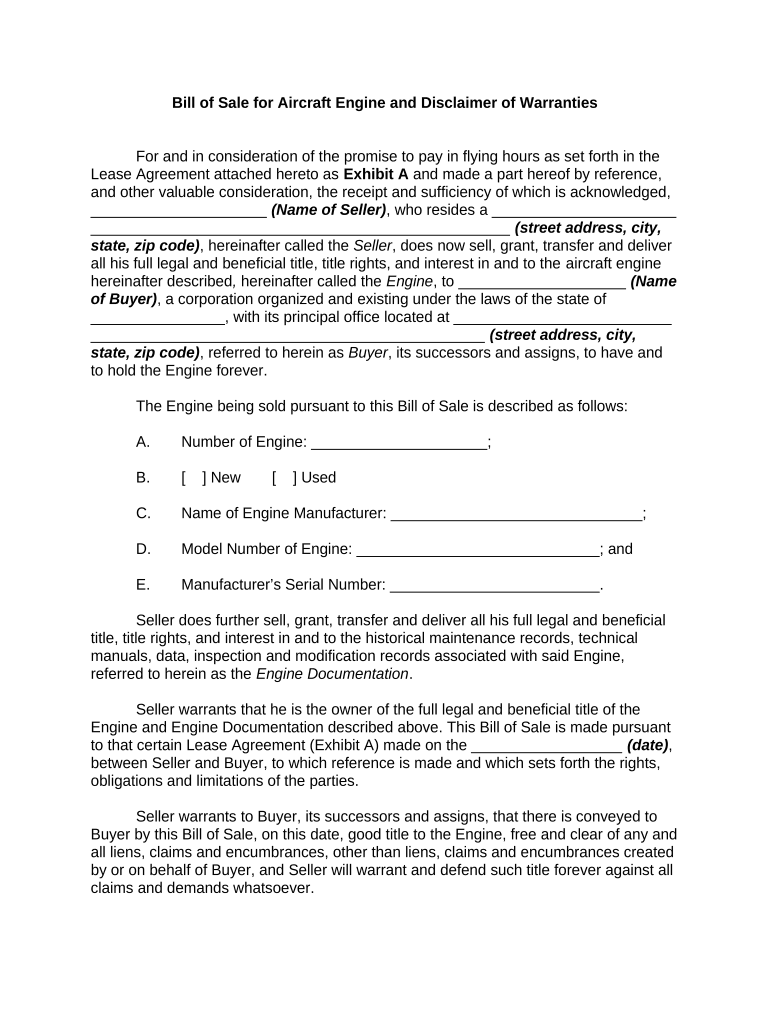
The Bill of Sale for Aircraft Engine is a written document that records the transfer of ownership of an aircraft engine from a seller to a buyer. It documents identifying details for the engine, the parties involved, the sale price or other consideration, and the effective date of transfer. For U.S. transactions it supports federal registration and title records and helps establish chain of ownership for tax, insurance, and lien-search purposes. Properly completed bills of sale reduce disputes, enable FAA registration filings when required, and serve as evidence in financing, insurance, and resale.

Key Legal and Practical Benefits of a Complete Bill of Sale for Aircraft Engine

A clear bill of sale clarifies ownership, documents consideration, and reduces transfer disputes. It supports FAA and insurer requirements, establishes priority for lien searches and financing, and provides a reproducible record that courts and regulators accept when the ESIGN Act or UETA govern electronic copies.

Key Legal and Practical Benefits of a Complete Bill of Sale for Aircraft Engine

Who typically prepares and relies on this bill of sale

Typical users include aircraft owners, brokers, maintenance facilities, and lenders who need documented title transfer for engines.

  • Owner-sellers who must document transfer and support FAA registration or tax reporting.
  • Buyers and lessors confirming clear title, serial numbers, and agreed consideration for engines.
  • Banks, leasing companies, and mechanics asserting liens, security interests, or maintenance obligations.

Step-by-Step: Preparing and Executing the Bill of Sale

Follow these steps to create a complete Bill of Sale for Aircraft Engine and reduce delays in registration, insurance, and financing.

  • 01
    Gather Info: Collect seller/buyer IDs, engine serial, logbook entries, and sale terms.
  • 02
    Draft Bill: Fill engine data, consideration, effective date, and governing law clause.
  • 03
    Sign & Notarize: All parties sign; notarize per state or FAA requirements.
  • 04
    File & Retain: Provide copies to FAA, insurer, lender, and keep originals.

Essential Sections to Include in a Professional Bill of Sale for Aircraft Engine

Core elements of a professional Bill of Sale for Aircraft Engine ensure legal clarity, track chain of ownership, and support FAA registration and lender requirements.

Parties

Identify seller and buyer with full legal names, business affiliations, addresses, and taxpayer identification numbers where applicable to support banking, insurance, and tax reporting inquiries.
Engine ID

Include make, model, part number, serial number, hours, and current condition. Cross-reference logbook entries and maintenance records to prevent disputes over airworthiness and service history.

Consideration

State exact sale price, currency, any deposits, payment schedule, escrow instructions, inspection contingencies, and whether adjustments or holdbacks apply, including any post-closing obligations and timelines.

Effective Date

Specify transfer date in MM/DD/YYYY. That date determines transfer of title, risk of loss, insurance responsibility, registration filings, and tax reporting periods for both parties.

Warranties

Describe any express or implied warranties, 'as-is' language, seller representations about no undisclosed liens, history of damage, and remedies for breach or misrepresentation and indemnities.

Signatures

Provide signature blocks for parties, printed names, titles, dates, corporate or agent capacity, and separate spaces for notarization, witness acknowledgment, and attachments like resolutions or POAs.

Security and Compliance Considerations for Electronic Bills of Sale

Encryption: TLS 1.2/1.3; AES-256 at rest
Certifications: SOC 2 Type II; ISO 27001
HIPAA: BAA required for PHI workflows
ESIGN/UETA: Legal e-signature framework compliance
Audit Trail: Detailed timestamps, IP, action log
Access Controls: SAML SSO, role-based permissions

Recommended Digital Workflow Settings for Online Completion

Configure a digital workflow to prefill fields, enforce sign order, and attach logbook scans before routing for signatures.

Field Configuration
Prefill Data Use engine serial to auto-populate related fields.
Sign Order Require seller signature before buyer completes.
Authentication Enable SMS code or KBA for high-value transfers.
Attachments Attach maintenance logs, bill of sale, and escrow terms.

Typical eSubmission Flow for an Aircraft Engine Bill of Sale

Typical e-submission flow for an engine bill of sale from preparation through signing and distribution.

  • Upload Doc: Upload PDF or DOCX with engine data.
  • Place Fields: Add text, date, and signature zones for each party.
  • Authenticate: Select email, SMS, or knowledge-based verification.
  • Distribute: Send signed copies to FAA, insurer, and lender.

Platform Capabilities to Support Secure eSigning and Notarization

Digital signing platforms should support PDFs, notarization options, and integrations with aviation record systems and storage.

  • Formats: PDF, DOCX, and editable forms
  • Integrations: CRM, ERP, and cloud storage platforms
  • Notarization: Remote notary and in-person options

Timing Considerations When Executing and Filing

Key timing considerations for executing and filing the bill of sale, notarization, and related FAA or lender submissions.

Execution Date:

Date parties sign; use MM/DD/YYYY.

Notarization Window:

Complete notarization before filing or within state timelines.

FAA Submission:

Submit registration or transfer forms per 14 CFR timelines.

Lender Notification:

Notify lienholders immediately after signing.

Record Retention:

Retain originals for state and federal retention periods.

Notarization and Witness Steps for Validating the Sale

Notarization and witness workflow for validating signatory identities and preserving evidentiary quality of the sale document.

01

Prepare Document

Ensure signature blocks and notarization clause present.

02

Sign Before Notary

Parties sign in notary presence unless RON used.

03

ID Verification

Notary performs ID checks or remote credentialing.

04

Audio-Video Record

RON requires recorded session preserved per state rules.

05

Notary Journal

Notary records transaction details in journal.

06

Witnesses

Some states require one or two witnesses; check local law.

07

Certificate

Notary completes acknowledgment or jurat per requirements.

08

File Copy

Provide notarized copy to FAA, lender, and buyer.

Common Preparation Mistakes to Avoid

  • Incomplete engine serial or model information causes registration rejection, valuation disputes, and delays in lien searches by lenders and insurers.
  • Mismatched party names between the bill of sale, logbooks, and government IDs can trigger title transfer rejections and backup withholding rules.
  • Vague consideration language such as 'fair market value' without amount or formula complicates tax reporting and creditor priority analyses.
  • Failing to notarize when required or using improper notarization undermines enforceability and may void registration or financing actions.

Consequences of an Incorrect or Incomplete Bill of Sale

Title Disputes: Risk of ownership litigation.
Registration Rejection: FAA may decline transfer.
Lien Exposure: Unexpected creditor claims.
Tax Penalties: IRS reporting errors trigger fines.
Insurance Denial: Coverage disputes over condition.
Contract Voided: Incomplete form may be invalid.

Real-World Examples: How Detailed Bills of Sale Help

Real-world examples show how a detailed bill of sale prevents disputes, speeds FAA registration, and supports lender requirements for engine financing.

Brokered Sale

A broker documented an engine sale for a piston-powered aircraft, recording serial numbers, logbook hours, and seller representations in a notarized bill of sale

  • This prevented post-closing title disputes.
  • When the buyer later financed the engine the lender accepted the bill of sale and logbook copies; registration with the FAA proceeded without delay because the document clearly matched the engine serial and ownership chain.

Maintenance Transfer

An MRO transferred a refurbished turbine engine to a leasing company and used a detailed bill of sale to note warranty terms, repair history, and parts replaced

  • Clarity avoided future warranty disputes.
  • Because the bill of sale included logbook references and signed representations about prior damage, the lessee accepted the engine into service quickly and insurance underwriters issued coverage without additional inspections.

Who Signs and Why Their Role Matters

Seller — Owner

A private aircraft owner or company officer who transfers an engine must confirm title, disclose known damages, and sign with capacity. They typically present logbooks and maintenance records and may need to provide a corporate resolution if an entity signs.

Buyer — Purchaser

Purchasers verify serial numbers, condition, and seller representations; they often request notarized bill of sale, proof of inspection, and escrow arrangements to protect financing or leasing commitments and ensure lien searches are clean.

Vendor Pricing and Compliance Snapshot for eSignature Support

Quick vendor comparison for eSignature support of a Bill of Sale for Aircraft Engine, focusing on pricing and core compliance features.

signNow DocuSign Adobe Sign PandaDoc HelloSign
Starting Price $8/user/mo $15/user/mo $14/user/mo $19/user/mo $15/user/mo
Free Trial 7-day free trial, no credit card required Trial availability varies by plan and region Trial availability varies by plan and region Trial availability varies; contact sales Trial availability varies by plan and account type
Bulk Send Yes — bulk send on Business Premium Yes — bulk send included on some plans Yes — available on enterprise tiers Yes — bulk send supported on plans Limited or plan-dependent; not universal
Audit Trail Yes — detailed audit trail included Yes — audit trail included Yes — audit trail included Yes — audit trail included Yes — audit trail included
HIPAA Compliant Yes — HIPAA BAA available upon request Yes — HIPAA solutions and BAA offered Yes — HIPAA BAA available via plan No — HIPAA BAA not available No — HIPAA BAA not available
Envelope Cap No envelope cap; unlimited envelopes per plan Limit of 100 envelopes per user per year Varies by plan; contact vendor for limits Varies by plan; usage limits may apply Varies by plan; contact sales for limits

FAQs: Common Questions About Bills of Sale for Aircraft Engines

Frequently asked questions about preparing, signing, and submitting a Bill of Sale for Aircraft Engine, addressing notarization, registration, and records retention.


Need help? Contact support

be ready to get more
Join over 28 million airSlate SignNow users