Establishing secure connection…Loading editor…Preparing document…

Bylaws of Unincorporated Association of Subdivision Residents

This template is fully customizable. Edit the text, fill out the fields, and send it for signature. Give it a try!
Bylaws of Unincorporated Association of Subdivision Residents

What the Bylaws of an Unincorporated Subdivision Association Are

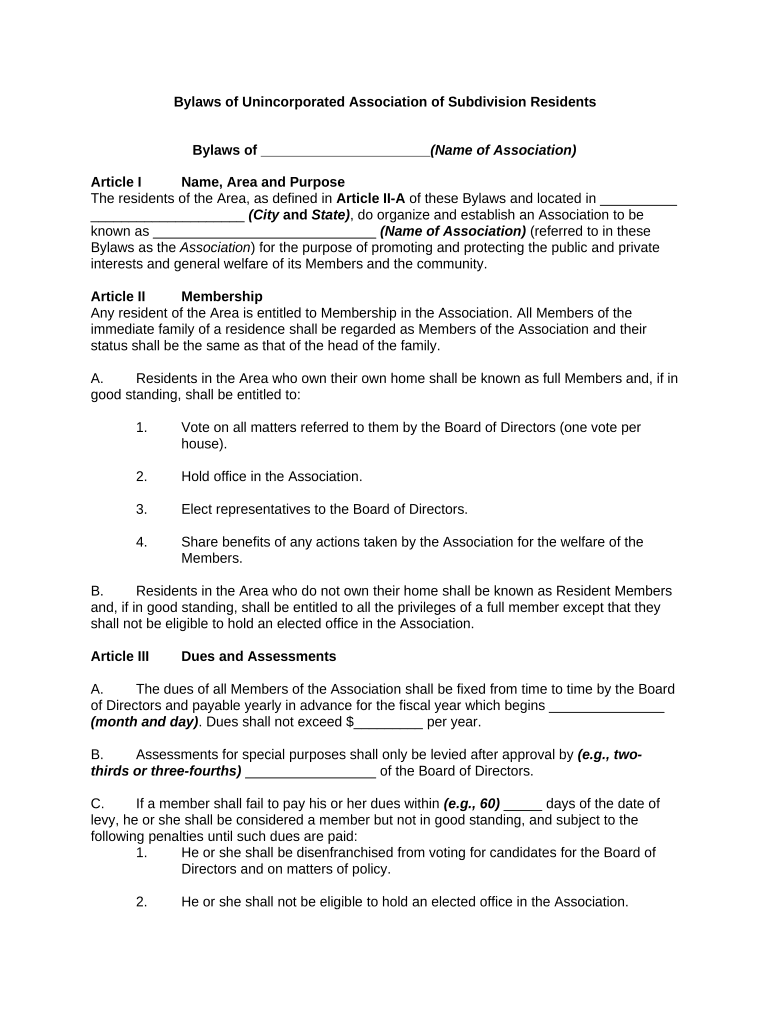
The Bylaws of Unincorporated Association of Subdivision Residents are the governing rules an association uses to manage membership, meetings, board duties, voting, and amendments. They are an internal corporate-style document for associations that have not formed a separate legal entity with the state. Bylaws set expectations for homeowner participation, define officer roles, prescribe notice and quorum rules for meetings, and explain procedures for admitting new members or removing members. Because they are a contractual governance tool between members, clarity and consistent application are essential to avoid disputes and preserve community stability.

Why Clear, Well-Written Bylaws Matter

Clear bylaws reduce ambiguity about governance, limit conflict among residents, and create an enforceable record of association procedures for meetings, assessments, and board authority.

Why Clear, Well-Written Bylaws Matter

Who Uses These Bylaws and When They’re Needed

These bylaws are used by resident groups organizing governance, committees, or informal associations that manage shared subdivision matters such as common areas, neighborhood safety, and voluntary assessments.

  • New resident associations forming to manage shared amenities and set rules for collective action.
  • Boards or steering committees needing a written framework to operate meetings and make decisions.
  • Developers transitioning control to residents and documenting handover procedures and voting thresholds.

Adopt bylaws at the first organizational meeting and revisit them when governance disputes, significant growth, or legal changes require updates.

Typical Roles Involved in Preparation and Sign-off

Board President

Typically leads drafting and adoption discussions, calls meetings for approval, and signs formal adoption records. The president often coordinates with counsel for legal review and ensures public distribution to members after adoption.

Secretary / Treasurer

Maintains the official record of bylaws and amendments, files adopted bylaws with any internal registers, manages meeting minutes, and often handles notices required by the bylaws for votes or assessments.

Required Information and Fields to Include

Association Name: Legal name of the association
Purpose: Primary objectives and scope
Membership: Who qualifies as a member
Board Composition: Number and term lengths
Meeting Rules: Notice, quorum, voting
Amendment Procedure: How bylaws are changed

Risks and Consequences of Poorly Drafted Bylaws

Unenforceable Provisions: May be struck down
Board Authority Limits: Legal challenges possible
Member Disputes: Litigation risk increases
Tax Exposure: Assessment treatment unclear
Recordkeeping Failures: Loss of historical proof
Invalid Amendments: Procedural defects void changes

Common Mistakes to Avoid When Preparing Bylaws

  • Using vague language for key terms such as 'majority' or 'quorum', which creates room for conflicting interpretations and contested votes.
  • Failing to specify notice procedures and timeframes for meetings and votes, often resulting in procedural challenges or claims of insufficient notice.
  • Mixing bylaws with recorded covenants or easements; recorded documents often require specific formality and may be governed by different filing rules.
  • Neglecting state-specific legal differences (for example, differences in electronic signature law or recording requirements) that can affect enforceability.

Step-by-Step: How to Complete the Bylaws

Follow a clear sequence: draft, review, vote, adopt, and maintain the bylaws to ensure valid governance and member awareness.

  • 01
    Draft: Compile standard clauses and customize to community needs
  • 02
    Review: Have counsel or experienced members check legal and practical issues
  • 03
    Vote: Hold a meeting with proper notice and record the vote
  • 04
    Adopt: Record adoption in minutes and distribute to members

Where to File, Send, and Record the Adopted Bylaws

Adopted bylaws are primarily internal documents; however you should distribute, store, and, when applicable, record associated instruments per local requirements.

  • Internal Records: Keep originals with secretary's records
  • Member Distribution: Provide copies to all members
  • Developer Handover: Supply to developer when control transfers
  • County Recording: Only for documents that a county requires recorded

Key Sections Every Professional Bylaws Document Should Include

A complete bylaws template groups governance into clear sections covering membership, board rules, meetings, finances, amendments, and dispute resolution.

Membership

Define member eligibility, classes, voting rights, and transfer or suspension rules so there is no ambiguity about who participates and how votes are counted.
Board and Officers

Specify number of directors, election timing, officer roles, succession, duties, and term lengths to guide consistent leadership transitions.

Meetings

Set notice requirements, quorum thresholds, meeting formats (in-person/virtual), proxy rules, and minute-keeping standards to validate corporate actions.

Assessments and Finances

Outline budgeting, assessment authority, collection procedures, reserve policies, and audit requirements for transparent financial governance.

Amendment Process

Describe how amendments are proposed, required notice, voting thresholds for passage, and effective dates to ensure changes are valid.

Dispute Resolution

Include mediation or arbitration provisions, jurisdiction selection, and any escalation process to limit costly litigation.

How to Customize and Complete the Bylaws Online

Configure a repeatable workflow: upload a master template, apply fillable fields, set signer roles, and enable secure signature methods for approvals.

Field Configuration
Document Template Use a PDF or DOCX master with locked structure
Signer Roles Assign Board President, Secretary, Member signer roles
Authentication Select email, SMS code, or stronger KBA authentication
Reminders & Expiry Set automatic reminders and an expiry for pending signature links

Digital Signing and eSubmission: Platform and File Requirements

Use file formats and integrations that preserve layout, support audit trails, and meet your authentication and retention needs.

  • File Formats: PDF, DOCX, or HTML
  • Integrations: Common: Microsoft 365, Google Workspace
  • Authentication: Email, SMS, or KBA options

Choose a provider that supports required authentication strength, export of a tamper-evident audit trail, and secure long-term storage.

eSignature Pricing Comparison for Signing and Managing Bylaws

Comparing typical vendor entry-level pricing, security, and envelope limits can inform platform selection for executing bylaws and member approvals.

signNow DocuSign Adobe Sign PandaDoc HelloSign
Starting Price $8/user/mo $15/user/mo $14/user/mo $19/user/mo $15/user/mo
Free Trial 7-day free trial Varies by vendor Varies by vendor Varies by vendor Varies by vendor
Bulk Send Yes (plan dependent) Yes Yes Yes No
Audit Trail Yes Yes Yes Yes Yes
HIPAA Compliant Yes Yes Yes No No
Envelope Cap No cap 100 envelopes/user/year Varies Varies Varies

Typical Timelines and Notice Periods to Expect

Bylaws set their own internal deadlines for notices, voting, and effective dates; align your calendar to those prescribed timeframes.

Organizational Meeting Notice:

Provide notice per bylaws; commonly 7–30 days

Adoption Effective Date:

Typically the date of vote or a specified later date

Amendment Notice Period:

Often 30 days prior to a vote

Annual Review:

Recommend annual governance review and possible updates

Record Distribution:

Distribute adopted text within 30 days of adoption

Key Milestones From Draft to Ongoing Administration

Track milestones from drafting through adoption and ongoing compliance to ensure each required step is completed on schedule.

01

Drafting Complete

Finalize provisional text and circulate for review

02

Legal Review

Obtain counsel input on complex or unusual clauses

03

Membership Vote

Hold vote with proper notice and record outcome

04

Post-Adoption Tasks

Distribute bylaws and update official records

Practical Tips for Accurate and Efficient Bylaw Completion

Apply straightforward drafting and administrative controls to reduce future disputes and administrative overhead.

Use Plain, Consistent Language
Write provisions in clear, nontechnical language; define terms such as 'member', 'quorum', and 'majority' to avoid different interpretations and to simplify enforcement.
Record and Distribute Minutes
Keep a formal adoption minute and distribute a dated copy of the adopted bylaws to every member to show proper procedure and establish a contemporaneous record of consent.
Preserve an Audit Trail
If using electronic signatures, retain a tamper-evident copy and an audit trail including signer identity, timestamps, and IP addresses to support enforceability under ESIGN and UETA.
Schedule Periodic Reviews
Set a standing agenda item for annual review to update the bylaws for membership growth, legal changes, or operational lessons learned, reducing emergency amendments later.

Real-World Examples of How Associations Use Bylaws

These examples illustrate common practical scenarios where bylaws guide association decisions and transitions.

Developer Transition

A developer drafted initial bylaws for a 120-lot subdivision to define board transition procedures

  • The bylaws set staged handover and election rules
  • After adoption, the document governed the first board election and clarified responsibilities, avoiding disputes during transfer.

Assessment Adoption

Residents proposed limited assessments to fund streetlights and common area upkeep

  • The bylaws required a 60-day notice and two-thirds vote
  • The vote passed with documented votes and the association used the bylaws' collection procedures to implement assessments lawfully.

Frequently Asked Questions About Bylaws and eSigning

Answers to common questions about validity, signing options, notarization, amendment mechanics, and record retention for bylaws.


Need help? Contact support

be ready to get more
Join over 28 million airSlate SignNow users