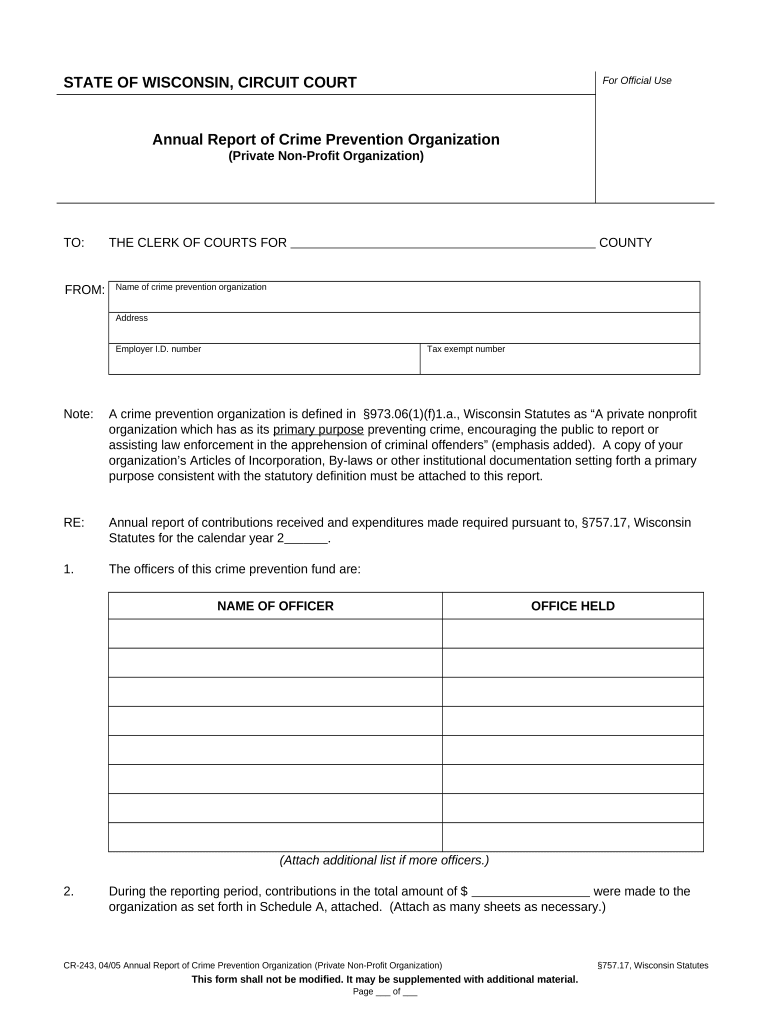
Wisconsin Annual Report of Crime Prevention Organization
What the Wisconsin Annual Report of Crime Prevention Organization Is
Why Completing This Annual Report Matters
Completing the Wisconsin Annual Report of Crime Prevention Organization ensures legal compliance, strengthens community transparency, and documents activities for grant or funding eligibility. Accurate reporting reduces enforcement risk and supports coordinated crime prevention efforts between nonprofits and state or local public safety agencies.
Who Typically Prepares and Signs the Report
Common users who prepare this report include organization officers, compliance officers, and registered volunteers responsible for governance and recordkeeping.
- Board presidents and executive directors who oversee program operations and sign certifications.
- Treasurers and finance officers providing financial summaries, budgets, and expense reports for the year.
- Volunteer coordinators tracking membership data, training activities, and community outreach metrics.
Step-by-Step: Complete the Annual Report
-
01Gather Information: Collect officer names, membership totals, program summaries, and financial statements.
-
02Complete Form: Enter data in required fields using MM/DD/YYYY where dates are requested.
-
03Attach Documents: Upload supporting financials, meeting minutes, and proof of nonprofit status.
-
04Review & Sign: Verify accuracy, obtain authorized signatures, and notarize if state rules require.
Configuring an Online Workflow for Submission
| Field | Configuration |
|---|---|
| Signer Order | Sequential routing with signer notifications |
| Authentication | Email link by default, SMS code optional |
| Attachments | Allow PDF uploads and image files for supporting records |
| Auto Reminders | Enable reminders at configurable intervals to reduce delays |
| Audit Trail | Capture timestamps, IP addresses, and action history |
Where to File or Send the Completed Report
-
State Portal: Submit via the Wisconsin Department of Justice or designated state e-filing system.
-
Local Agency: Municipal clerks or county offices may accept paper or electronic copies per local rules.
-
Email Filing: If allowed, send a signed PDF to the agency's official email account with subject line.
-
Physical Mail: Mail printed, signed reports with supporting documents to the address specified by the agency.
Technical and Platform Requirements for eSubmission
Digital filing and eSubmission require compatible file formats, reliable internet, and signer authentication aligned with agency rules.
- File Formats: PDF preferred; DOCX acceptable
- Connectivity: Stable internet and current browser required
- Integrations: Supports Google Workspace and Microsoft 365
Timing and Deadlines to Watch
Annual Filing:
Due annually on the date specified in registration documents.
Correction Window:
Correct errors promptly; agencies may allow amendments within weeks of submission.
Processing Time:
Expect review and processing times of several weeks depending on agency workload.
Late Filing:
Late reports may trigger notices, penalties, or suspension of registration.
Recordkeeping:
Keep copies of filed reports and proof of delivery for at least three years.
Milestone Timeline for Filing and Verification
Prepare Materials
Collect financials, membership lists, and meeting minutes before starting the form.
Draft Entries
Complete draft responses and circulate to officers for factual verification.
Authorize & Sign
Obtain required signatures and notarizations according to agency rules.
Submit & Confirm
File via agency portal or mail and retain confirmation or tracking details.
Penalties and Risks of Incorrect or Late Reports
Common Preparation Mistakes to Avoid
- Submitting mismatched legal names or incorrect EINs that do not match state registration records, triggering rejections, manual corrections, and potential backup withholding or administrative delay.
- Failing to attach required financial statements or meeting minutes, which can prevent acceptance, prompt information requests, or lead to provisional approvals pending documentation.
- Using informal abbreviations for officer titles or omitting contact emails and phone numbers, hindering verification and slowing agency follow-up for clarifications.
- Relying on scanned, low-quality documents without searchable text or broken PDFs, causing processing errors and requests for resubmission from the filing authority.
Practical Tips to Complete the Report Accurately
Common eSignature Plans and Features for Filing Workflows
| signNow | DocuSign | Adobe Sign | PandaDoc | HelloSign | |
|---|---|---|---|---|---|
| Starting Price | $8/user/mo | $15/user/mo | $14/user/mo | $19/user/mo | $15/user/mo |
| Free Trial | 7-day free trial | Trial available | Trial available | Trial available | Trial available |
| Bulk Send | Yes | Yes | Yes | Yes | No |
| Audit Trail | Yes | Yes | Yes | Yes | Yes |
| HIPAA Compliant | Yes | Yes | Yes | No | No |
Frequently Asked Questions and Practical Answers
-
Who must file the annual report?
Registered crime prevention organizations that maintain formal registration with state or local authorities generally must file the annual report. Confirm eligibility and filing responsibility by reviewing your registration documents or contacting the relevant agency before preparing the submission.
-
Can the report be submitted electronically?
Many agencies accept electronic filings and digital signatures under ESIGN and UETA. Verify the receiving agency's electronic submission policies, required file formats, and whether additional authentication or RON notarization is necessary for acceptance.
-
Is notarization or witnessing required?
Notarization and witness requirements differ by state and by the type of certification. Check the filing instructions or state statutes; if RON is permitted, follow identity proofing and audio-video recording rules. When unsure, consult the agency or legal counsel.
-
What happens if I file incorrect information?
Agencies commonly require amendments or corrections and may issue notices. Repeated or material inaccuracies can trigger audits, penalties, or suspension of registration. Correct errors promptly, keep records of corrections, and communicate with the filing authority to resolve disputes.
-
How should supporting documents be submitted?
Attach PDFs of financial statements, meeting minutes, and proof of nonprofit status where requested. Use searchable PDFs when possible, include a cover note describing attachments, and follow size and file-type limits stated by the agency to avoid rejection.
-
Can eSignatures be used and are they legally binding?
Yes. Electronic signatures are legally enforceable under the ESIGN Act (15 U.S.C. ch. 96) and UETA where adopted, provided the signature shows intent, consent, attribution, and records can be retained. Confirm any agency-specific exceptions before relying on e-signatures.