Wyoming Order of Dismissal
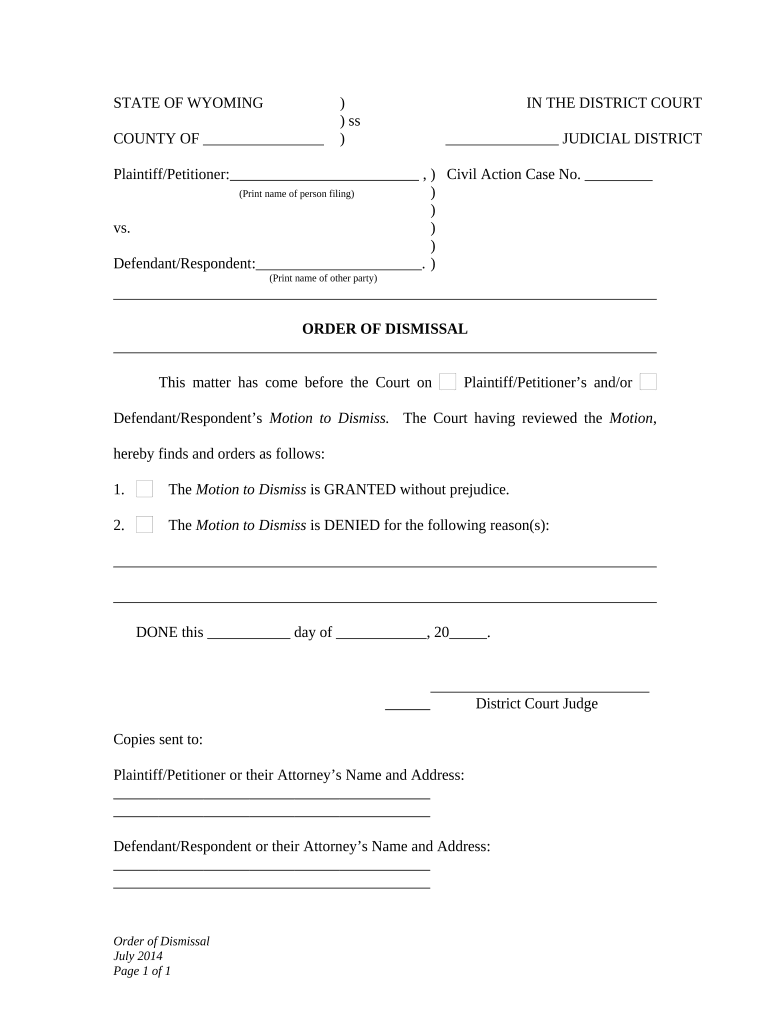
What a Wyoming Order of Dismissal Is
Why an Order of Dismissal Matters
An Order of Dismissal provides a clear, enforceable end point to litigation, protects parties from further claims on the dismissed cause, and documents any conditions or costs. It creates an official record for appeals, lien searches, and future litigation planning.

Who Typically Prepares or Signs This Document
The Order of Dismissal is prepared and submitted by litigants, attorneys, or court clerks depending on the dismissal type.
- Plaintiffs and defense counsel prepare and submit proposed orders for judge signature after settlement or motion resolution.
- Court clerks enter and docket the signed order once a judge signs it and may provide certified copies on request.
- Judges sign the order to make dismissal effective; in some limited contexts a presiding magistrate or clerk may have authority.
Ensure the correct signer and filing pathway is used to avoid delays in docketing and finality.
Step-by-step: Completing a Wyoming Order of Dismissal
-
01Draft Proposed Order: Prepare text specifying parties, case number, and dismissal terms.
-
02Obtain Signatures: Get counsel or parties to sign; include judge signature when submitted.
-
03File with Court: Submit the signed order via e-file or at the clerk’s office per local rules.
-
04Clerk Entry: Clerk stamps and dockets the order, creating the official closure.
How to configure an online dismissal workflow
| Field | Configuration |
|---|---|
| Signature Field | Require judge or attorney signature with date field |
| Attachment | Attach settlement agreement or stipulation if required |
| Certificate of Service | Auto-generate service certificate with parties listed |
| Clerk Stamp Area | Reserve space for clerk entry and docket number |
Where to file and how the dismissal is processed
-
E-Filing: Submit proposed order and attachments through the court’s electronic filing system.
-
Paper Filing: Deliver the signed order to the clerk’s office for manual docketing.
-
Judge Review: Judge signs or signs with modifications and returns to the clerk for entry.
-
Docket Entry: Clerk stamps, assigns entry date, and issues a filed copy to parties.
Digital signing and e-filing considerations
Confirm the court accepts electronically signed or e-filed orders before relying solely on digital signing.
- Authentication: Use email/SMS or stronger signer verification when required
- File Formats: PDF/A is typically accepted for court filings
- Audit Trail: Maintain timestamp, IP, and signer evidence
If the court requires original ink or judge in-chambers signature, follow local protocol and retain electronic records for your file.
Typical timing expectations and court deadlines
Proposal Submission:
Submit proposed order promptly after settlement or ruling to avoid delay in entry.
Judge Review Time:
Review and signing may take days to weeks depending on calendar and staffing.
Clerk Entry Timing:
Clerk typically enters the order on the date received or the judge-specified date.
Notice to Parties:
Service or notification methods and timing are governed by local rules.
Appeal Deadlines:
Finality after entry triggers appeal timelines; check local rules for exact periods.
Key milestones from settlement to formal dismissal
Settlement Reached
Parties agree on terms and instruct counsel to prepare dismissal documents.
Proposed Order Drafted
Prepare clear dismissal language and attach required settlement exhibits.
Judge Signs Order
Judge reviews and signs the proposed order or issues an amended order.
Clerk Dockets Entry
Clerk stamps and files the order, and the case is marked closed on the docket.
Common pitfalls to avoid when preparing the order
- Using incorrect case caption or case number causes clerical rejection and filing delays.
- Failing to specify whether dismissal is with or without prejudice can affect future litigation rights.
- Neglecting to attach relevant settlement exhibits or fee orders may require re-filing or amendment.
- Assuming electronic signatures are acceptable without confirming local court e-file rules may invalidate submission.
Risks and consequences of an incorrect or premature dismissal
Real-world examples of dismissal orders
Civil Case Example
After settlement, plaintiff filed a proposed order of dismissal with stipulated terms and cost allocation.
- The judge reviewed and signed the order.
- The clerk entered the order the same day, the case was closed on the docket, and the parties exchanged certified copies for their records; no further action was required.
Criminal Case Example
Following plea negotiations, prosecution filed a motion to dismiss certain charges and submitted a proposed order.
- The court considered victim input.
- The judge granted the motion, signed the order, and the clerk entered it; remaining counts proceeded while dismissed counts were removed from the active charging instrument.
Practical tips for accurate and efficient completion
How an Order of Dismissal differs from similar filings
| Criteria | Order of Dismissal | Stipulation of Dismissal |
|---|---|---|
| Who files | judge or parties | parties |
| Judge needed | often yes | |
| Effect on record | formal court entry | agreement filed and entered |
| Typical timing | after ruling or motion | after settlement |
eSignature vendor comparison for completing and signing dismissal orders
| signNow | DocuSign | Adobe Sign | PandaDoc | HelloSign | |
|---|---|---|---|---|---|
| Starting Price | $8/user/mo | $15/user/mo | $14/user/mo | $19/user/mo | $15/user/mo |
| Free Trial | 7-day free trial | Varies | Varies | Varies | Varies |
| Bulk Send | Yes | Yes | Yes | Yes | No |
| Audit Trail | Yes | Yes | Yes | Yes | Yes |
| HIPAA Compliant | Yes | Yes | Yes | No | No |
Frequently asked questions about Wyoming Orders of Dismissal
-
Can an order be e-signed and e-filed?
Many Wyoming courts accept electronically signed documents and e-filing, but acceptance depends on the court’s local rules; verify the specific district or county clerk requirements before relying solely on electronic signatures.
-
Who must sign the order?
A judge or presiding judicial officer typically must sign an order of dismissal to make it effective; parties and counsel may sign a proposed order but the judge’s signature is what creates judicial finality.
-
What if the case number is wrong?
An incorrect case number can delay clerk entry or lead to administrative rejection; file an amended proposed order promptly and include a cover letter explaining the correction to assist clerk processing.
-
Can I revive a dismissed case?
Reopening a dismissed case depends on the dismissal type and reasons; motions to vacate or reopen are governed by court rules and timing limits—consult counsel for eligibility and deadlines.
-
Is notarization ever required?
Notarization is not typically required for orders of dismissal themselves; however, supporting documents submitted with the motion or stipulation may require notarization depending on their nature.
-
How do I get a certified copy?
Request a certified copy from the clerk of court after the order is docketed; fees and processing times vary by county and clerk’s office.