Digital Signature Algorithms





Get the most from your eSignatures with airSlate SignNow
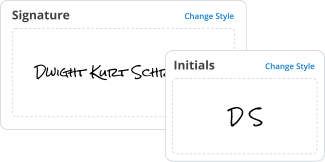
Accelerate work with documents
Create electronic signatures and submit documents in moments instead of hours. Our eSignatures have the same legal push as wet-ink ones.

Modify samples safely
Take advantage of the digital signature algorithms functionality and improve your records without any concerns about the protection of your data. With all the security features in airSlate SignNow, only you can get the data kept in your account.
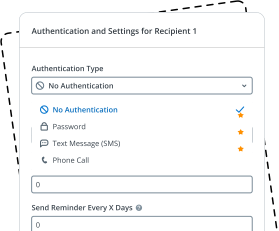
Share files
Modify existing forms and save alterations, and airSlate SignNow will instantly notify your entire staff that there are updated templates. Don’t waste the time you would spend emailing your co-workers new documents.
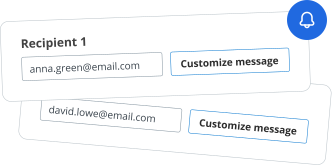
Make use of Digital signature algorithms
Place fillable areas, generate or collect electronic signatures, request attachments and payments, and discover alternative methods to enhance your workflows. airSlate SignNow is here to help you.
We spread the word about digital transformation
signNow empowers users across every industry to embrace seamless and error-free eSignature workflows for better business outcomes.






Free 7-day trial. Choose the plan you need and try it risk-free.

Honest pricing for full-featured plans. airSlate SignNow offers subscription plans with no overages or hidden fees at renewal.

Enterprise-grade security. airSlate SignNow helps you comply with global security standards.
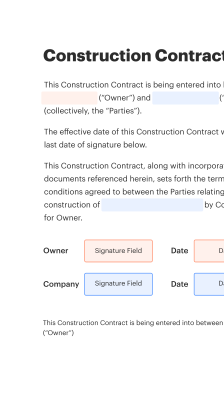

Place electronic signatures and send records in moments instead of hours. Our eSignatures have the identical legal power as wet-ink ones.

Take advantage of the signature tips function and improve your files without any concerns about the safety of your information.

Modify existing forms and save changes, and airSlate SignNow will immediately inform your entire crew that there are updated templates.

Place fillable areas, create or collect electronic signatures, get supplementary documents and payments, and discover different ways to boost your workflows.

Use airSlate SignNow API, the easiest way to create and collect eSignatures. Do so within your CRM systems, on your website, or even in specific apps.

Generate a public link for your template and collect signatures while not having to directly send your document to specific consumer email addresses.
Your complete how-to guide - digital signature algorithms
Self-sign documents and request signatures anywhere and anytime: get convenience, flexibility, and compliance.
At present, it is likely you won't find an organization that doesn't use contemporary technology to atomize workflow. A digital signature is not the future, but the present. Modern organizations with their turnover simply don't want to stop browser programs that provide superior data file management automation tools, like Digital signature algorithms function.
How to handle Digital signature algorithms airSlate SignNow feature:
-
After you get to our website, Login or register your account if you don't have one, it will take you a couple of seconds.
-
Upload the needed data file or choose one from your library folders: Documents, Archive, Templates.
-
Due to the cloud-structured storage compatibility, you may quickly import the needed doc from recommended clouds with almost any device.
-
You'll find your data document opened in the up-to-date PDF Editor where you can make changes before you move forward.
-
Type text, place pictures, add annotations or fillable fields to be accomplished further.
-
Use My Signature button for self-signing or place Signature Fields to deliver the eSign request to a single or multiple recipients.
-
Click the DONE button when finished to continue with Digital signature algorithms function.
airSlate SignNow browser platform is vital to improve the efficiency and performance of most working procedures. Digital signature algorithms is one of the features that will help. Utilizing the web-based software nowadays is a necessity, not just a competitive advantage. Test it now!
How it works


Electronic Signature Legality
What are three NIST approved digital signature algorithms
NIST approved digital signature algorithms are cryptographic methods that ensure the authenticity and integrity of digital messages or documents. Among the most recognized algorithms are:
- RSA (Rivest-Shamir-Adleman): A widely used public-key cryptosystem that allows for secure data transmission. RSA is known for its strong security, relying on the difficulty of factoring large integers.
- DSA (Digital Signature Algorithm): This algorithm is specifically designed for digital signatures. It provides a means to verify the authenticity of a message and is often used in conjunction with other cryptographic protocols.
- ECDSA (Elliptic Curve Digital Signature Algorithm): ECDSA offers similar security to RSA but with smaller key sizes, making it more efficient. It uses elliptic curve cryptography to provide a high level of security with reduced computational requirements.
How to use the NIST approved digital signature algorithms
To utilize NIST approved digital signature algorithms effectively, you can integrate them into your electronic document workflows. Here’s how:
- Choose a digital signature solution that supports these algorithms, ensuring compliance with NIST standards.
- When preparing a document for signing, select the appropriate algorithm based on your security requirements.
- Generate a digital signature using the chosen algorithm, which will create a unique signature for the document.
- Send the document for signature, allowing recipients to verify the authenticity using the same algorithm.
Key elements of the NIST approved digital signature algorithms
Understanding the key elements of NIST approved digital signature algorithms is crucial for effective implementation. These elements include:
- Public and private keys: Each user has a pair of keys; the private key is kept secret, while the public key is shared to verify signatures.
- Hash functions: These functions create a fixed-size output from variable-size input, ensuring data integrity before signing.
- Signature generation and verification: The process involves creating a signature using the private key and verifying it with the corresponding public key.
Legal use of NIST approved digital signature algorithms
In the United States, NIST approved digital signature algorithms are recognized under various laws and regulations, including the Electronic Signatures in Global and National Commerce (ESIGN) Act and the Uniform Electronic Transactions Act (UETA). These laws affirm that electronic signatures, when created using approved algorithms, hold the same legal weight as handwritten signatures. To ensure compliance:
- Use algorithms that meet NIST standards for security and reliability.
- Maintain a clear audit trail of the signing process.
- Ensure that all parties consent to use electronic signatures.
Examples of using NIST approved digital signature algorithms
Implementing NIST approved digital signature algorithms can enhance various business processes. Here are a few examples:
- Contract signing: Businesses can streamline contract execution by using digital signatures to sign agreements securely.
- Financial transactions: Banks and financial institutions can use digital signatures to authenticate transactions, ensuring security and compliance.
- Government documents: Agencies can utilize digital signatures for forms and applications, improving efficiency and reducing paper usage.
Security & Compliance Guidelines
When using NIST approved digital signature algorithms, adhering to security and compliance guidelines is essential. These guidelines include:
- Regularly updating cryptographic protocols to address vulnerabilities.
- Implementing strong access controls to protect private keys.
- Conducting periodic audits to ensure compliance with legal and regulatory requirements.
 Best ROI. Our customers achieve an average 7x ROI within the first six months.
 Scales with your use cases. From SMBs to mid-market, airSlate SignNow delivers results for businesses of all sizes.
 Intuitive UI and API. Sign and send documents from your apps in minutes.
FAQs
Here is a list of the most common customer questions. If you can't find an answer to your question, please don't hesitate to reach out to us.
What are three NIST approved digital signature algorithms to choose three for secure document signing?
The three NIST approved digital signature algorithms to choose are RSA, ECDSA, and EdDSA. These algorithms ensure the integrity and authenticity of your documents, making them ideal for secure eSigning. By using these algorithms, airSlate SignNow provides a reliable solution for businesses looking to enhance their document security.
How does airSlate SignNow ensure compliance with NIST approved digital signature algorithms?
airSlate SignNow complies with NIST standards by implementing robust security measures, including the use of NIST approved digital signature algorithms. This ensures that all signed documents meet federal regulations and industry standards, providing peace of mind for businesses. Choosing airSlate SignNow means you can trust that your document signing process is secure and compliant.
What features does airSlate SignNow offer for digital signatures?
airSlate SignNow offers a range of features for digital signatures, including customizable templates, real-time tracking, and secure storage. Additionally, it supports NIST approved digital signature algorithms, ensuring that your documents are signed securely. These features make it easy for businesses to manage their signing processes efficiently.
Is airSlate SignNow cost-effective for small businesses looking to implement digital signatures?
Yes, airSlate SignNow is designed to be a cost-effective solution for businesses of all sizes, including small businesses. With flexible pricing plans, you can choose the features that best fit your needs while ensuring compliance with NIST approved digital signature algorithms. This affordability allows small businesses to leverage secure eSigning without breaking the bank.
Can airSlate SignNow integrate with other software applications?
Absolutely! airSlate SignNow offers seamless integrations with various software applications, including CRM systems, document management tools, and cloud storage services. This flexibility allows businesses to streamline their workflows while utilizing NIST approved digital signature algorithms for secure document signing. Integrating airSlate SignNow enhances productivity and efficiency.
What benefits does using NIST approved digital signature algorithms provide?
Using NIST approved digital signature algorithms provides enhanced security, legal validity, and compliance with federal regulations. These algorithms ensure that your documents are tamper-proof and verifiable, which is crucial for businesses handling sensitive information. By choosing airSlate SignNow, you can confidently sign documents knowing they are protected by these trusted algorithms.
How does airSlate SignNow handle document security?
airSlate SignNow prioritizes document security by employing NIST approved digital signature algorithms and encryption protocols. This ensures that all signed documents are secure from unauthorized access and tampering. With airSlate SignNow, businesses can trust that their sensitive information is protected throughout the signing process.




airSlate SignNow is committed to protecting your sensitive information by complying with global industry-specific.

digital signature algorithms
Your entire business wins with electronic signature software. Generate a unique eSignature and boost your document workflows.


How to complete and sign a papers online
So, you need to eSign a document online? Drive your process with airSlate SignNow, a perfect solution to lost time, risky security and inefficient processes. Generate your signatures online in three possible ways: draw, type in or upload an image of a handwritten signature. digital signature algorithms at ease.
Follow the step-by-step guidelines to digital signature algorithms online:
- Upload a document.
- Once it’s uploaded, it’ll open in the online editor.
- Select My signature.
- Choose one of three options to generate a signature: draw, type or upload an image of a handwritten one.
- Once you create a signature click Ok.
- Finish the process by clicking Done.
airSlate SignNow supports almost every format: PDF, Word, etc. Apart from signing a document, you can fill it out by adding a variety of fields: text, date, dropdown. Send a doc for signing via email, SMS or with a public hyperlink. Set-up Bots that’ll remind a signer to validate the document and inform a sender once it's signed. digital signature algorithms effectively immediately.
Trusted eSignature solution - digital signature algorithms
Explore how the airSlate SignNow eSignature platform helps businesses succeed. Hear from real users and what they like most about electronic signing.


The ins and outs of eSignature
Find everything you need to know about electronic signatures. We've collected all the best tips and step-by-step instructions for working with eSignatures in a single place.

Signature verification: what is it and how to use it?
Find out why electronic signature verification is so important and learn how to do it with the help of specialized software.

How to sign documents electronically
Learn how you can electronically sign documents, the reasons why you should use an electronic signature and how to find the best service for it.

How to sign as power of attorney
Use airSlate SignNow to help sign as power of attorney and enjoy the benefits of electronic notarization!
Discover powerful features with airSlate SignNow
Feb 5, 2024 — FIPS approved digital signature algorithms shall be used with an appropriate hash function that is specified in the SHS. The digital ...
Rather than developing your own digital signature algorithms or trying to shoe-horn PGP into a situation, you can use OpenSSL and S/MIME. In this section you ...
Definition 9.1 A digital signature scheme DS = (K,Sign,VF) consists of three algorithms, as follows: The randomized key generation algorithm K (takes no inputs ...
